







Remote job statistics Nigeria headlines need a denominator. In the JobRise snapshot retained for this article, the displayed remote share is 70%. However, that percentage covers only listings from sources that supply a remote-status field.
The publisher’s report, dated 12 November 2026 at 07:07 UTC, contains 421 open listings. It identifies 176 remote listings among 251 with remote-status coverage. Another 170 listings lack that coverage. Missing status does not mean on-site work.
Our four charts rebuild those denominators, identify the source-coverage gap and show how unknown records limit interpretation. The downloadable calculations use this retained snapshot throughout. The live page can change; a later visit may show different totals.
Remote job statistics Nigeria: start with all 421 listings
The complete snapshot has three mutually exclusive categories. There are 176 remote listings, 75 covered listings not classified as remote, and 170 without status coverage. Together, they sum to 421.
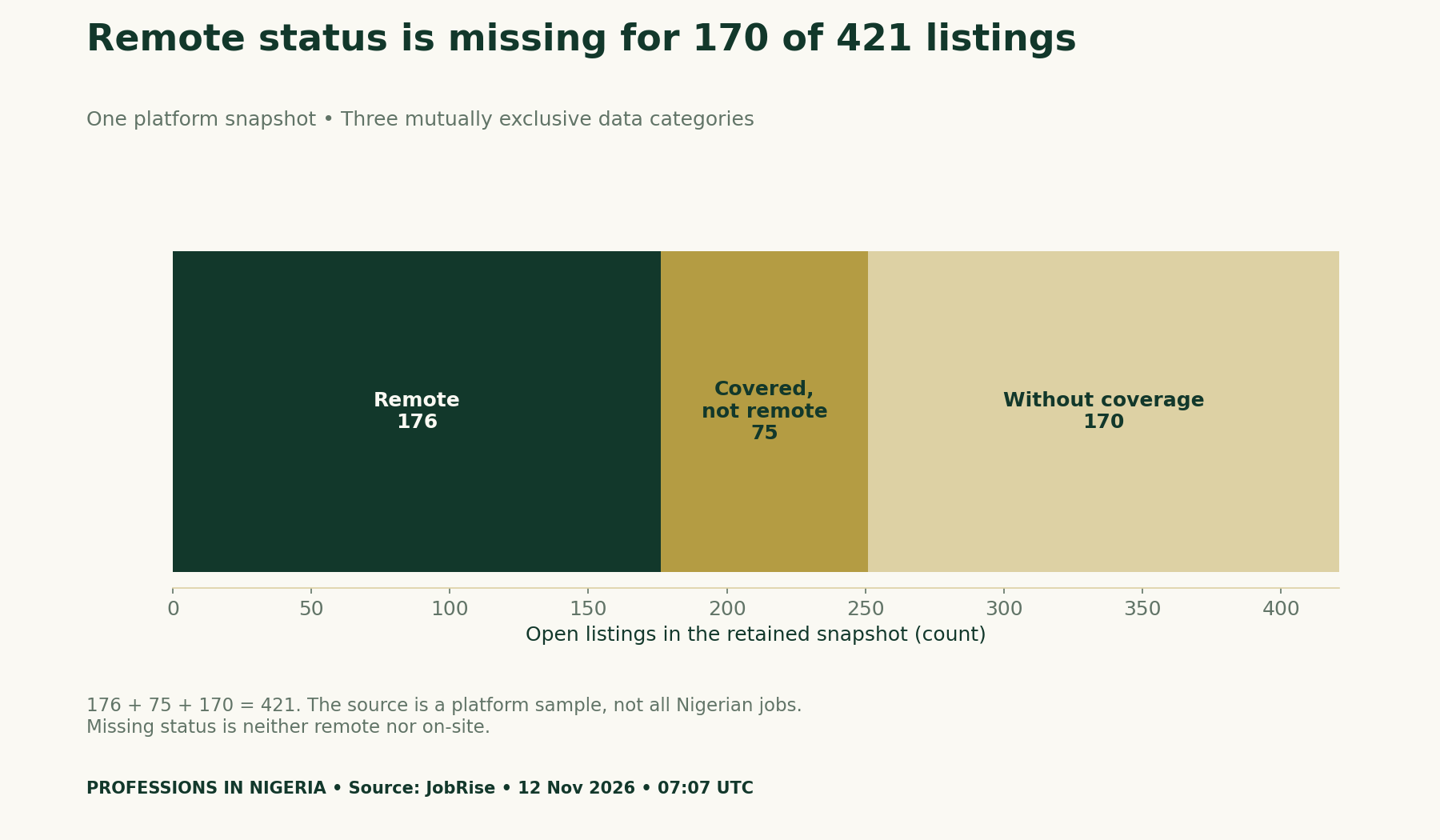
This classification is more informative than calling every unmarked advert on-site. It also avoids calling every role “remote” merely because it appears in an online search. Preserve an unknown category until the original employer supplies enough information.
The unit is an open listing at one point in time. It is not a person hired, an application submitted or a month’s total recruitment. Consequently, the snapshot cannot establish a candidate’s chance of receiving an offer.
Reconstruct the 70% headline using its own denominator
The reported calculation is 176 divided by 251, multiplied by 100. That equals approximately 70.1%, which the publisher displays as 70%. The remaining 75 covered listings account for 29.9% of that same subset.
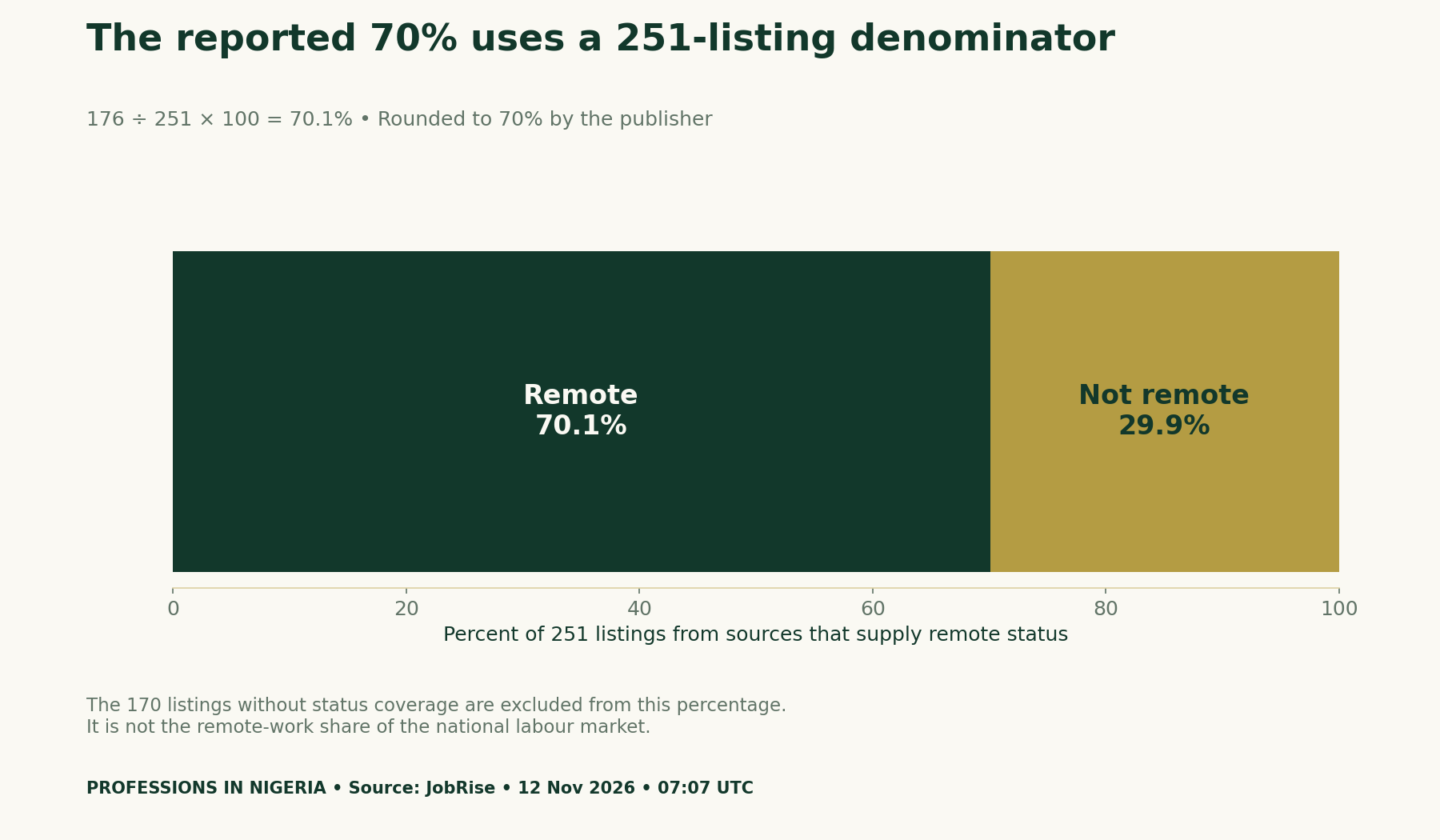
Dividing 176 by all 421 listings instead gives 41.8%. That is the known-remote count expressed against the full sample. It is not a corrected estimate of the true remote share, because some of the 170 unknown records might also be remote.
Neither fraction estimates the remote-work prevalence of Nigeria’s national workforce. The sample comes from one platform’s collection and classification process. Its coverage and definitions must travel with any quoted percentage.
| Question | Calculation | Interpretation |
|---|---|---|
| Remote among covered listings? | 176 ÷ 251 = 70.1% | Excludes listings without status coverage. |
| How much of the full snapshot has coverage? | 251 ÷ 421 = 59.6% | A data-coverage measure. |
| How much lacks coverage? | 170 ÷ 421 = 40.4% | Unknown, not automatically on-site. |
Source coverage explains the missing records
The report identifies whether each source supplies a remote-status field. Six marked sources contribute 251 listings. Workable’s 169 listings and Oracle Recruiting’s one listing make up the 170 without that field.
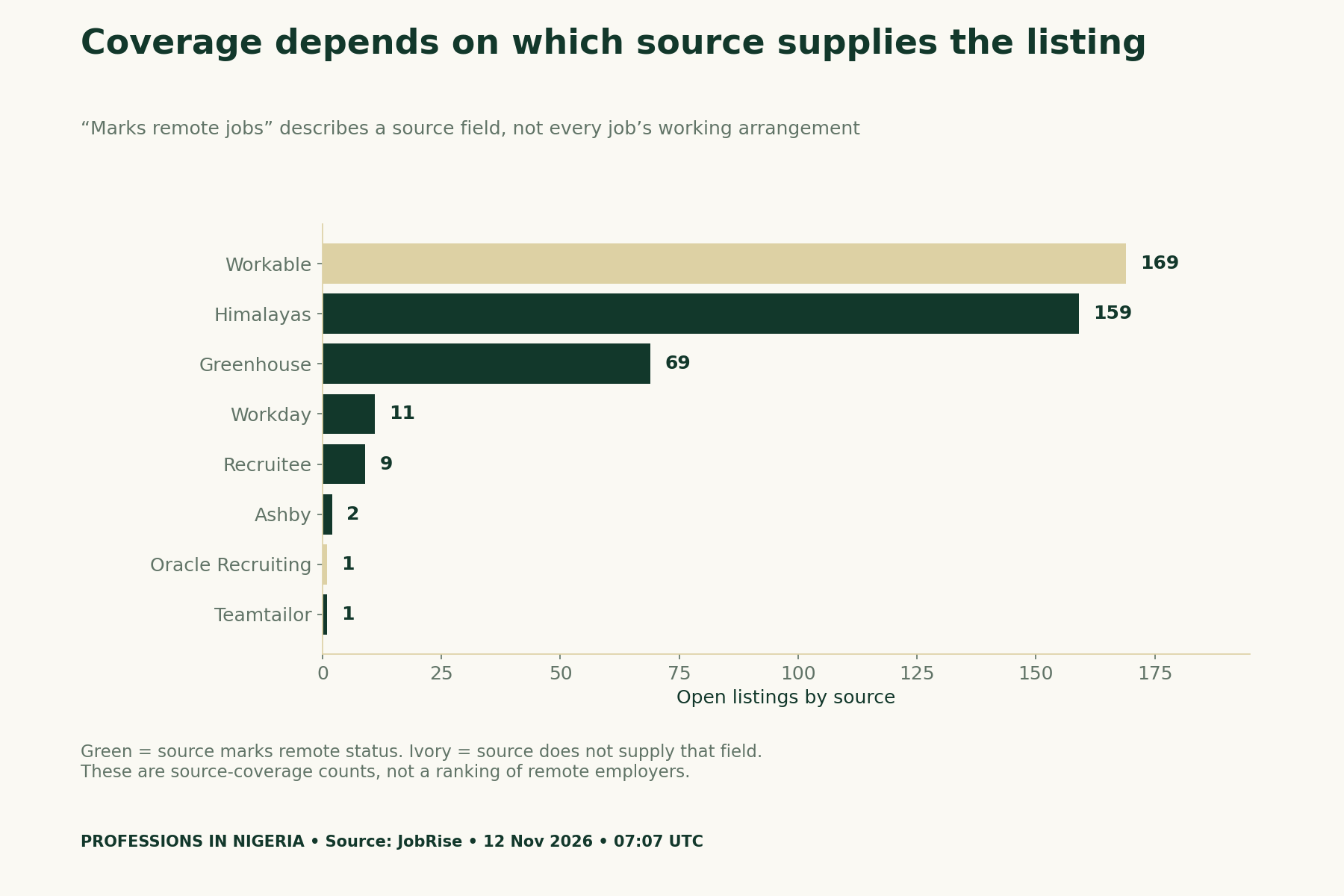
A source marked “Yes” does not mean every listing from it is remote. It means the source provides the field used in this classification. This distinction matters when one collection channel contributes a large share of a small dataset.
Likewise, an employer name in a platform table is not necessarily the organisation that would directly employ every successful applicant. Read the report’s methodology and return to the original advert before interpreting an agency’s listing count as direct hiring demand.
What can the unknown records change?
Two deliberately extreme assumptions show the uncertainty created by missing status. If all 170 unknown records were non-remote, the all-listing remote fraction would be 176 divided by 421, or 41.8%.
If all 170 were remote, the numerator would become 346. Dividing 346 by 421 gives 82.2%. These endpoints are logical bounds within this snapshot. Neither assignment has been observed.
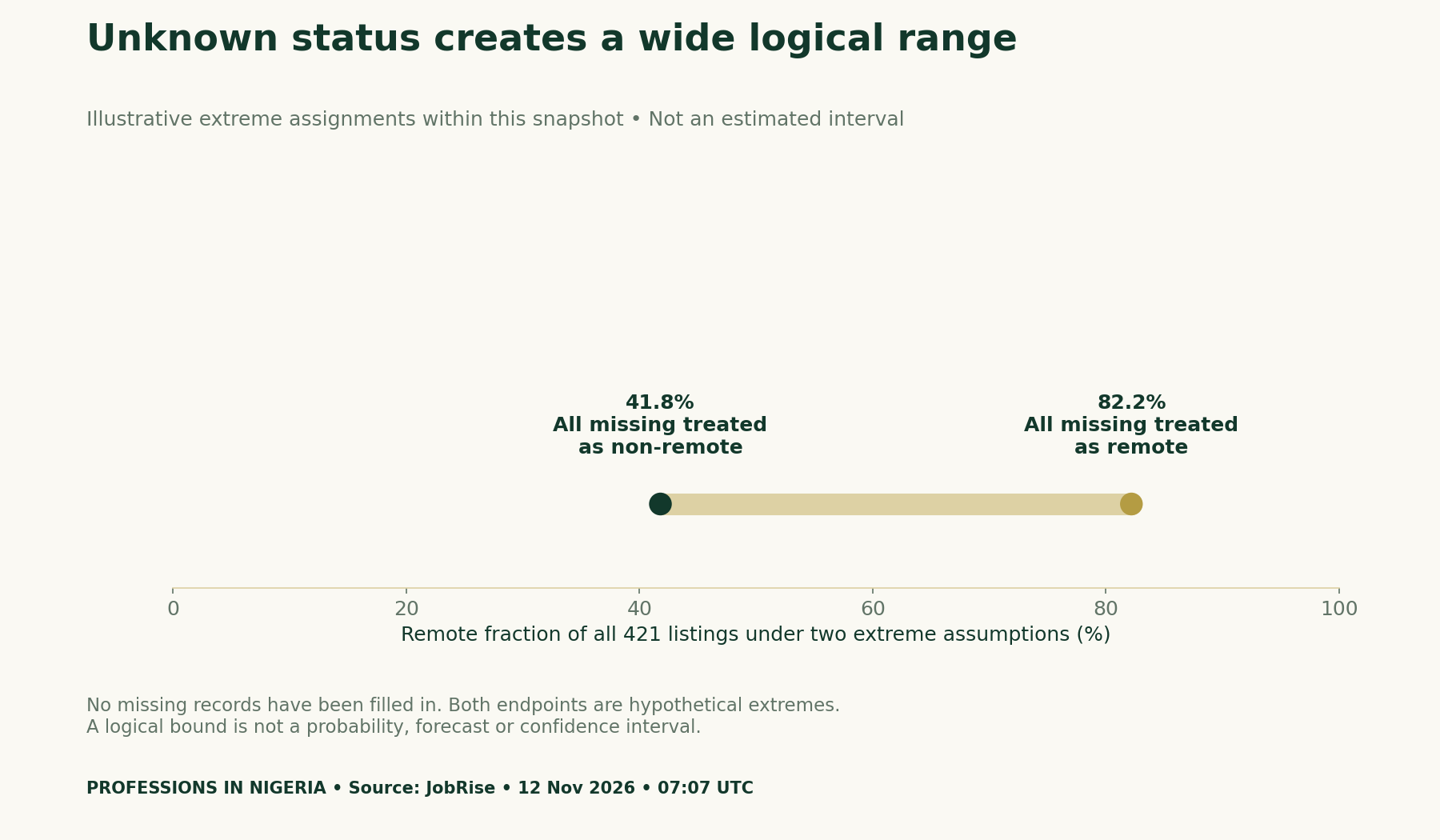
This range is not a confidence interval, a forecast or a probability distribution. We have not filled missing records or selected a preferred endpoint. The exercise shows why a precise-looking headline should not conceal incomplete classification.
A remote label does not finish the eligibility check
Even a correctly classified remote advert can leave important application questions unanswered. Confirm whether applicants resident in Nigeria are accepted, which locations are allowed, and whether fixed working hours or time-zone overlap are required.
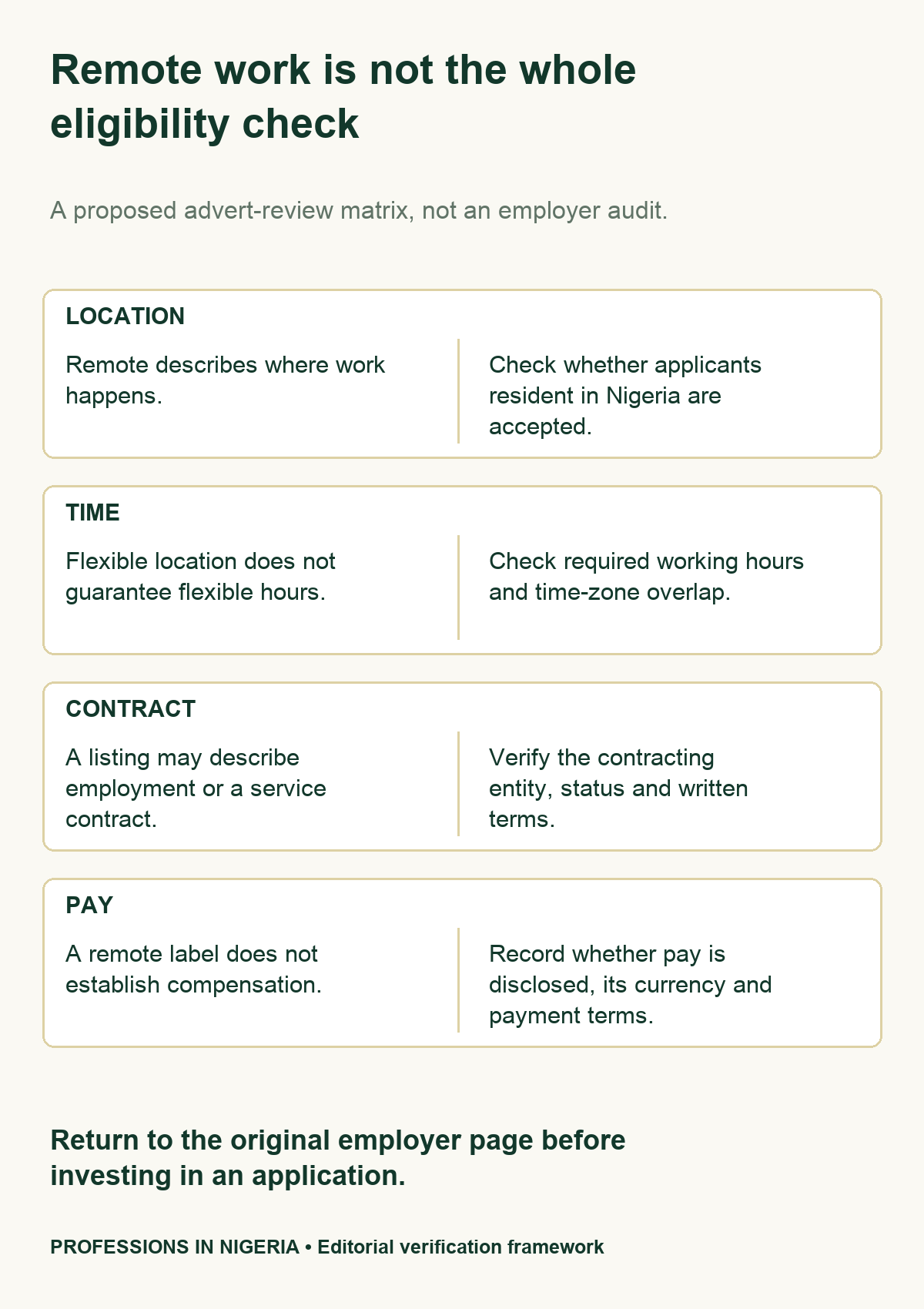
Then distinguish employment from a service contract and check the written terms. Record pay disclosure, currency and payment arrangements when they are stated. Do not infer a salary premium or payment guarantee from the work-arrangement label.
Our qualification requirements guide offers a related way to separate an actual hiring condition from a general impression. The employer-concentration analysis explains another reason a platform headline may describe a narrower opportunity set than readers expect.
Download the snapshot and blank advert-checking tools
- Retained snapshot and source counts (CSV): classifications, source coverage and the exact timestamp.
- Denominator calculations and logical bounds (CSV): reproducible numerators, denominators and qualifications.
- Blank advert-verification sheet (CSV): a private worksheet for reviewing original employer pages.
- Verification coding guide (CSV): suggested rules for missing fields and inaccessible adverts.
No employer-page audit was conducted for this article. If you run one, declare a selection rule before inspecting results—for example, a fixed number of the newest listings in a stated category. Retain closed and inaccessible adverts separately instead of silently replacing them with easier cases.
Do not publish a validation rate until that audit exists. A worksheet is a proposed tool, not evidence that a set of employers has already passed its checks.
Methodology, limitations and citation
We retained the visible JobRise report at its 12 November 2026, 07:07 UTC snapshot. We transcribed the classifications and eight source counts, checked their sums, and calculated percentages without mixing later totals. Figures round percentages to one decimal place unless showing the publisher’s whole-number headline.
JobRise describes deduplication using company and job title, with country and posting-date rules that affect classification. These rules do not turn the report into a representative labour-force survey. Older daily bars include only listings still open, so they should not be treated as complete historical hiring flows.
When citing these remote job statistics Nigeria calculations, include the platform, timestamp and denominator. The durable finding is methodological: an unknown field belongs in the evidence record, not in an invented work-arrangement category.


