






3MTT delivery partner outcomes require a stronger evidence plan than an attendance register. A provider needs to connect learning, demonstrated skills, a qualifying opportunity and continuity of earnings. That changes how a training team should plan assessment, employer relationships and follow-up.
The ministry’s 11 November announcement earmarks about ₦4 billion for verified results across Cohorts 5 and 6. This is an announced programme envelope, not a fixed provider award, learner stipend or completed disbursement.
We checked the official Delivery Network portal in Chrome on 12 November 2026. This report adds a proposed evidence map, transparent fictional capacity calculations and four downloadable tools. None is an official reporting form or a promise of funded selection.
3MTT delivery partner outcomes: membership and funding differ
Enabled membership and Funded selection are separate routes. The ministry describes a membership review for every application. The portal requires the lead organisation on a funding application to be registered and operating in Nigeria.
For clarity, a useful provider briefing should keep three decisions separate: whether to seek membership, whether to apply for a funded offer, and whether the final agreement is operationally workable. Record each stage by its actual status. Approval at one stage does not settle every later decision.
For example, a training organisation may have a strong course but an incomplete employer-verification process. Its preparation question is then about evidence and responsibilities, rather than assuming that course completion alone establishes a payable result.
What each of the four results asks you to demonstrate
The portal links staged payment to four verified results: learning commenced, verified skills, a secured opportunity and a sustained opportunity. The provider and 3MTT agree a rate per successful Fellow for each training offer. We have not assigned payout percentages or a universal naira rate.
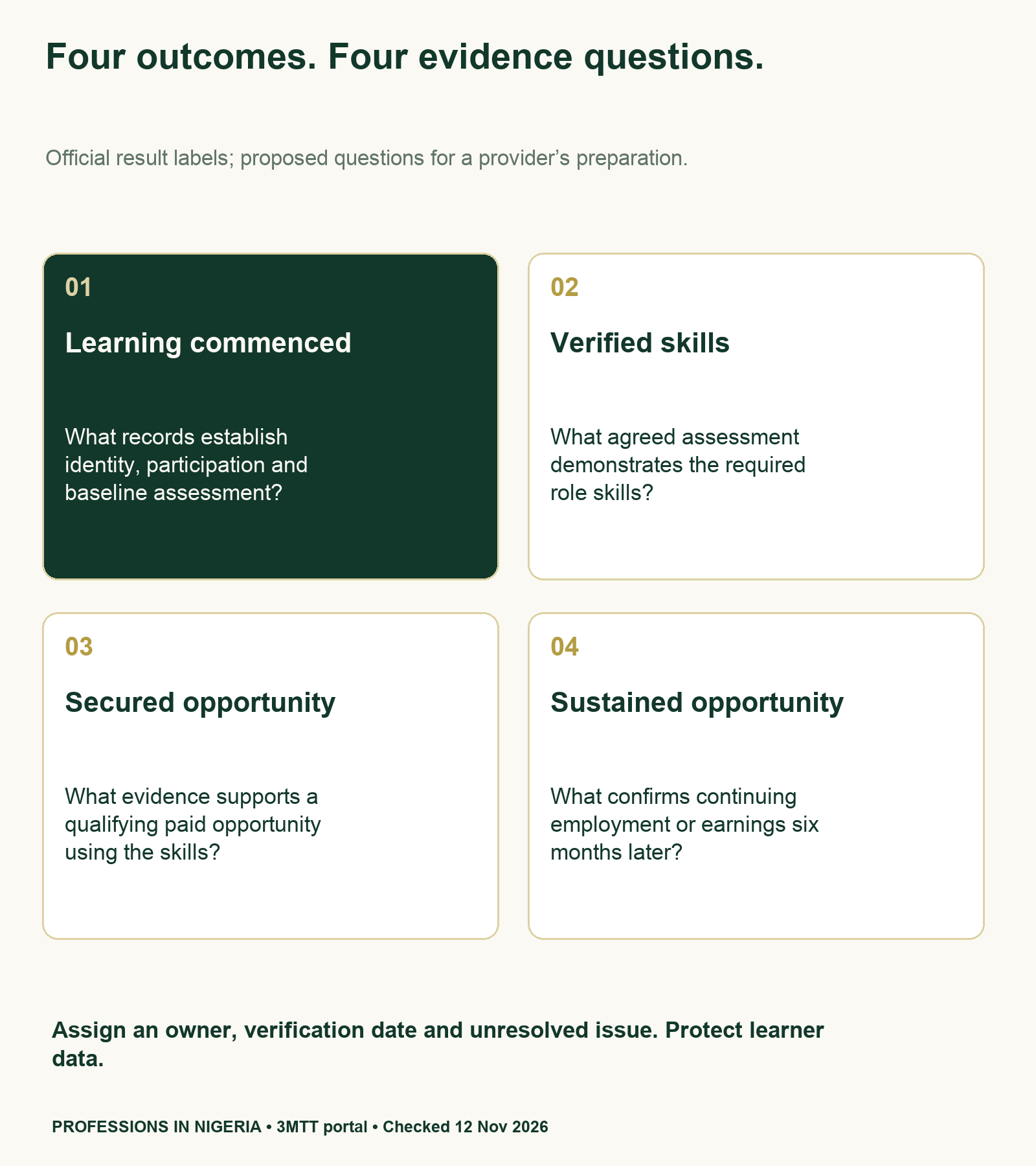
Our infographic adds evidence questions to those official labels. It suggests a way to prepare for discussion, rather than an approved proof standard. Ask the programme what it accepts, who checks it and who decides a disputed result.
At commencement, distinguish registration from active participation. Next, separate attendance from an assessment against the agreed skills standard. For opportunity, the portal includes jobs, internships, freelance engagements and a Fellow’s own business using the learned skills and earning above the national minimum wage.
The fourth result concerns employment or earnings six months later. A photograph at graduation cannot establish that later condition. Equally, a missing follow-up response should remain unresolved until the applicable verification process determines its status.
Give each evidence question an owner
A practical planning meeting can assign a responsible role to each result. The course lead may organise the agreed assessment; an employer-contact role may coordinate opportunity evidence; a follow-up role may track later checks. Those are proposed management assignments, subject to the actual agreement.
Also, write the unresolved issue beside the evidence reference. “Document requested,” “document received” and “result verified” should be distinct statuses. Otherwise, a busy team can accidentally convert a handover into an unsupported success claim.
A fictional example makes the distinction clear. Suppose an anonymous learner has finished a course and has a pending freelance discussion. The record should not label that learner as having secured a qualifying opportunity. Instead, it should preserve the pending status and the next evidence question.
Do not gather more personal data merely to make a spreadsheet appear complete. Use private references, appropriate consent and the programme’s actual data requirements. Keep identity documents and learner evidence in authorised systems.
Plan follow-up hours before promising delivery capacity
Our fictional capacity model uses a simple equation: review hours equal Fellows due for review multiplied by planned minutes per review, divided by 60. Both inputs belong to the provider. They do not represent observed programme averages.
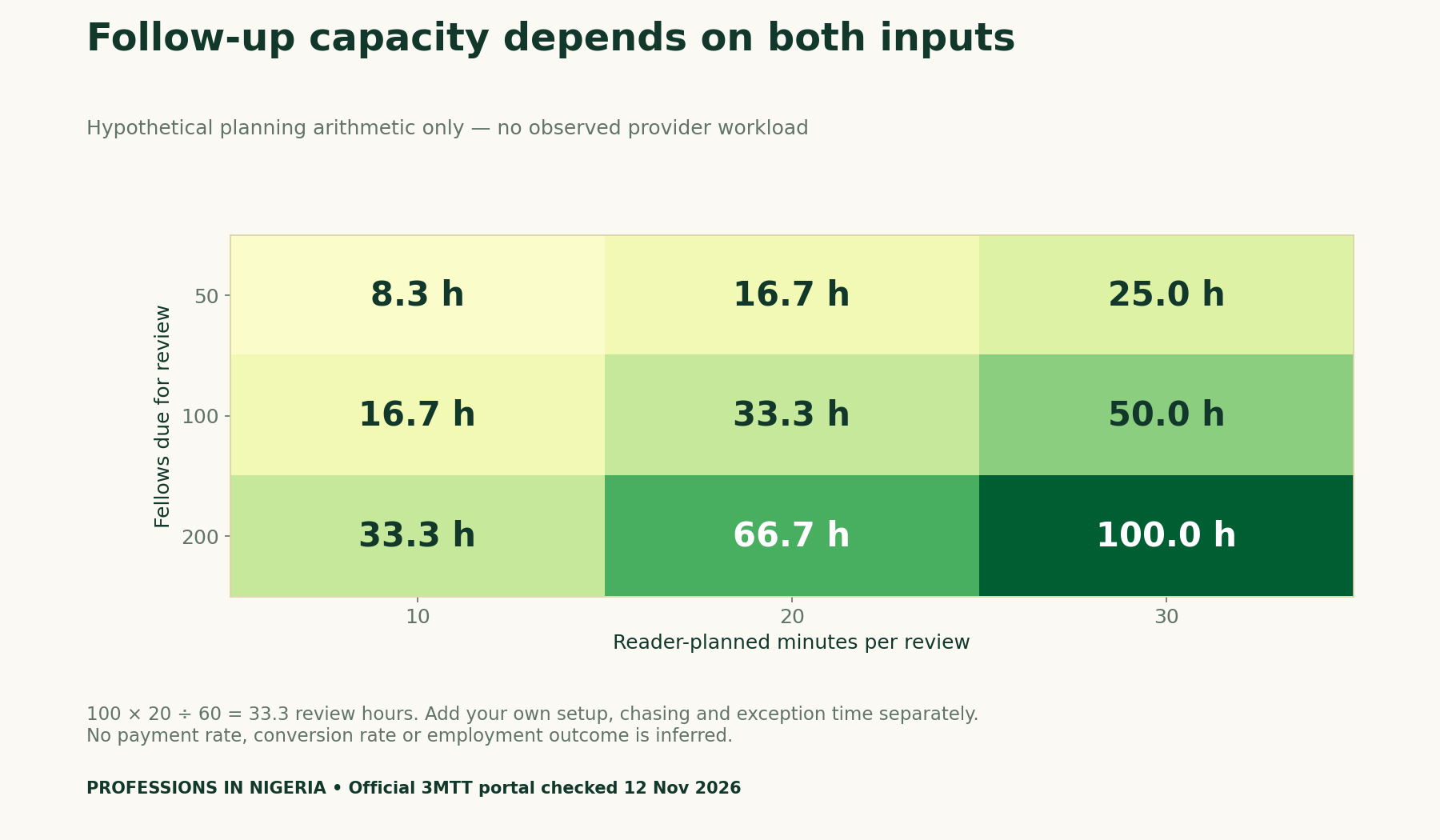
At an invented 100 Fellows due and 20 planned minutes each, the arithmetic is 2,000 minutes, or 33.3 review hours. Doubling either input doubles those review hours. That says nothing about whether 20 minutes is sufficient for a real verification task.
The chart excludes setup, unsuccessful contact attempts, consent administration, corrections and difficult cases. Add these separately in a realistic plan. Do not treat the chart as a staffing norm, evidence that a provider can serve a cohort, or an estimate of total delivery cost.
It also does not establish revenue. A workload plan and a payment agreement answer different questions. Ask how evidence acceptance, disputed cases, payment timing and delivery responsibilities interact before committing resources.
Keep the funding deadline distinct from membership review
The official deadline is 30 November 2026 at 23:59 WAT for Cohort 5 funding applications. Membership stays open, with quarterly application review. The dated portal entries are more useful than a countdown that can change or render incorrectly.
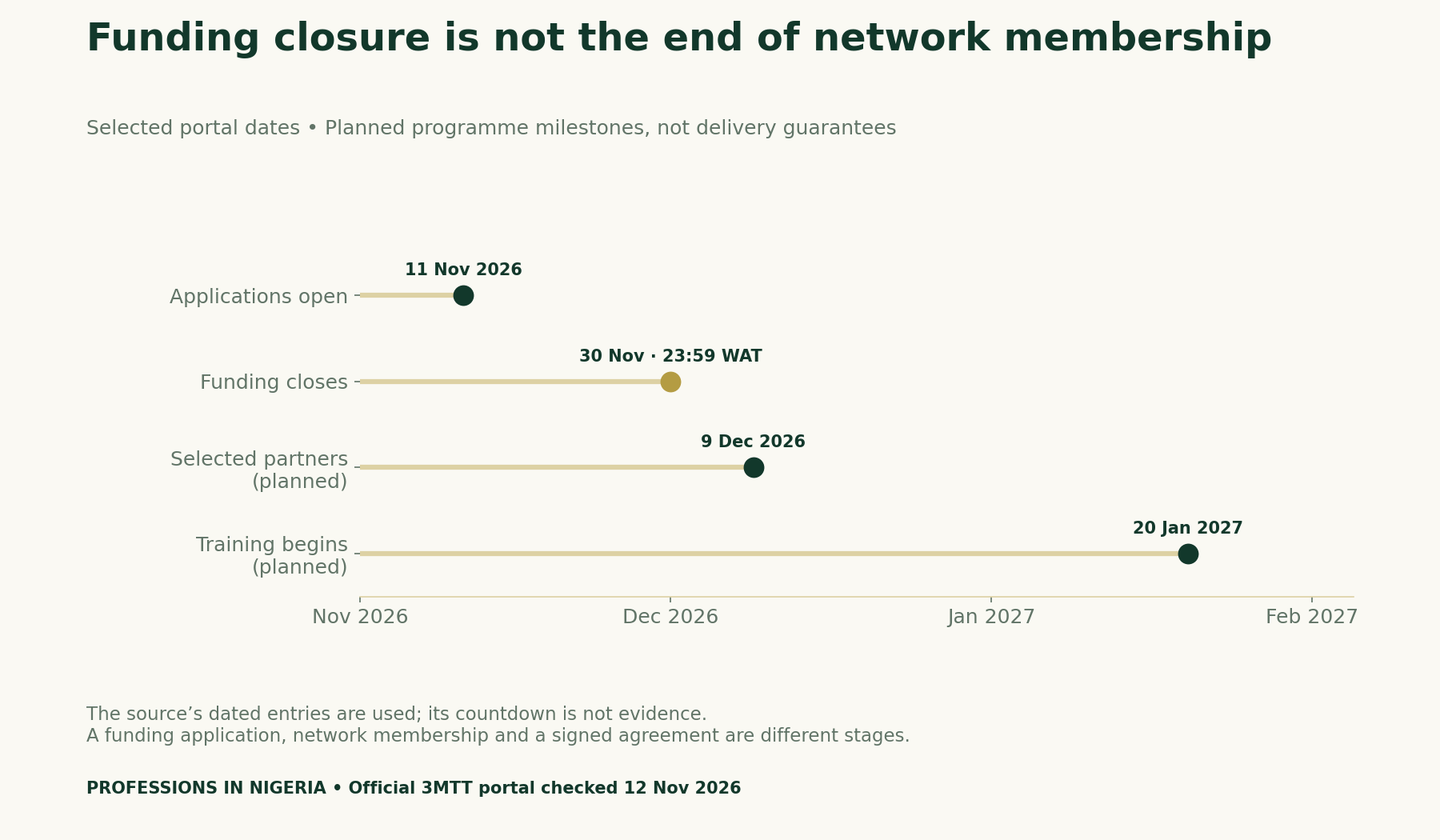
The chart also shows planned programme milestones. They do not guarantee that 3MTT will select or contract a particular applicant on that date. Keep a dated source reference when briefing colleagues, and check the current portal again before submission.
Applying and joining are free, according to the portal. Do not confuse an unofficial promise to sell access with an authorised application route. Use the official site for the application itself; this publication does not collect applications or offer paid placement.
Use current portal wording, including evidence requirements
The live portal can change after a research brief is written. On our retained 12 November view, partner outcome reporting is quarterly, with Funded partners also reporting as results are verified. That differs from older cached annual wording.
The live FAQ also tells applicants to submit most evidence with the application. However, the programme requests founder or director identity documents, full learner lists and the cost breakdown only from shortlisted applicants. Read the current instructions before deciding what to prepare or submit.
Our source register records these distinctions. It does not reproduce an application package or invite readers to upload sensitive files here. Therefore, check requirements against the current official process and the eventual agreement.
Download the evidence and capacity tools
- Source and result-definition register (CSV): dated primary references, scope and qualifications.
- Hypothetical review-capacity calculations (CSV): invented inputs and transparent hours arithmetic.
- Blank minimal cohort register (CSV): synthetic IDs, private references, stages, follow-up and unresolved questions.
- Blank outcome-evidence map (CSV): proposed evidence, responsible role and verification fields for each official result.
We have not tested these tools as a delivery or compliance system. Adapt them to the agreed definitions and authorised records process. A completed worksheet does not certify a result.
Our campaign-payment analysis explains why administrative handovers and actual receipt need separate clocks. Our remote-job denominator guide shows why missing information must remain visible rather than becoming a favourable classification.
Methodology and limitations
We inspected the ministry announcement and live portal, retained their visible wording and built original editorial planning tools. The capacity chart is wholly hypothetical. We did not conduct a provider survey, learner-outcome audit or verification experiment.
We do not use historical registration and training totals as a current conversion funnel. We do not divide the funding envelope by earlier learner counts. 3MTT delivery partner outcomes remain subject to selection, agreed terms and official verification; no employment, funding or payment result is guaranteed here.


