






Eye care training Nigeria professionals consider should come with evidence about the actual course. A workforce target can signal policy attention. However, it does not identify an approved provider, a funded place or a job offer. Before paying, separate the national commitment from the programme you can verify.
Our analysis retains five announced measures, explains their different units and supplies a reusable evidence chain. Three figures show the targets and their mathematical limits. Four CSV resources help readers retain sources, check course claims and record unanswered questions. This is career-evidence analysis, not clinical advice or a credentialing decision.
What the November eye-care statement commits to
The ministry statement published by FMINO on 3 November 2026 reports commitments announced by the Minister of State for Health and Social Welfare. By 2027, these include training 15,000 primary healthcare workers, distributing five million pairs of reading spectacles and delivering 25,000 fully subsidised cataract surgeries. By 2030, it announces 20% growth in the active eye-care workforce and a 30-percentage-point increase in effective cataract surgical coverage.
These are commitments, not measured achievements. The release does not supply the workforce or coverage baseline, funded training places by profession, an intake timetable or confirmed vacancies. It also does not establish salaries. Therefore, none of those missing details should enter a course advert or career forecast as if the announcement supplied them.
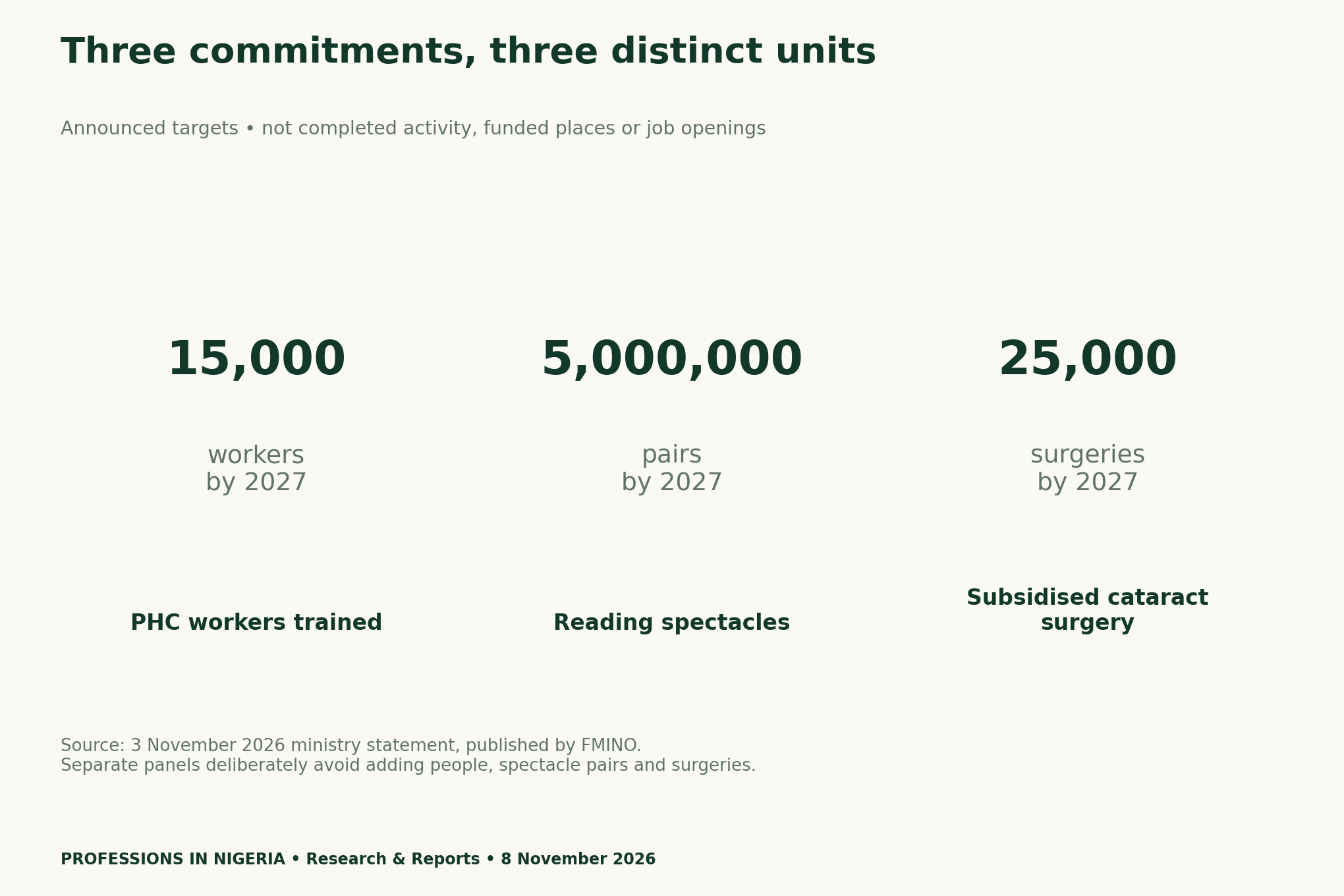
Eye care training Nigeria: keep the units separate
A trained worker, a pair of spectacles and a surgery are different units. Adding their counts would produce a meaningless total. Also, a training target does not necessarily count new entrants. Without the programme definition, it may involve existing workers. Do not relabel 15,000 workers trained as 15,000 newly created positions.
Next, distinguish a target date from a course deadline. A 2027 commitment does not establish that applications close this month. An actual intake needs its own dated notice, eligibility conditions and contact route. Similarly, a service-volume commitment cannot establish how many learners a provider may enrol.
Read workforce growth as a relative change
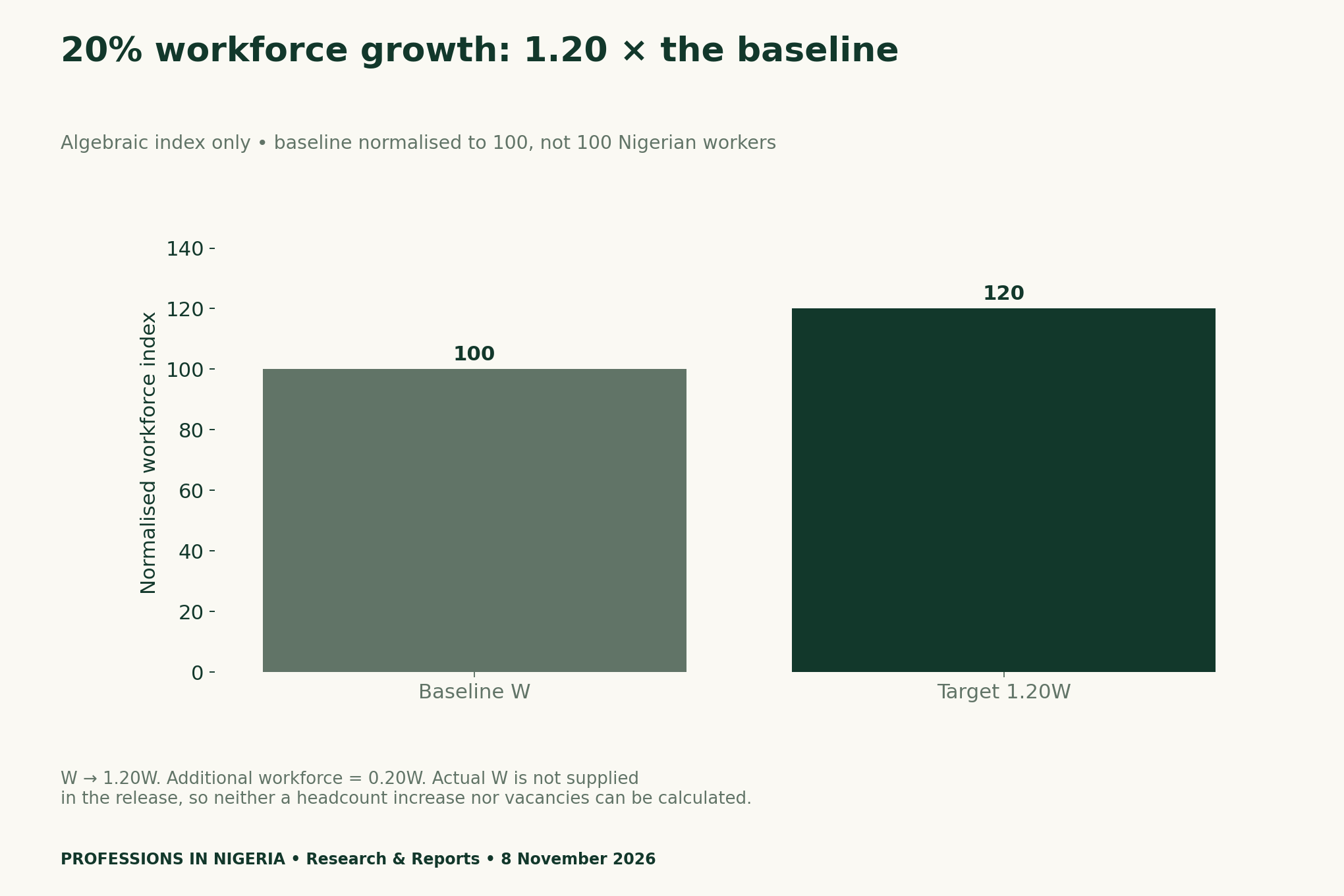
Let W represent the active workforce baseline defined by the responsible programme. A 20% increase means a target of 1.20W and an increase of 0.20W. Because the release does not supply W, an actual headcount cannot be calculated from it. The index in Figure 2 uses 100 only as a mathematical reference.
Even a verified headcount increase would require careful interpretation. It is not automatically the number of posts open to applicants at a particular date. Entry, exit and workforce definitions can matter. For an employment decision, use the employer’s current official requisition rather than converting a policy percentage into a vacancy estimate.
A percentage-point target uses another calculation
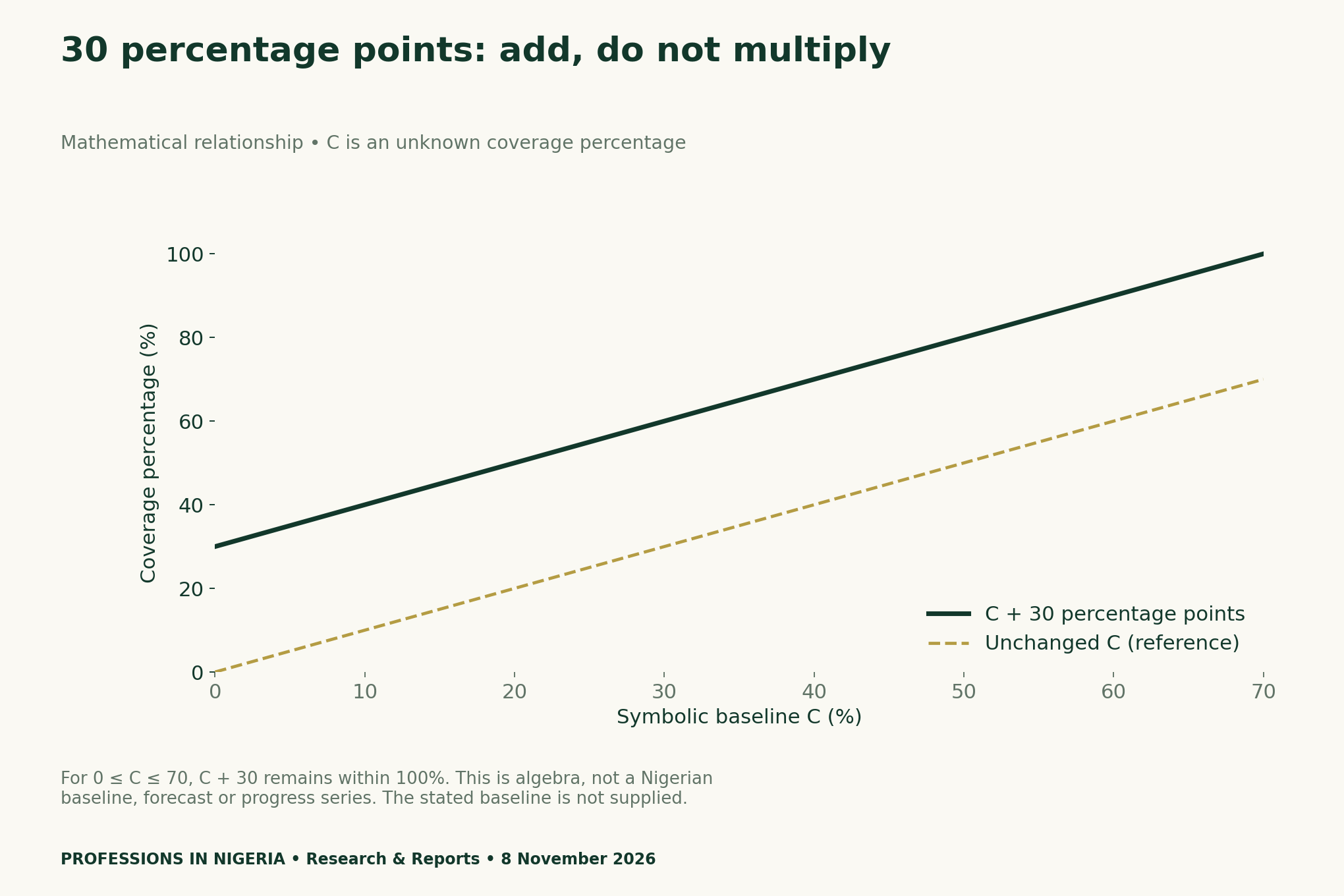
Let C stand for the baseline coverage percentage. Adding 30 percentage points gives C + 30. Multiplying by 1.30 would describe a different relative change. The release does not supply C. Therefore, this article cannot report the final coverage level or progress towards it.
Figure 3 plots the mathematical relationship over the range where adding 30 points stays within 100%. That range is a boundary explanation, not a claim that any plotted baseline describes Nigeria. If a later official definition changes the reference period or measure, retain that documentation before comparing updates.
Follow the commitment-to-opportunity evidence chain
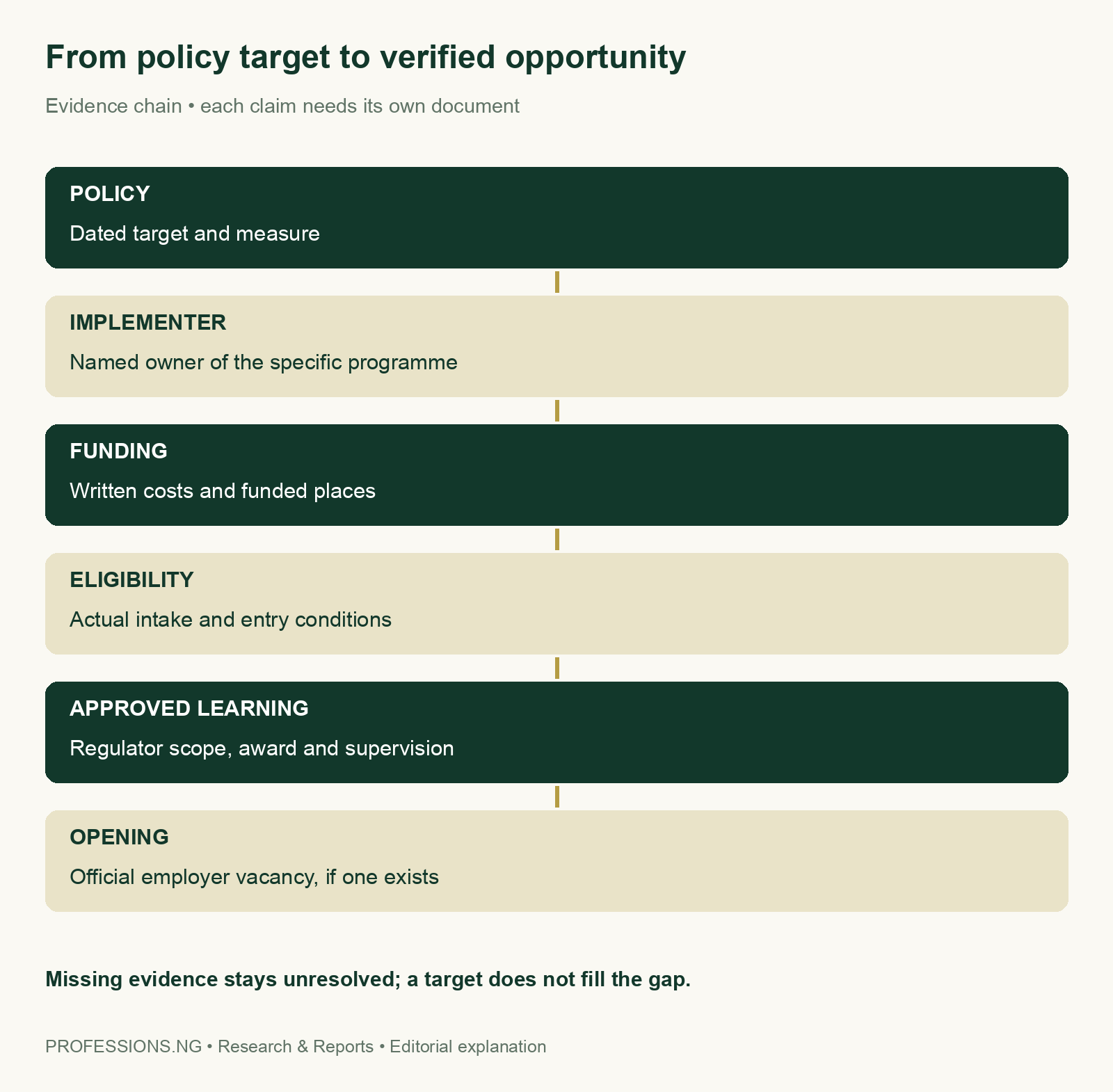
Start with the dated policy source and its exact measure. Then identify the implementing body for the particular programme. Ask which document establishes its responsibility. A familiar logo or a repeated headline is not a substitute for a verifiable official notice.
Next, request written funding and fee information. Separate tuition, equipment, travel, assessment and other quoted costs. Check which items support covers and which remain the learner’s responsibility. Our first-job budgeting report explains why announced support and available cash must remain separate.
After that, verify entry eligibility, the named award and the current approval for this specific course. Confirm the relevant regulator through an official channel for the profession and training concerned. A provider’s general registration does not, by itself, prove approval for every programme it advertises.
Check scope and supervision before enrolling
Ask what the course teaches, what award it issues and which supervised activities the learner may undertake within their existing professional position. Obtain written clarification from the provider and relevant regulator when scope is unclear. Short-course attendance must not be presented as permission to perform a different regulated clinical role.
This guide does not determine an individual’s clinical competence, registration or authority to practise. It also does not recommend a particular provider. Keep that distinction in the verification sheet, especially when promotional language mixes professional development with a new professional title. Have an appropriately qualified Nigerian professional resolve scope questions before relying on them.
For a job claim, locate the official employer advert and record its requisition, location, contract and closing status. Our job-qualification coding guide separates minimum conditions, alternatives and preferences. Use the exact employer wording rather than assuming that a training certificate removes every eligibility barrier.
Download the verification resources
The target ledger retains each measure and marks missing baselines and funded places. The formula guide contains algebra, not a hidden workforce estimate. The blank course worksheet records written evidence and unresolved questions. It collects no patient information. Keep private personal records out of any public example.
- Eye-care target ledger (CSV)
- Percent and percentage-point formula guide (CSV)
- Blank training-verification worksheet (CSV)
- Commitment-to-opportunity evidence chain (CSV)
Method, limitations and how to cite
Research checked 8 November 2026. We retained the official 3 November statement and separated its five commitments by unit and deadline. Our original contribution is the target ledger, mathematical boundary explanation and course-verification workflow. We did not survey providers, verify funding, count current vacancies or measure implementation progress.
Suggested citation: Professions In Nigeria, “Eye Care Training Nigeria: Verify Workforce Targets Before Enrolling,” 8 November 2026. Attribute the commitments to the ministry statement. Identify the index and coverage curve as mathematical explanations. Link the original release alongside this guide, and retain the relevant baseline and definition if later reporting progress.


