







Agricultural extension feedback skills Nigeria teams can demonstrate include more than delivering training. A worker can record a farmer’s question, locate a responsible technical person and return an answer. They can also show which cases remain unresolved. An attendance list alone cannot establish any of those steps.
New preliminary research offers a reason to examine that loop. Our analysis preserves the interview counts and their limits, then builds a clearly fictional case log. Three charts, a feedback-loop infographic and four CSV tools explain how a team could document the process. No field pilot or farm-income improvement is claimed.
What the preliminary NISER findings show
NISER’s account published on 6 November 2026 describes a validation event held the previous day with IWMI. The Nigerian diagnostic used 65 key-informant interviews across five states and the FCT. It generated 2,557 coded responses. Those codes are not 2,557 separate participants.
Among 59 interviews addressing the farmer–researcher link, 32 rated it mainly weak. In 48 of 65 interviews, respondents described farmer demands as diluted, captured, lost or reshaped before implementation. These are preliminary interview findings. They do not measure the share of all Nigerian farmers experiencing a failed service.
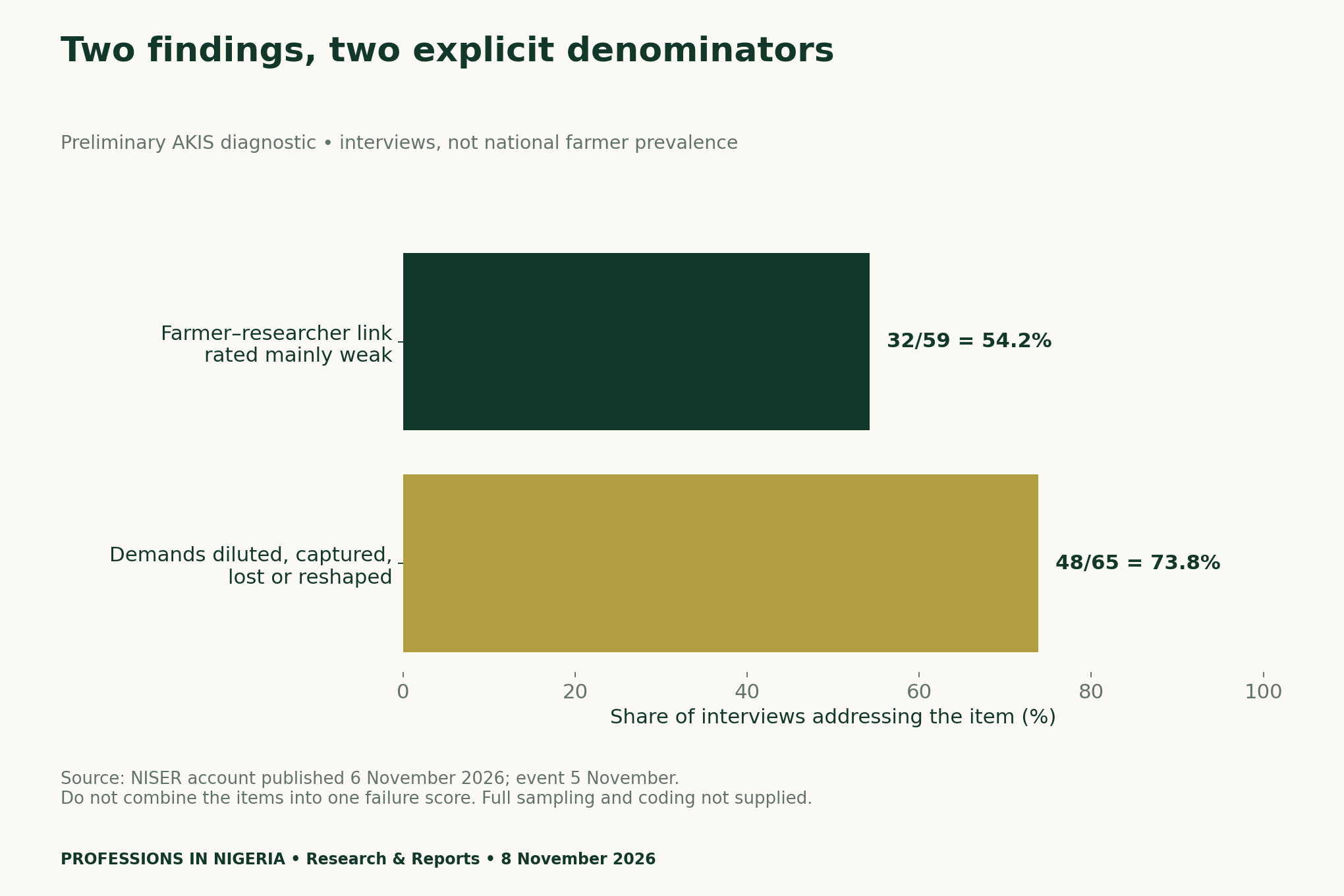
We calculate 32 divided by 59 as about 54.2%, and 48 divided by 65 as about 73.8%. Do not add, average or subtract these as a combined failure score. Different questions and denominators describe different evidence. The public account does not supply full sampling, fieldwork dates or question-level coding detail.
Agricultural extension feedback skills Nigeria teams can document
First, separate activity from return. A meeting held or message sent records work undertaken. A documented answer returned records a different stage. Resolution requires another check: did the answer address the original question, and what still needs action? Each measure needs its own evidence.
The case register is a professional work sample, not a substitute for technical expertise. Route questions to an appropriately qualified person within the organisation’s remit. Do not turn this administrative tool into unverified pesticide, veterinary or crop-treatment advice. Keep the exact technical source and its limits with any permitted response.
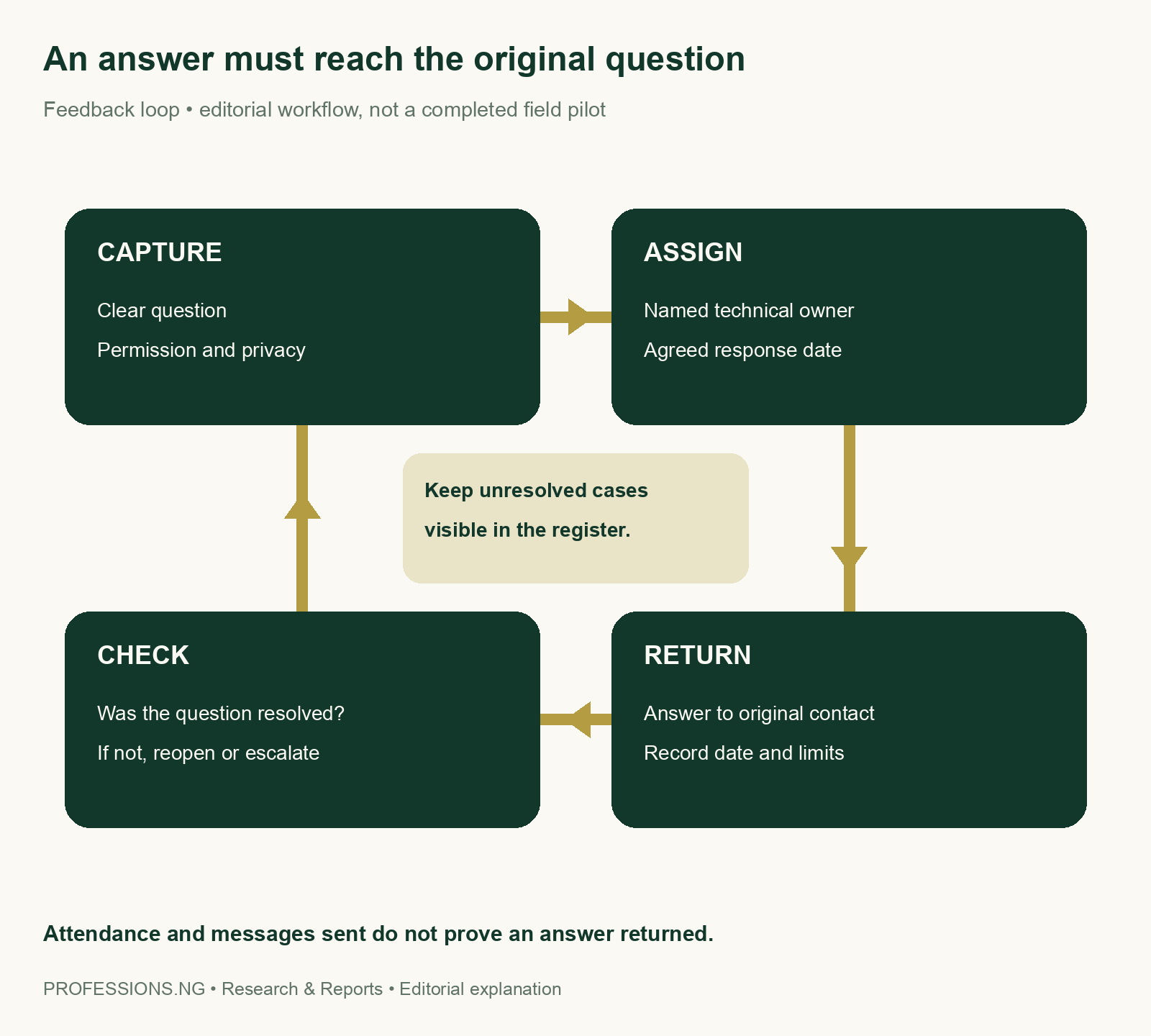
Read the fictional eight-case example
Our demonstration contains eight invented requests dated 20 October and reviewed on 30 October. There are no real farmer names, contact details or sensitive records. Five cases have a recorded answer returned. Three of those are resolved; two remain unresolved after the answer. Three have no returned answer by review.
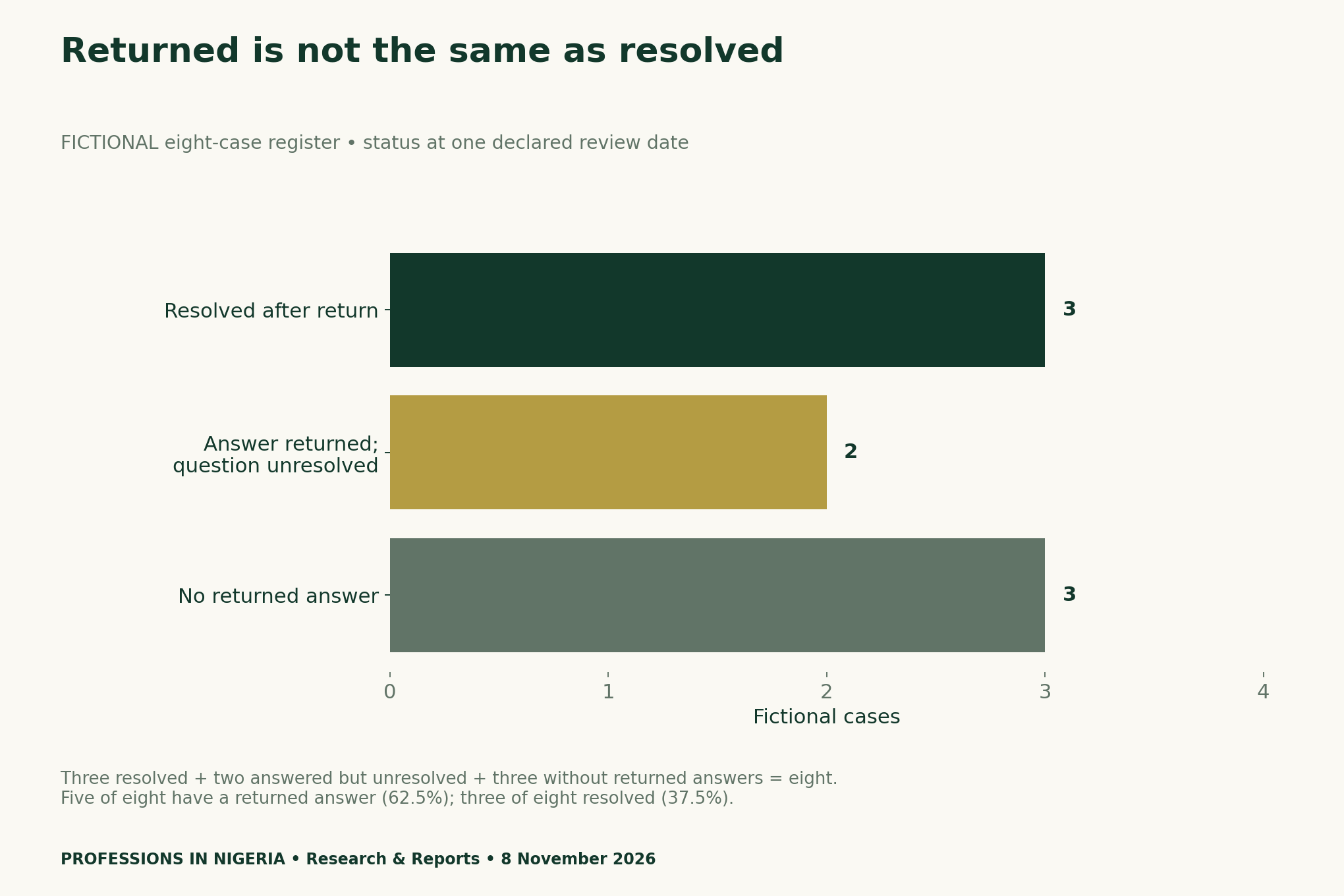
The returned-answer share is 5/8, or 62.5%. The resolved share is 3/8, or 37.5%. Using only the five answered cases would change the resolution denominator. If you report that conditional measure, label it separately. Do not quietly exclude the cases still waiting for an answer.
Also, avoid treating an unresolved case as a worker failure. Funding, mobility, remit or a technical evidence gap may prevent closure. Record the constraint, next action and responsible owner. The register should make a limitation visible without blaming a person for conditions outside their control.
Calculate timing without hiding missing answers
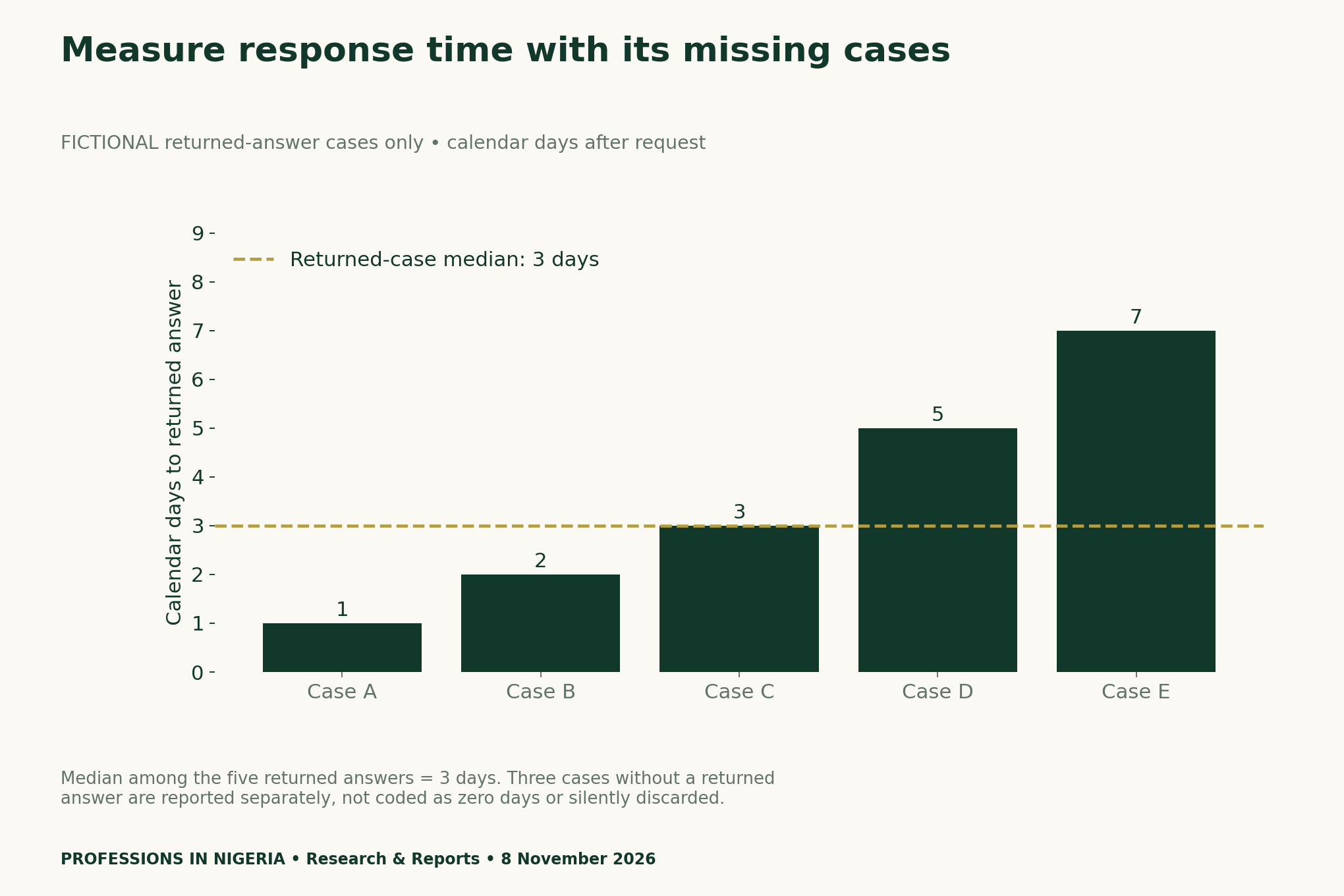
For the five returned cases, our invented delays are one, two, three, five and seven calendar days. Their median is three days. This is not a response-time estimate for Nigerian extension services. It only demonstrates a calculation on fictional records.
The other three cases have no return date. Do not code them as zero days, and do not describe the three-day figure as the experience of the whole cohort. A report should disclose both the timing denominator and the number without answers. If dates are missing even for returned cases, flag that additional limitation separately.
Build a privacy-conscious prospective pilot
Before collecting anything, obtain organisational permission and appropriate data-handling arrangements. Define one intake window, eligible request types and a review date. Assign neutral case identifiers. Retain only the minimum information needed for the purpose, with access controls and retention rules set by the organisation.
Next, agree the technical owner, response date and escalation route. Keep the original question visible so that a general message is not mistaken for an answer. If a case is transferred, retain the handover record. If a request changes materially, record the change rather than rewriting the original evidence.
After that, review returned answers and unresolved cases. Predefine the denominator as all eligible requests in the intake cohort. Deduplicate repeat messages about the same request and retain the exclusion count. Record missing dates honestly. A neat spreadsheet cannot compensate for an undefined cohort or an undocumented exclusion.
This is a prospective protocol. We have not obtained permission for a real pilot, contacted farmers or collected case data. The proposed measures concern the response process. They cannot establish that yields, incomes or adoption improved because of the register.
Use the work sample in professional development
A permission-cleared, anonymised process example can show how a worker handles ownership, handover and follow-up. Explain the evidence limits alongside the measures. Do not publish private records or claim results from a demonstration. A supervisor should assess the sample against the actual role and organisation’s rules.
For broader career decisions, our qualification-requirements report shows how to retain an employer’s exact conditions. If a proposed course promises a new role, compare that promise with a current official advert. Our employer-breadth report also explains why a headline count cannot replace current opportunity verification, although its sector differs.
Download the case-log resources
The source CSV retains counts and denominators. The example log is fictional. The blank register contains no farmer records, and the protocol is prospective. Keep those labels when adapting or sharing the files so a useful template does not become an invented field result.
- Source counts and denominators (CSV)
- Fictional feedback case log (CSV)
- Blank farmer-feedback register (CSV)
- Prospective process-pilot protocol (CSV)
Method, limitations and citation
Research checked 8 November 2026. We retained NISER’s account, calculated each share from its own numerator and denominator, and created an original eight-case demonstration. We checked that the review statuses add to eight, that returned cases total five, and that their median delay is three calendar days.
Suggested citation: Professions In Nigeria, “Agricultural Extension Feedback Skills Nigeria: Close the Loop,” 8 November 2026. Attribute the preliminary findings to NISER. Identify the log and process charts as fictional, and the pilot protocol as prospective. The public news account is geographically bounded and does not supply a nationally representative service-performance estimate.


