






A vocational start-up grant budget Nigeria graduates can use should begin with the first feasible job. Tools matter, but a machine does not pay for stock, transport or power. First, establish which resources you actually control. Then record what a specific job would require before promising delivery to a customer.
A new Nasarawa announcement provides the news context. Our contribution is a transparent fictional tailoring case, a cash-timing comparison and blank planning tools. These examples do not describe the beneficiaries’ accounts or actual local prices. No quotation survey, business follow-up or grant application is claimed.
What the Nasarawa report announced
A Federal Information Centre report published on 2 November 2026 describes start-up packs for 50 selected graduates of the Wing Commander Abdullahi Ibrahim Vocational and Technical Institute in Lafia. It also reports an additional ₦100,000 announced for each. The account mentions welding, electrical installation, catering, tailoring and hairdressing.
The implied aggregate cash announcement is ₦5 million: 50 multiplied by ₦100,000. This calculation excludes equipment because the report supplies no valuation. Also, the account provides no bank receipts or subsequent earnings. Its date is the publication date; a specific ceremony date is not supplied. Therefore, do not treat it as a disbursement audit.
The total eligible graduating group is unknown. As a result, 50 selected recipients cannot become a programme success rate. Nor does this report establish an open application route. The practical question here concerns readiness after support, rather than who can currently apply for a grant.
Vocational start-up grant budget Nigeria: separate assets and cash
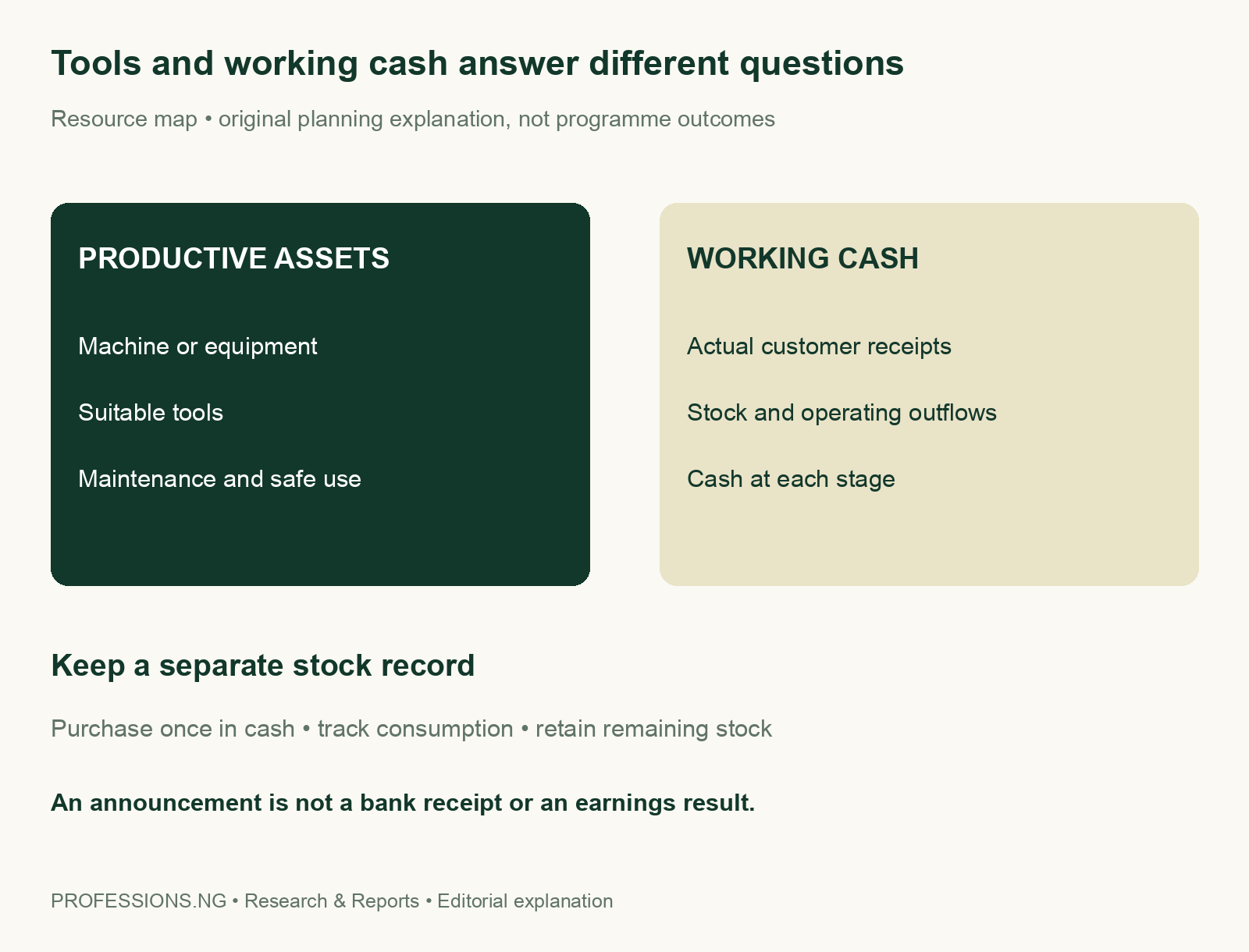
Begin with an asset list. Note the condition, permitted use and any maintenance or supervision the equipment needs. Next, list unrestricted cash actually available. An announced award belongs in a separate evidence note until you confirm receipt. Do not enter expected support as spendable money simply because a headline names an amount.
Also, keep customer money and payment terms clear. Record the agreed work, receipts and due dates. A deposit is not a universal entitlement. Discuss lawful, appropriate terms for the specific job and retain an agreed record. Avoid collecting sensitive customer information in a public example.
Follow an entirely fictional first-job cash ledger
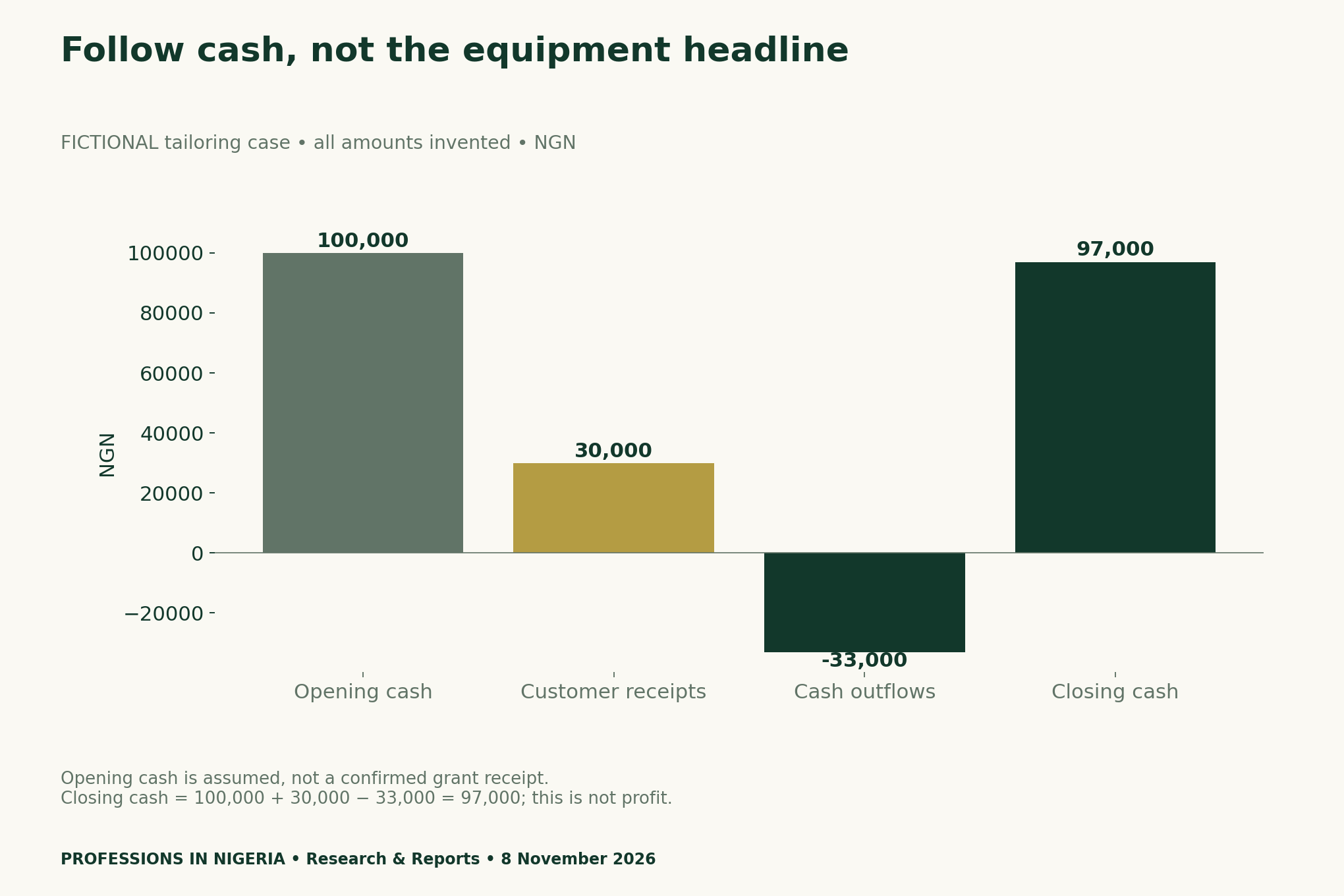
For this teaching case, assume ₦100,000 opening cash, ₦15,000 customer deposit and ₦15,000 final payment. We invent ₦33,000 of cash purchases and operating outflows. Closing cash is therefore ₦97,000: ₦100,000 plus ₦30,000 minus ₦33,000. The example does not show that a beneficiary received the announced grant.
Importantly, a closing balance is not profit. It includes opening resources and reflects when receipts and purchases occur. The case does not price the owner’s time, taxes, depreciation or every business obligation. Therefore, do not use the final balance to claim the job or grant produced an earnings return.
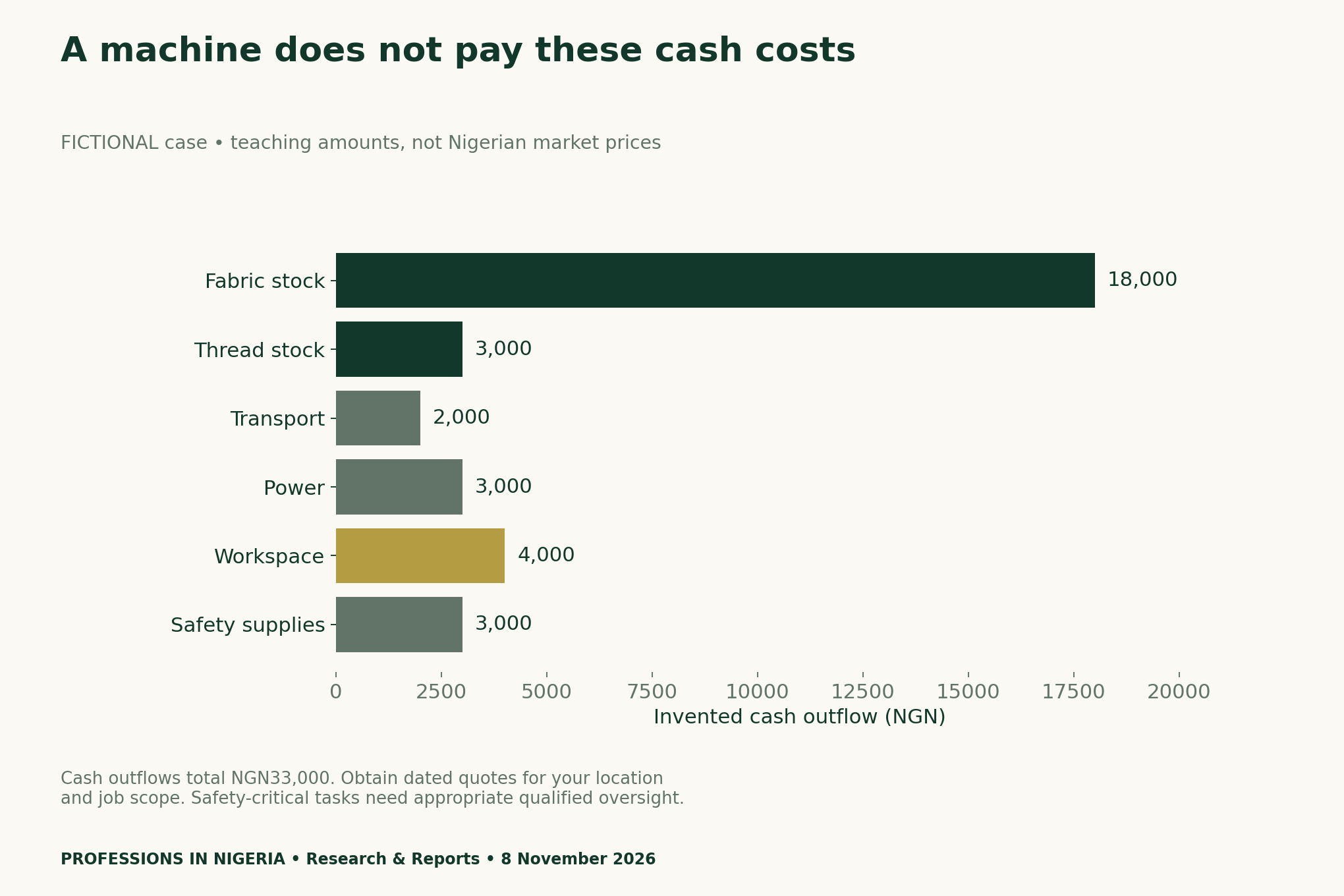
The ledger records fabric, thread, transport, power, workspace and safety supplies. These categories are prompts for a real quotation exercise. They do not prove that the amounts are sufficient or that every trade has the same needs. Safety-critical work requires appropriate competence, authorisation and qualified oversight. A grant does not remove those requirements.
Avoid subtracting inventory twice
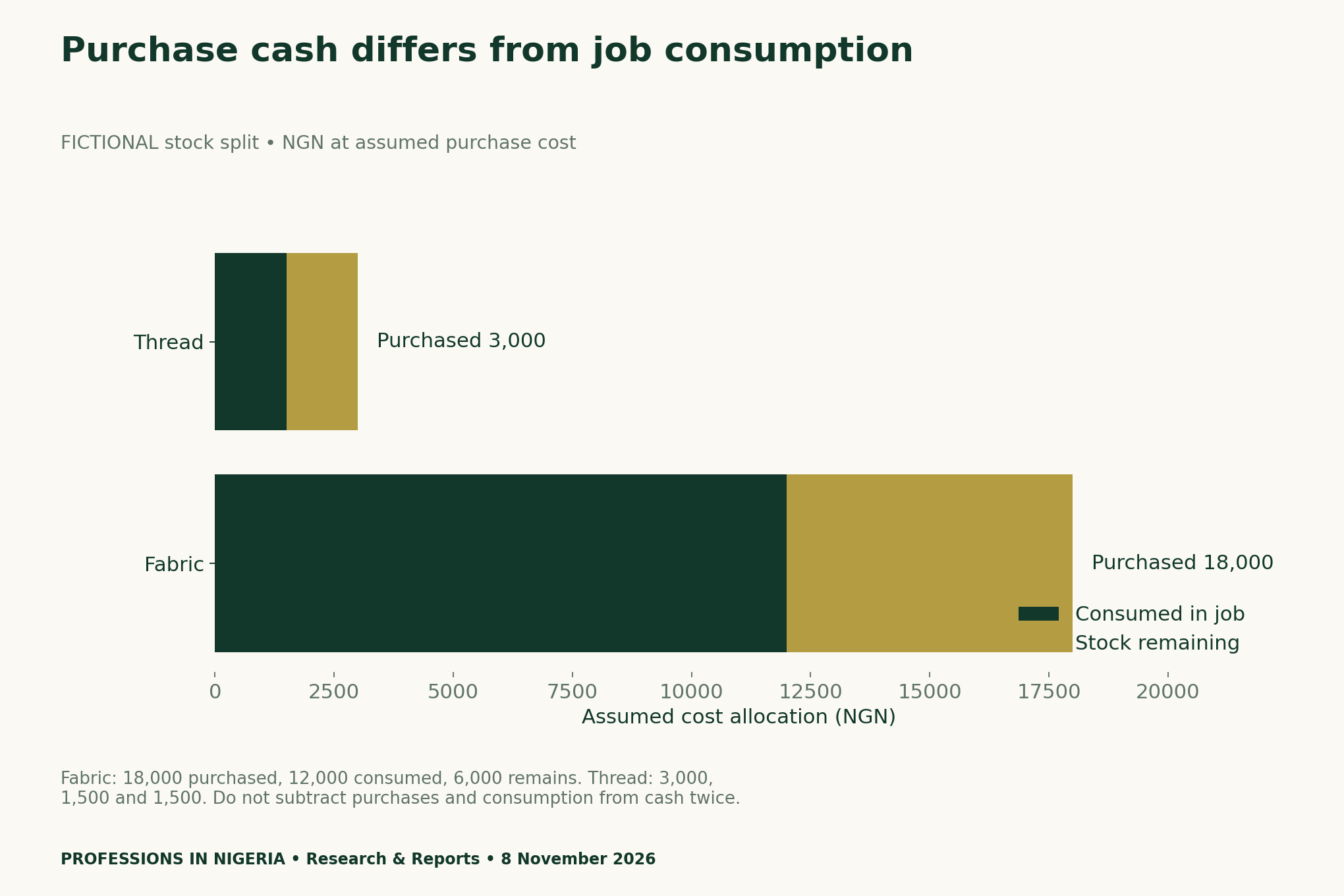
In the fictional example, the fabric purchase costs ₦18,000. We allocate ₦12,000 to the job and retain ₦6,000 as stock. Thread similarly splits into ₦1,500 consumed and ₦1,500 remaining from a ₦3,000 purchase. These allocations are invented, but the bookkeeping distinction is useful.
The cash ledger already subtracts the purchase payments. Therefore, do not subtract the consumed amounts from the same cash balance again. A separate job-cost discussion can examine consumption, time and other costs using a consistent method. This guide does not produce a complete profit statement or advise on tax accounting.
Check the balance before the final payment
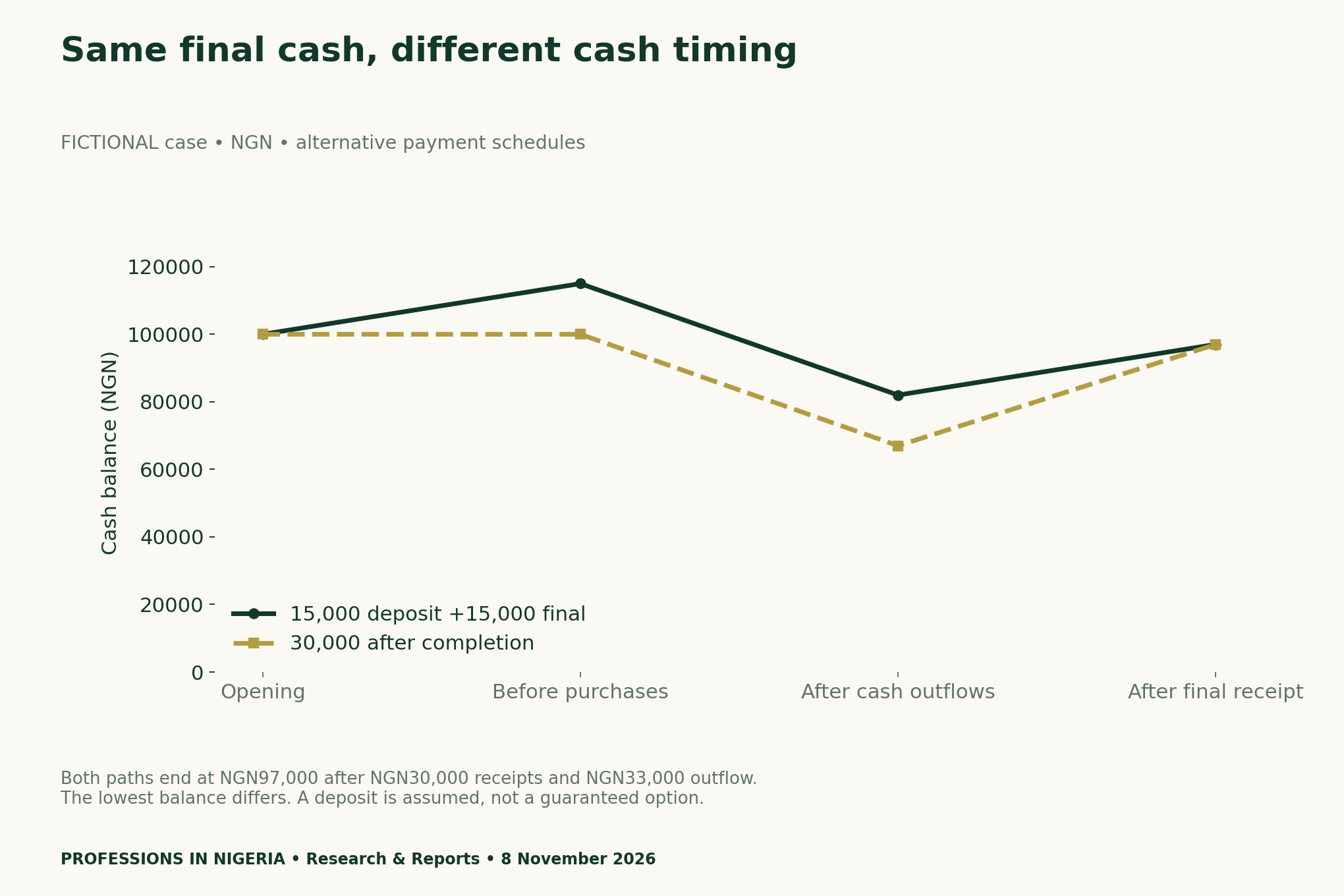
Both fictional schedules receive ₦30,000 and spend ₦33,000. However, the deposit path falls to ₦82,000 after outflows, while the later-payment path falls to ₦67,000. Both finish at ₦97,000. This comparison explains timing; it does not guarantee that a customer will agree to a deposit.
Before accepting work, identify which payments fall due before receipts arrive. Also, check whether any opening cash is restricted or already committed. If a plan depends on an unconfirmed payment, mark that gap. A mentor can review the assumptions without treating this fictional balance as a minimum required for every business.
Collect comparable quotes and test readiness
Choose one town, date and precisely specified consumable basket. Then seek three written quotes on the same quantities and quality. Retain delivery costs, validity and supplier terms. Our worksheet is prospective: we have not collected prices, chosen a supplier or found the cheapest basket.
Next, confirm tools, safe scope, supervision, workspace, transport and a payment record. The relevant check varies by trade. For example, electrical installation cannot become unsupervised work simply because equipment is available. Our qualification-requirements report explains how to retain exact conditions and unresolved questions.
Download the first-job planning resources
The source ledger retains the announcement and its unknowns. The demonstration files contain invented amounts. The readiness and quotation sheet is blank. Keep those evidence types separate when adapting the resources. No real customer or beneficiary data appears in these files.
- Announcement facts and unknowns (CSV)
- Fictional first-job cash ledger (CSV)
- Fictional stock split and payment paths (CSV)
- Blank readiness and three-quotation sheet (CSV)
Method, limitations and citation
Research checked 8 November 2026. We retained the official FIC account, derived ₦5 million as 50 times ₦100,000, and built an original teaching case. We verified the fictional cash totals and separated stock purchases from consumption. No beneficiary accounts, actual quotes, selection denominator or business outcomes were obtained.
Suggested citation: Professions In Nigeria, “Vocational Start-Up Grant Budget Nigeria: Plan the First Job,” 8 November 2026. Attribute announcement facts to the FIC report. Identify the cash case and timing paths as fictional, and the quotation sheet as a prospective resource. This is educational budgeting, not personalised financial advice or a profitability test.


