







Nigerian job qualification requirements deserve a close reading before you pay for another course. A popular credential in a national-looking chart may not be the missing requirement for your target role. First, check the employer’s exact words. Then separate a minimum qualification from an accepted alternative, a preference and relevant experience.
A new NISER report offers useful context. However, its qualification chart combines HND and bachelor’s degrees. That grouping matters for both polytechnic graduates and degree holders. Our guide preserves the published categories and provides a blank, reproducible method for investigating a specific career decision. We have not conducted the proposed employer-ad audit.
What the November release actually measures
The NISER publication page dates the release to 1 November 2026. Its Q2 report covers April–June 2026 advertisements in The Guardian, The Punch and The Nation. It records 660 ads. Therefore, the publication date is not the period when employers advertised those roles.
Also, the report excludes many online openings and other newspapers. It is not a census of Nigerian vacancies. An advertisement does not establish a completed hire, an available November vacancy or a particular person’s eligibility. Use this evidence to frame questions rather than decide what to buy.
Nigerian job qualification requirements: preserve the combined category
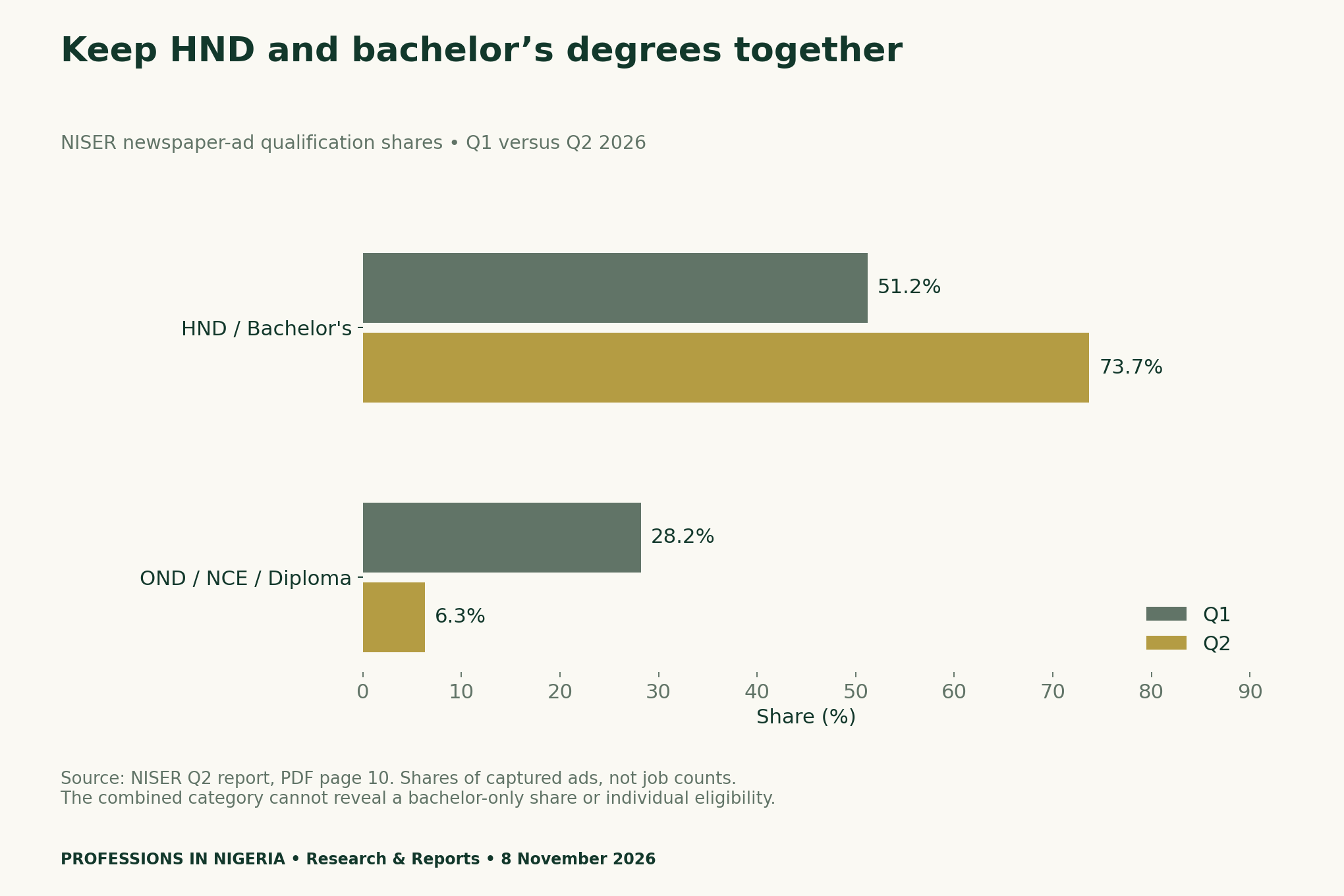
The HND/bachelor’s share rises by 22.5 percentage points: 73.7 minus 51.2. Meanwhile, OND/NCE/diploma falls by 21.9 points: 6.3 minus 28.2. These are changes in shares, not percentage changes in vacancy counts. The figures alone cannot show how many ads in either group were added or removed.
Importantly, the detailed chart groups two qualifications together even though parts of the report’s narrative use bachelor’s-only shorthand. We follow the chart label. The publication does not provide a split that would let us calculate a bachelor-only share or compare the two qualifications’ acceptance rates.
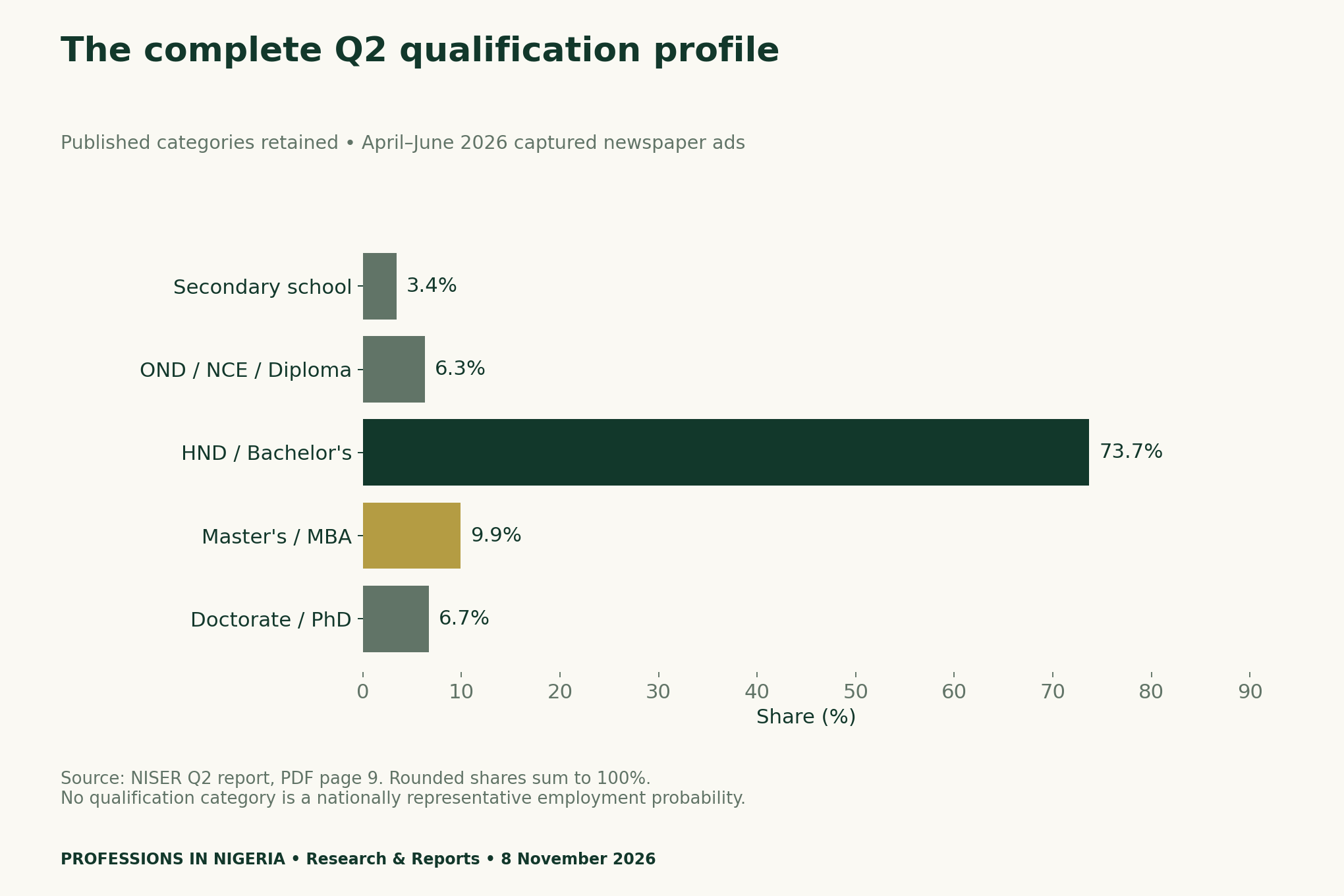
For example, a candidate with an HND should not read the combined bar as evidence that every employer requires a bachelor’s degree instead. Conversely, an applicant should not assume that every advertisement in that category accepts both. Only the actual ad and any relevant professional rules can settle that question.
Code four different kinds of requirement
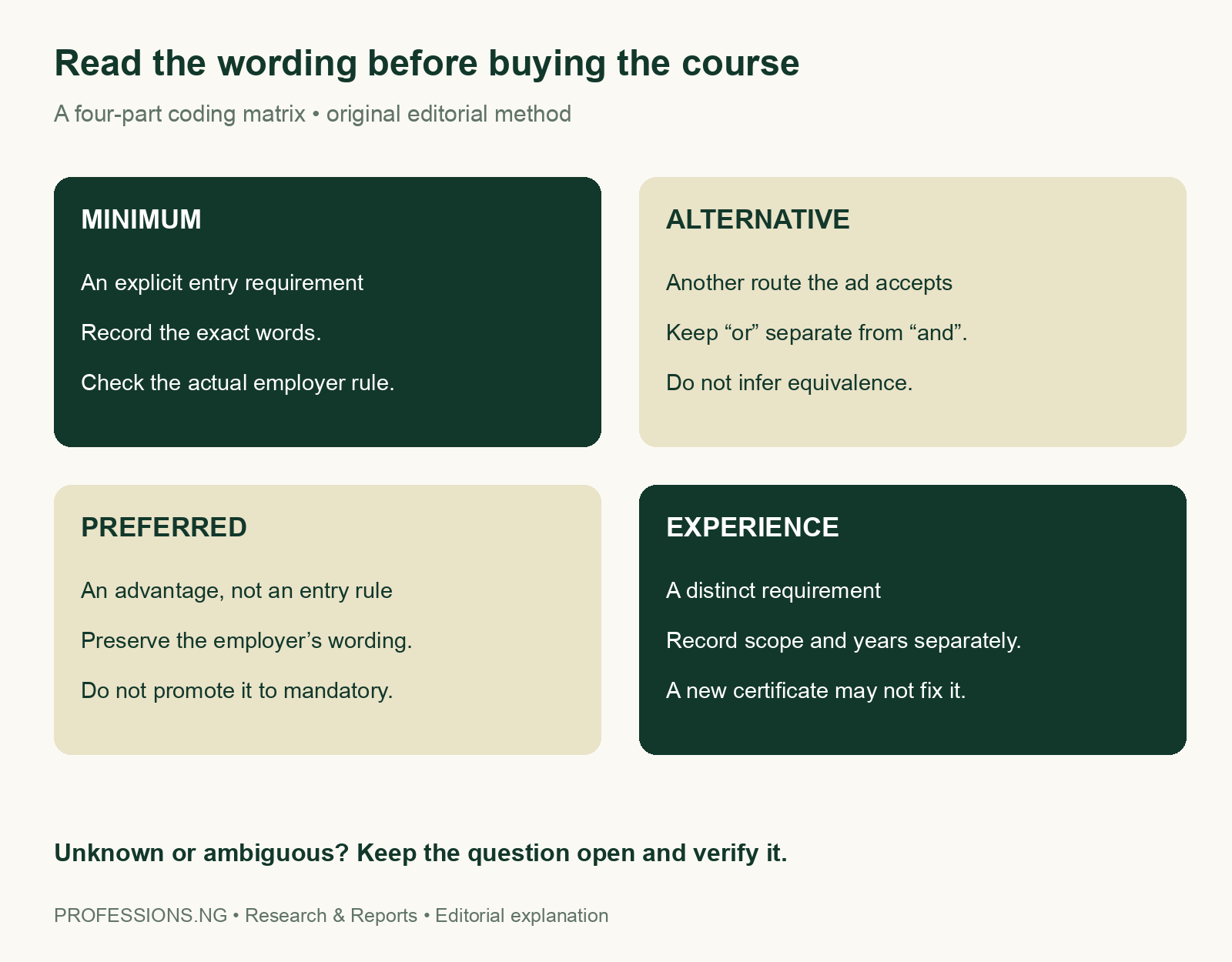
Start with the minimum. Copy the exact phrase and keep its source link. Next, record acceptable alternatives separately. The words “HND or degree” and “degree with a professional qualification” describe different conditions. Do not flatten either into a single “degree required” flag.
Then identify preferences. An employer may describe a certification as desirable without making it an entry condition. Finally, retain experience as a separate field. Record years, relevant tasks and any supervision requirements. If a sentence is unclear, flag it and seek clarification through the employer’s published recruitment channel.
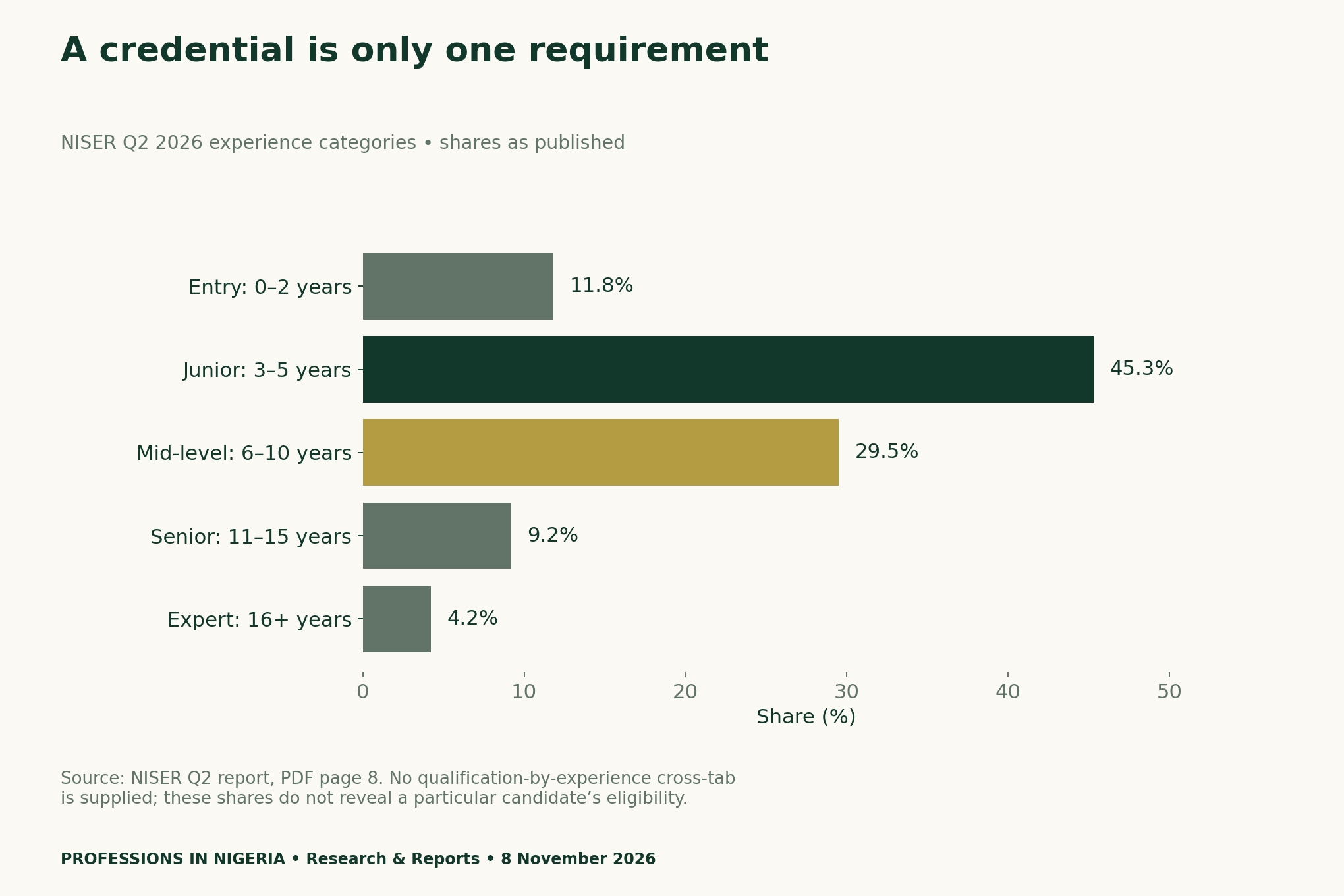
This experience chart answers a different question. It cannot tell us what share of HND holders need three years of experience. Nor can it reveal which course would overcome a task-experience gap. Those claims would need linked ad-level information that this publication does not supply.
Run a small official-ad audit before making a study decision
Choose one occupation and a practical location or work arrangement. For instance, define the scope as a specific type of administrative role rather than “all good jobs.” Also, declare a seven-day collection window before starting. Our blank register has space for up to 30 ads, but those rows are capacity, not observations.
For each eligible official employer page, record the access date, role, requisition ID and exact requirement wording. Deduplicate using employer plus requisition ID. Where an ID is absent, keep an ambiguity flag and describe how you checked for reposts. Exclude irrelevant roles and retain a short reason for each exclusion.
After collection, report how many unique ads you actually found. Then show known answers and missing wording separately. If only twelve eligible ads exist, report twelve rather than filling the remaining rows with unrelated examples. A second reader can review ambiguous coding. This remains a descriptive, occupation-specific exercise, not a national estimate.
Ask which barrier the course would remove
Before comparing providers, write one sentence: “This course would address this verified requirement for this target role.” If you cannot complete it with evidence, investigate further. A course can still be valuable for learning, but that is a different reason from claiming it unlocks an entry requirement.
Next, obtain dated written information on total fees, prerequisites, duration, study hours and any relevant approval. Include travel, materials and examinations where applicable. Verify accreditation or regulated scope with the responsible body and the actual programme. A provider’s promotional statement alone does not establish employer acceptance.
Also, list the barriers that would remain. These might include experience, location, a work sample or a specific professional registration. Do not assume a salary increase or a payback period. The NISER shares supply neither course prices nor earnings returns. Our procurement evidence-pack guide offers a related way to separate learning from verified work readiness.
Download the source table and blank tools
The files below contain published figures and original planning resources. The employer register, course sheet and collection protocol are blank or prospective. They contain no surveyed employers, recommended providers or individual eligibility decisions.
- Published qualification and experience figures (CSV)
- Blank 30-ad qualification audit (CSV)
- Blank course-decision sheet (CSV)
- Prospective collection and coding protocol (CSV)
Method, limitations and citation
Research checked 8 November 2026. We transcribed the detailed qualification charts on PDF pages 9–10 and the experience chart on PDF page 8. Printed slide numbering differs. We calculated two percentage-point changes by subtraction and retained rounded source shares. We did not reconstruct counts from percentages, collect a new employer sample or estimate qualification returns.
The report’s three-newspaper coverage, historical reference period and missing qualification-by-experience cross-tab limit interpretation. Therefore, this guide cannot establish a national qualification hierarchy or recommend an individual education purchase. Suggested citation: Professions In Nigeria, “Nigerian Job Qualification Requirements: Check Before More Study,” 8 November 2026. Attribute the published figures to NISER and identify our worksheets as original prospective resources.


