






NTI admissions accreditation Nigeria checks must identify the exact programme before money changes hands. A familiar institution name does not answer whether a particular award, study centre, delivery mode and admission session are authorised.
The Federal Ministry of Education’s 6 November 2026 announcement cancels NTI’s 2026 NCE and degree admissions across the affected full-time, part-time and distance-learning routes. It advises prospective applicants against applying, accepting offers or paying for those programmes.
Checked 12 November 2026. This guide separates the notice’s findings from our proposed verification tools. It does not determine an individual learner’s status. Download the blank worksheet below and keep completed records privately.
NTI admissions accreditation Nigeria: three different reader situations
Start with your current situation. New applicants, existing learners and serving teachers asking about professional development need different answers. Treating all three as one group can produce either unnecessary alarm or misplaced confidence.
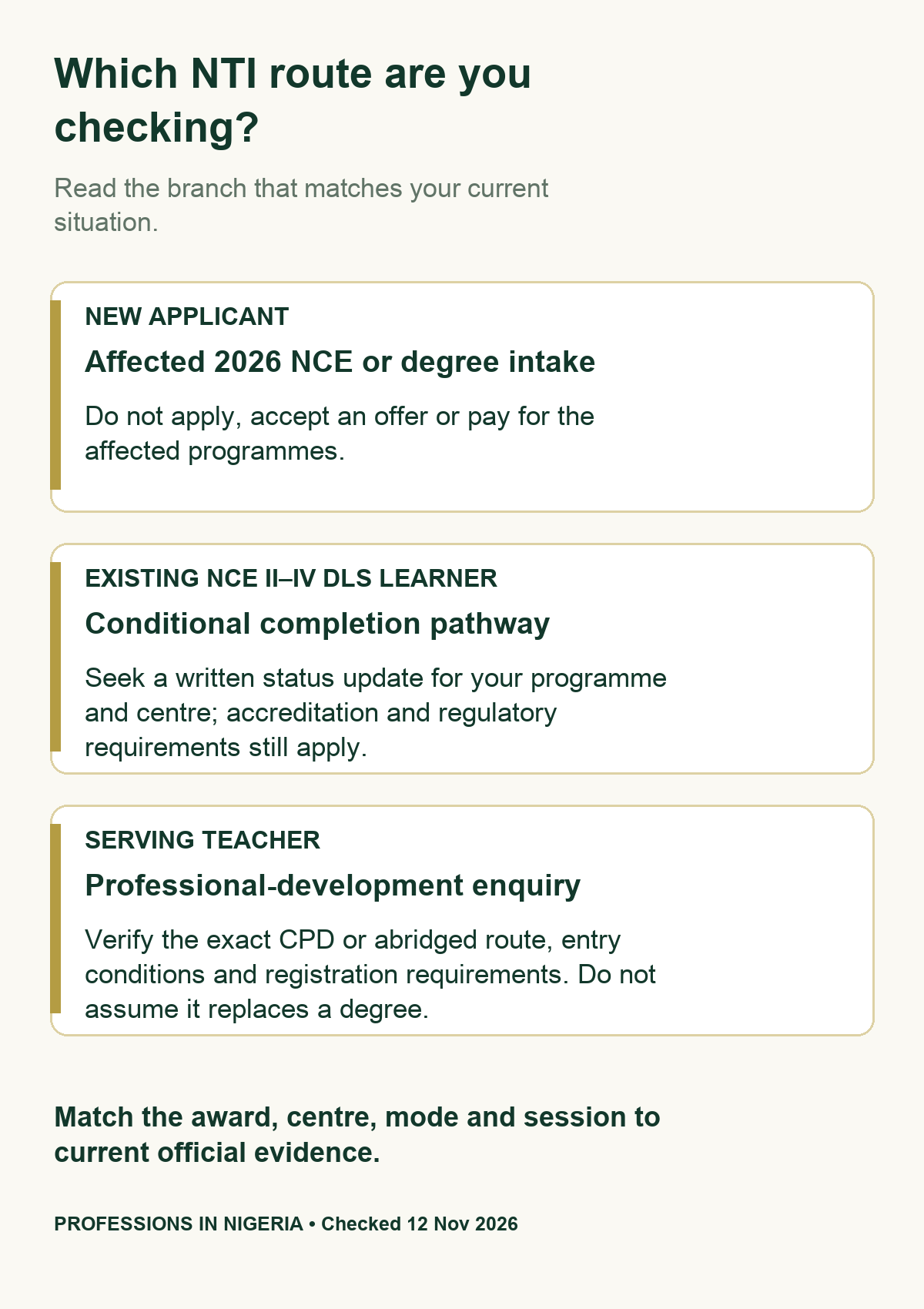
The notice provides a conditional completion pathway for existing NCE II–IV distance learners, subject to accreditation outcomes and regulatory requirements. It separately retains NTI’s teacher-development remit, including a specific three-to-six-month abridged programme for serving teachers with non-Education degrees. That is not automatic TRCN registration.
For a new application, a payment request is not proof that the advertised route remains authorised. For an existing learner, retain admission correspondence and receipts while seeking written clarification about the particular programme and centre. Do not infer a promised refund, transfer or completion date.
Keep the announcement date separate from the academic session
The ministry references operational guidelines dated 12 September 2025. Its warning was published on 6 November 2026 and concerns the 2026 academic session. Our check date is later again. These labels answer different questions.
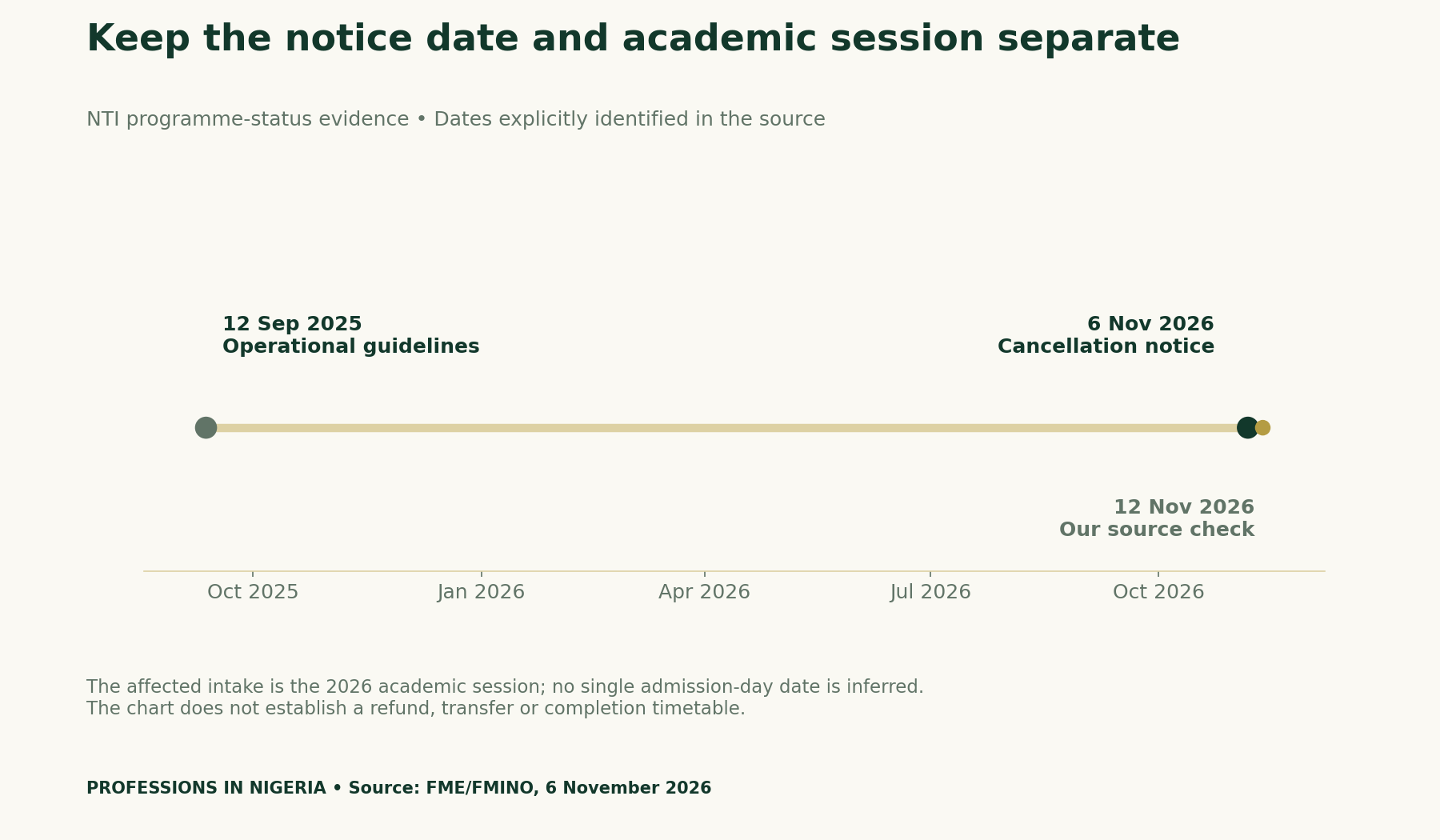
A search result labelled “2026” might refer to a session, an article’s publication year or an old advertisement that remains online. Therefore, save the source URL, publication date and retrieval date together. Check the document itself before treating a search snippet as current permission.
The timeline deliberately excludes an assumed first day of admissions. It also excludes refund and transfer deadlines: this source does not establish them. An attractive graphic should not turn an unknown date into a factual-looking milestone.
Verify a programme, not just an institution’s name
Our worksheet uses a simple matching rule. Write down the full award name, awarding body, study centre, delivery mode and admission session. Then compare that combination with current official evidence. Keep an unresolved question visible when the evidence does not settle it.
The NCCE’s official college directory is one starting point for identifying institutions. A directory entry alone does not establish the status of every programme, centre or intake. Similarly, the NUC’s approved-affiliations information should not be read as permission to ignore a later, specific government directive.
Ask for an answer that repeats your exact programme details. A general statement such as “our institution is recognised” leaves the original question unresolved. Record who supplied the clarification, its date and the official public reference supporting it.
| Check | Useful evidence question | What remains insufficient |
|---|---|---|
| Award | What exact qualification is being offered? | A general training-provider name. |
| Centre and mode | Does the current authorisation cover this centre and delivery route? | An unrelated centre’s approval. |
| Session | Does the notice cover this intake? | An undated advert or historic approval. |
| Professional registration | What does the relevant regulator require for this individual route? | A promise of automatic registration. |
What the three-to-six-month duration does—and does not—mean
The duration in the announcement belongs to a defined abridged route. It is not a general estimate for completing a teaching degree. Nor can it answer how long an existing learner must wait for an individual accreditation decision.
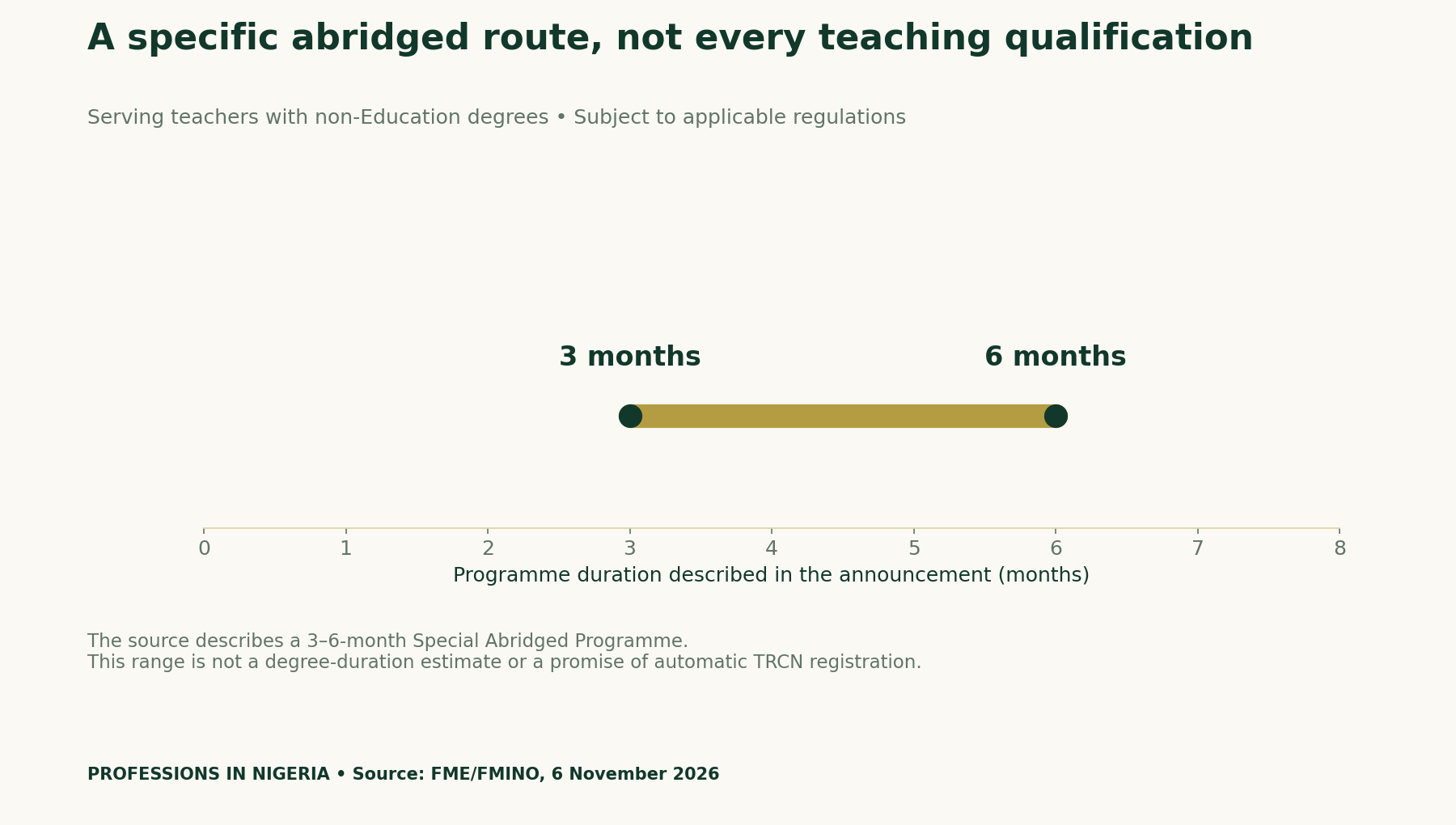
Professional registration is a separate decision. Consult the TRCN’s official registration guidance for the appropriate route and current requirements. Check those requirements directly rather than relying on a course seller’s description.
Qualification verification also differs from building classroom skills. Our digital teaching skills analysis explains why training participation does not by itself demonstrate classroom competence. The job qualification requirements guide offers a related method for checking a role’s actual entry conditions before pursuing further study.
Use the verification downloads privately
These files are editorial tools, not application forms or official accreditation decisions. The blank worksheet contains no real learner records. Use a private reference code and avoid placing identity documents, bank details or personal correspondence in public places.
- Programme-status source map (CSV): the three reader routes and their qualifications.
- Dated evidence and duration values (CSV): the exact inputs used in the charts.
- Blank programme verification sheet (CSV): a reusable private record for a specific route.
- Verification field definitions (CSV): what each field is intended to establish.
For example, a fictional prospective applicant might know the award name but have no centre-specific confirmation. Their next task is to resolve that evidence gap. It is not to mark every blank field as approved because an advertisement looks professional.
Methodology, limits and updates
We checked the ministry’s announcement and relevant regulator pages on 12 November 2026. We found no superseding notice in the recorded official-source checks. The source map retains the notice’s scope and conditions; the charts reproduce its explicit dates and duration range. We conducted no student survey, centre inspection or individual credential assessment.
This evidence does not establish the number of affected learners, tuition losses, refund arrangements or individual completion outcomes. The verification questions are our proposed method and have not been evaluated as a consumer-protection intervention.
Recheck the latest official notice before acting. If a new directive changes a route’s status, preserve the earlier record, add the new source and date, and revise the affected entry. Accurate NTI admissions accreditation Nigeria checks depend on specific, current evidence rather than a permanent yes-or-no label for an entire institution.


