




Procurement leadership skills in Nigeria include helping an institution define its need before it specifies a purchase. A complete file should explain the service problem, considered options, assumptions and unresolved questions. Buying an item on time does not by itself demonstrate that the item solved the original problem.
This report turns a new leadership statement into a fictional office-printing exercise. Two cost charts, an evidence-trail infographic and four CSV tools make the reasoning inspectable. The figures are invented units, not prices, supplier quotations or national savings estimates.
What the BPP leadership statement says
The 13 November 2026 BPP forum release describes a one-day Abuja event held on Thursday. It encourages procurement leaders to contribute earlier to institutional planning. The areas include needs, priorities, budgets and delivery options, before advertisement.
The release also identifies five leadership responsibilities. However, it supplies no participant denominator, measured saving or controlled evaluation. These are professional expectations, not five statistically proven success factors. Nor does the statement change legal permissions or replace applicable procurement rules.
Define a service need before naming the item
In our fictional office, users report repeated disruption when printing authorised routine documents. The decision question is how to provide an appropriate, reliable service within the institution’s actual constraints. “Buy a new printer” is one possible response, not the need itself.
First, ask what evidence supports the problem description. For example, a future authorised review could define a period and record disruption events consistently. It should distinguish equipment faults from consumable shortages, access issues and avoidable workflow problems. We have not collected those records or tested a device.
Next, identify the affected users, service requirements and applicable constraints. A mentor can ask whether an option meets access, information-handling, support and continuity needs. Leave an unanswered suitability question visible instead of assuming that a low cost resolves it.
Compare three fictional options over the same period
| Fictional option | One-off units | Annual recurring units | Three-year total |
|---|---|---|---|
| Maintain | 20 | 40 | 140 |
| Replace | 100 | 15 | 145 |
| Service arrangement | 10 | 50 | 160 |
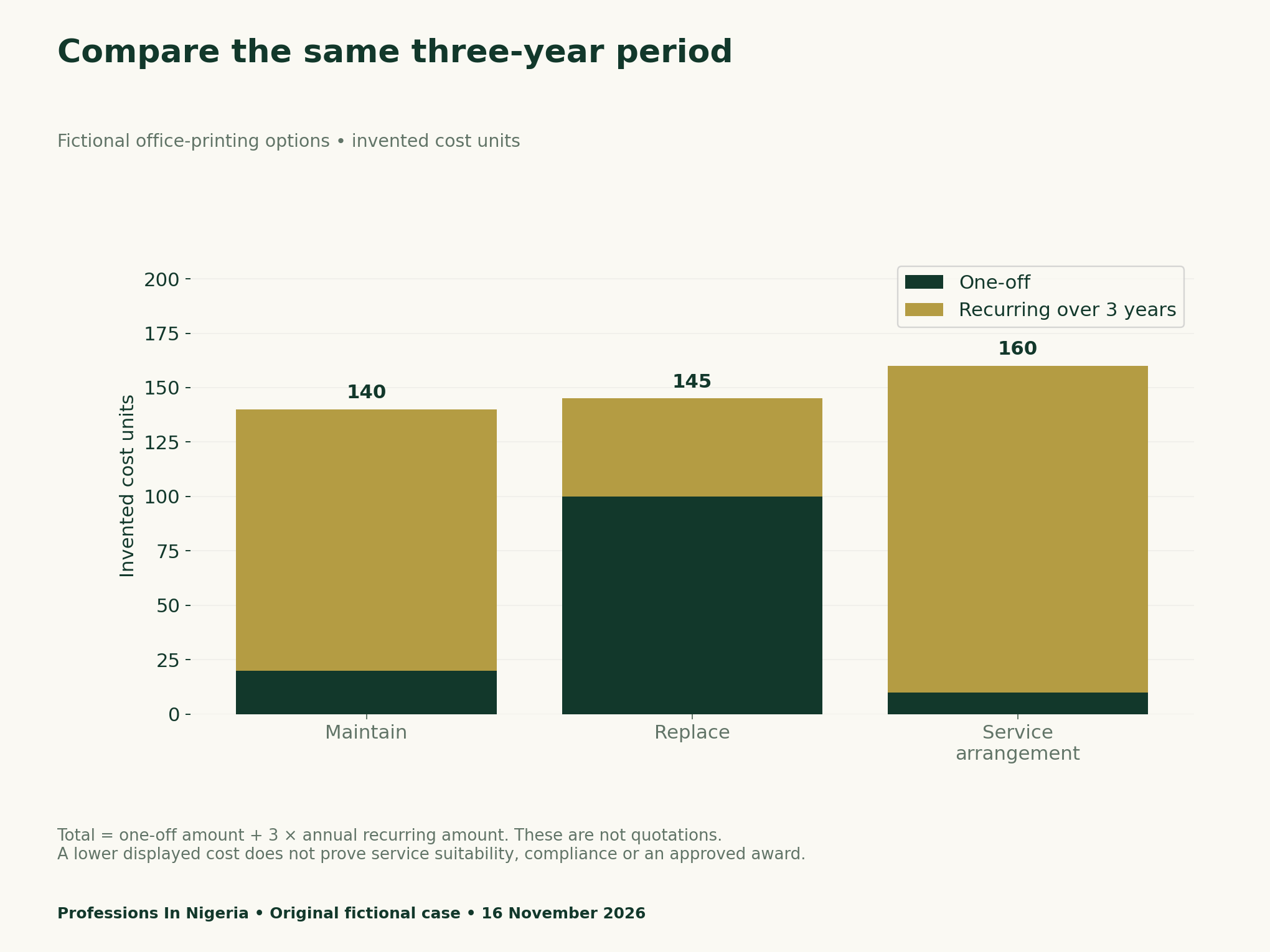
The formula is one-off amount + annual recurring amount × years. Thus, maintaining costs 20 + 40 × 3 = 140 invented units. Replacement totals 100 + 15 × 3 = 145, and the service arrangement totals 10 + 50 × 3 = 160.
At three years, maintaining has the lowest displayed cost by five units compared with replacement. That small arithmetic difference is not a measured saving. There is no actual baseline expenditure, observed performance, verified quotation or decision in this exercise.
Show what the comparison leaves out
List the cost boundary before discussing value. A real comparison might need installation, consumables, maintenance, support, transition arrangements and other relevant items. Each needs a justified source and period. Our fictional annual amounts are deliberately simple, not a complete procurement model.
Also record omitted financing, discounting, residual values and uncertain downtime costs. A missing amount is not automatically zero. If an option fails an essential service requirement, a low displayed total cannot rescue it. The appropriate reviewers must address those matters within the applicable process.
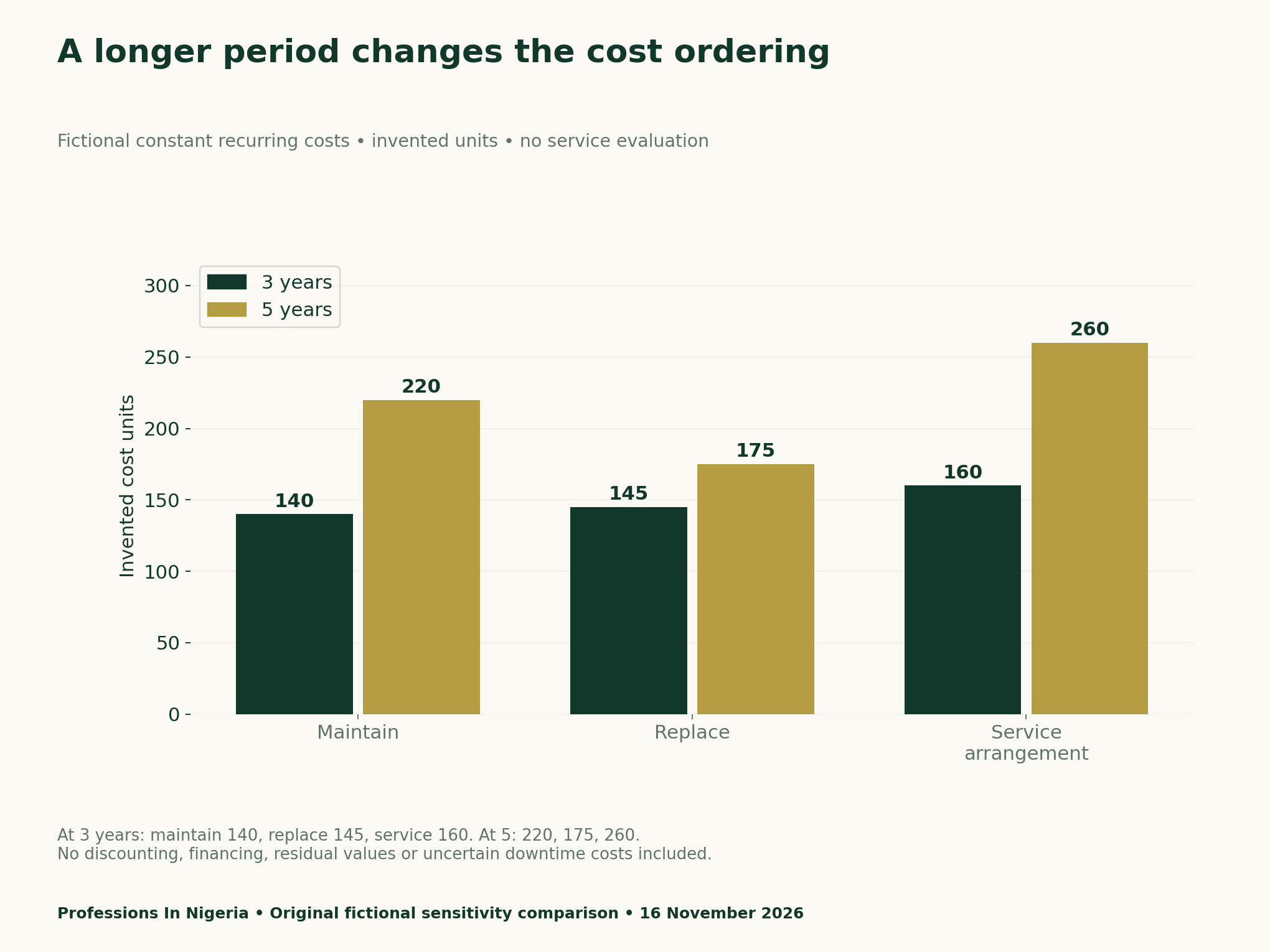
The five-year comparison makes the horizon visible. Maintaining totals 220, replacement 175 and the service arrangement 260. Therefore, replacement has the lower displayed five-year cost. An unexplained choice of period could conceal that change in ordering.
For a more detailed assumption exercise, see our feasibility sensitivity model. Its editable calculator shows how both a horizon and an annual cost can affect a limited arithmetic result.
Connect leadership responsibilities to work evidence
The matrix below is our editorial learning aid. It links the release’s responsibilities to proposed artifacts and mentor questions. It is not an official BPP assessment, certification rubric or evidence that a person is competent to conduct a real procurement.
| Responsibility | Proposed evidence | Mentor question |
|---|---|---|
| Integrity | Conflict/declaration and source record | Can someone trace the evidence and challenge it? |
| Strategic positioning | Need and service-outcome note | Does the proposed purchase address the actual need? |
| People and professional judgement | Mentor challenge and learning note | What judgement did the team test? |
| Change management | Implementation and user-feedback plan | How will people use the changed arrangement? |
| Accountability for results | Target, observation and unresolved-outcome log | Which results were actually measured? |
Use the questions to explain your contribution accurately. For instance, drafting a needs note differs from approving an award. A learning record should state what you actually did, who reviewed it and which matters remain unresolved. Do not imply an authority that the evidence does not support.
Separate proposed benefits from observed results
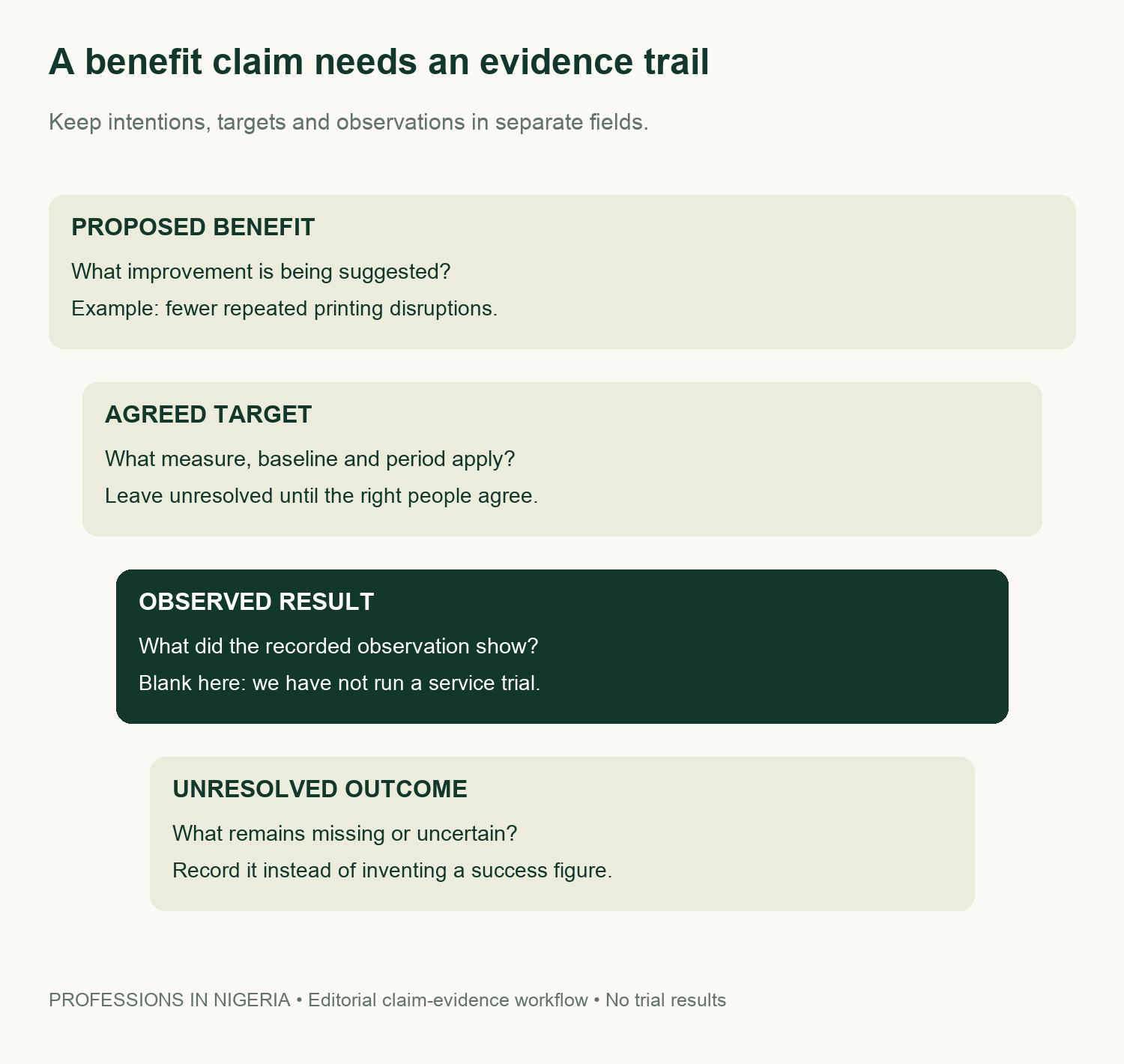
A proposed benefit is an intention, such as fewer repeated service disruptions. An agreed target needs a measure, a baseline and a period. An observed result then needs an actual record using those definitions. Until that exists, retain the outcome as unresolved.
For example, the fictional cost table cannot show that anyone saved time or improved service. It contains no user survey, equipment trial or spending observation. Also, a compliance record and a service-outcome record answer different questions; retain both where the applicable process requires them.
Prepare a pre-decision record for challenge
The decision register asks for the need, users, constraints, assumptions, exclusions and reviewer questions. Record why each option remains in scope and what could change the preliminary view. Then identify the people responsible for review and approval through the actual authorised process.
Keep confidential institutional information out of a public portfolio. Use this fictional case to demonstrate reasoning, and obtain appropriate permission before sharing any real work artifact. No real vendor selection, expenditure, supplier allegation or procurement commitment is proposed here.
Download the fictional case and blank registers
- Fictional printing inputs and whole-period totals (CSV)
- Blank pre-procurement decision register (CSV)
- Editorial responsibility-to-evidence matrix (CSV)
- Blank proposed-benefit and observation log (CSV)
These learning tools do not replace procurement law, official tender templates or professional oversight. Browse more dated analyses in Research & Reports.
Methodology and limitations
We checked the official forum release on 16 November 2026, preserved its professional-expectation framing and created an original fictional case. We calculated each total as the one-off input plus the stated number of annual amounts. The two charts show cost composition and period sensitivity without implying national savings.
No suppliers were contacted, quotations obtained, institutional data collected or service outcomes measured. The infographic and registers are editorial discussion aids. Two substantive charts are sufficient for this small case; extra plots would repeat the same invented information.


