




Short-term public works jobs in Nigeria need a duration check before a headline becomes a career plan. A temporary engagement can provide useful experience, but the number of people involved does not establish permanent posts, paid working days or employment after the programme. Read the terms and retain a clear work record.
This report uses a recent Ebonyi announcement to separate those measures. It includes a conditional duration chart, a four-measure infographic and four CSV tools. The planning worksheets contain no verified wage, attendance or post-programme findings.
Read the short-term public-works announcement with its limit
The Federal Information Centre report dated 13 November 2026 says FERMA engaged 50 local youths for one month in Ebonyi’s second preventive-maintenance phase. The listed activities are vegetation clearance, drainage desilting and pothole patching. A similar first phase occurred two months earlier.
The release does not supply wages, exact start and end dates, hours, paid days, selection criteria or a new application route. It reports an engagement, not 50 currently open vacancies. We therefore cannot tell readers how to apply, calculate a payment or assume an extension from this announcement.
People and person-months are different units
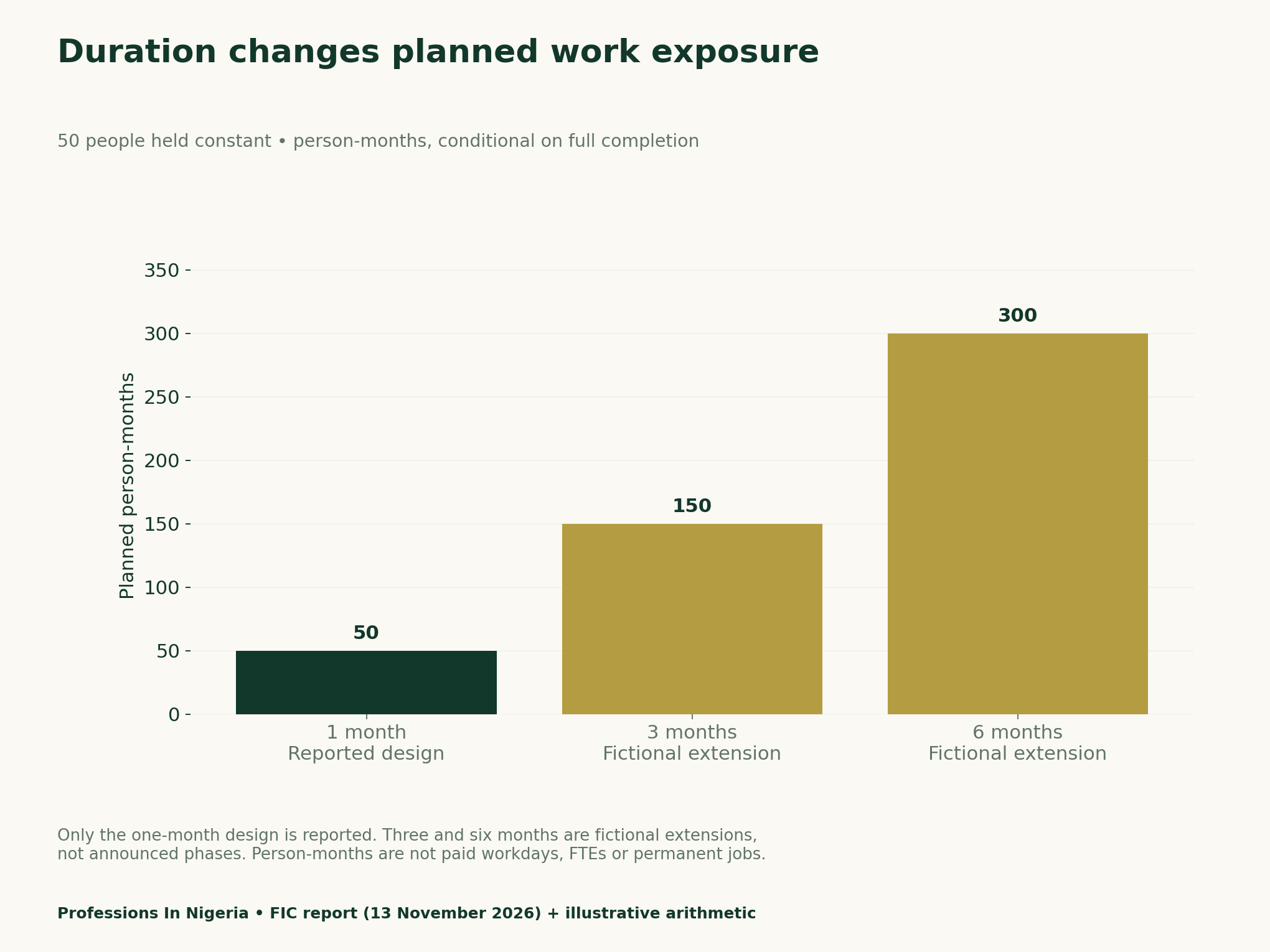
Person-months combine a headcount with a duration. At the stated design level, 50 people × one month gives 50 planned person-months if everyone completes the month. The calculation does not establish a full-time work pattern, 1,500 paid days or an annual job-creation total.
The fictional extensions show why the duration belongs beside the headcount. Holding people constant while changing months changes planned exposure. It still does not answer how often someone works, whether each day is paid or what happens after the engagement ends. Those need separate evidence.
Keep four employment measures separate
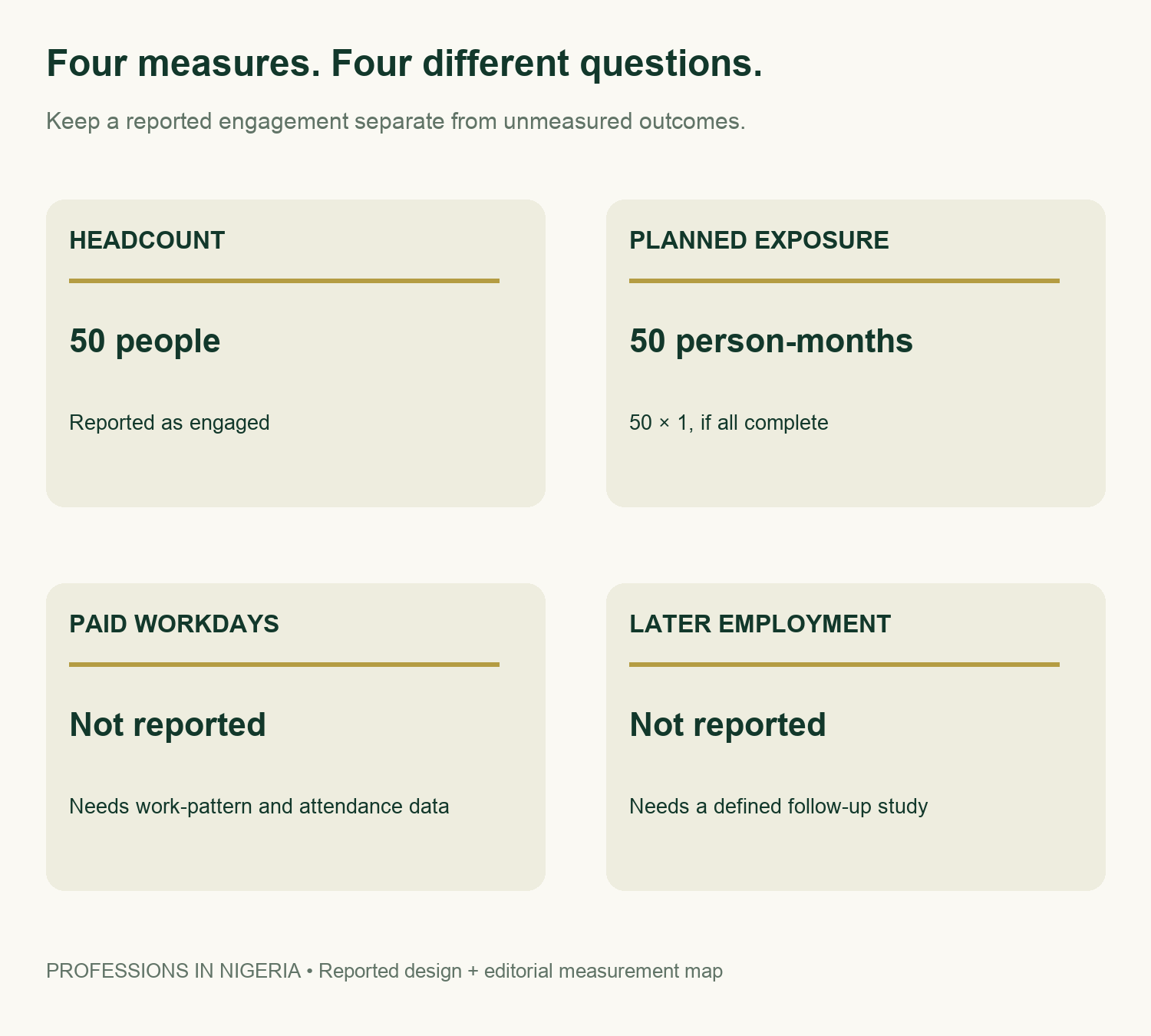
Think of each measure as a question with its own record. Who did the programme engage? How long did it plan to run? Which days did people actually work and receive pay for? Finally, what happened in a defined later period? A single number cannot answer all four.
This distinction also helps when discussing your own experience. You can describe a verified contribution during a temporary engagement without calling it permanent employment. Keep the actual dates and role boundaries visible. A careful account can be more credible than a broad title that the records cannot support.
Clarify the terms through the authorised contact
First, start with the named employer or programme contact and the person who supervises your assigned work. Ask who can confirm the role, dates, work pattern and payment basis. Then retain a dated record of the answer through an appropriate channel. Do not use a news headline as a substitute for those terms.
The terms worksheet leaves the details blank. It asks about the start and end dates, hours, paid-day arrangements and payment timing. A blank is an unresolved question, not a zero payment or proof of misconduct. Record what is confirmed and what still needs an answer.
Also ask about authorised induction, supervision and equipment provision. This article does not teach road-maintenance procedures. Participation in hazardous work requires the appropriate arrangements for the actual task; a general planning worksheet cannot establish readiness or authorise deployment.
Build a participation record that someone can verify
Also, keep a simple private record of the dates attended, task category and contribution. Where appropriate, obtain confirmation through the programme’s normal supervisory process. Distinguish work performed from training attended and from activities you only observed.
Use clear, bounded wording. “Maintained a daily participation record under supervision” describes evidence you could show if accurate. A claim to have designed or approved an engineering solution needs different authority and proof. Supervised participation does not itself confer a professional engineering licence.
Avoid collecting unnecessary personal information. Do not publish attendance sheets, worker identifiers, private contact details or confidential site records as portfolio material. Use a redacted or fictional example when explaining the method publicly, and retain any legitimate employment documents securely.
Plan the transition without assuming renewal
A useful next-step plan can begin before a temporary engagement ends. Identify which contribution you can document, which training you received and who may provide an appropriate reference. Keep these items separate from a promise of future work.
Check a next opportunity through its official source. Record the role, requirements, location, application route and live status. If there is no verified opening, retain it as a lead rather than describe it as a job offer. Do not assume that participation guarantees selection elsewhere.
You may also identify a specific practice need. Connect it to a task you actually performed or found difficult, then choose a proportionate next activity. Our office task-diagnostic kit shows how to keep evidence of an error separate from confidence and access barriers.
What a later outcome study would need
A follow-up study should define the contact date and the outcome question before counting results. Record how many people were contacted, how many responded and which respondents completed the engagement. Then define subsequent paid work within an explicit period.
Nonresponse is not evidence of unemployment. Similarly, later work is not automatically caused by participation. A descriptive follow-up can report what respondents say, but it needs a stronger design to estimate a programme effect. We have not contacted workers or conducted such a study.
Keep unknown outcomes visibly unknown. This avoids turning an announced objective into a measured result. It also gives a future reviewer a clear list of the evidence that would be needed, rather than a number built from assumptions.
Download the duration and work-record tools
- Source measures, conditional calculation and unknowns (CSV)
- Reported design and fictional duration scenarios (CSV)
- Blank terms and participation record (CSV)
- Blank transition and follow-up planning worksheet (CSV)
Use the blank tools for a private, authorised discussion. They are not application forms, official programme records or a promise of employment. Find more dated evidence-led articles in Research & Reports.
Methodology and limitations
We read the dated FIC announcement on 16 November 2026 and separated its reported design from our arithmetic and fictional extensions. No attendance, payroll, contract or worker-outcome records were available. The source does not support a wage estimate, a renewal claim or an application instruction.
The chart has one reported-design case and two explicitly fictional extensions. The four-part infographic is a measurement explanation. Our blank worksheets propose a record-keeping method; no worker outreach, safety assessment, reference request or job application was performed. One substantive chart is appropriate because the verified announcement contains very few quantitative measures.


