




Primary healthcare staffing numbers in Nigeria describe different activities and populations. People recruited, people trained and facilities meeting a headcount threshold are not interchangeable measures. None alone tells you who will be available for a particular shift at a particular workplace.
This report reads the Health Ministry’s new workforce figures with their scope intact. It includes a facility-threshold chart, a fictional availability infographic and four CSV tools. The practical aim is to prepare better questions for an authorised job or workforce discussion, without prescribing clinical staffing levels.
Keep the publication date and event date separate
The Health Ministry keynote was posted on 13 November 2026 and carries a 10 November event dateline. Paragraph 13 reports the workforce counts and the facility-threshold comparison used here. These are ministry-reported administrative achievements, not figures we independently audited.
The FIC summary dated 10 November also reports the measures. Its community-health-worker wording is “engaged”, while the speech says “recruited”. We retain that distinction in the source register rather than assuming a precise contract type from either description.
Read three workforce counts without adding them
| Reported measure | Count | Stated coverage |
|---|---|---|
| Skilled birth attendants recruited | 19,758 | 22 states |
| Community health workers recruited / engaged | 4,747 | 10 states |
| Frontline health workers trained | 78,054 | Frontline workforce; distinct-person rules not supplied |
Recruitment and training answer different questions. A worker may appear in more than one activity, and the release does not provide an overlap rule. Therefore, adding the three counts would not establish how many distinct people joined or remained in the workforce.
Similarly, the state counts describe the stated coverage of each reported activity. They do not justify an equal per-state allocation. Nor do these figures identify a vacancy, pay rate, retention outcome or the working conditions at any named facility.
What the 12% to 91% comparison covers
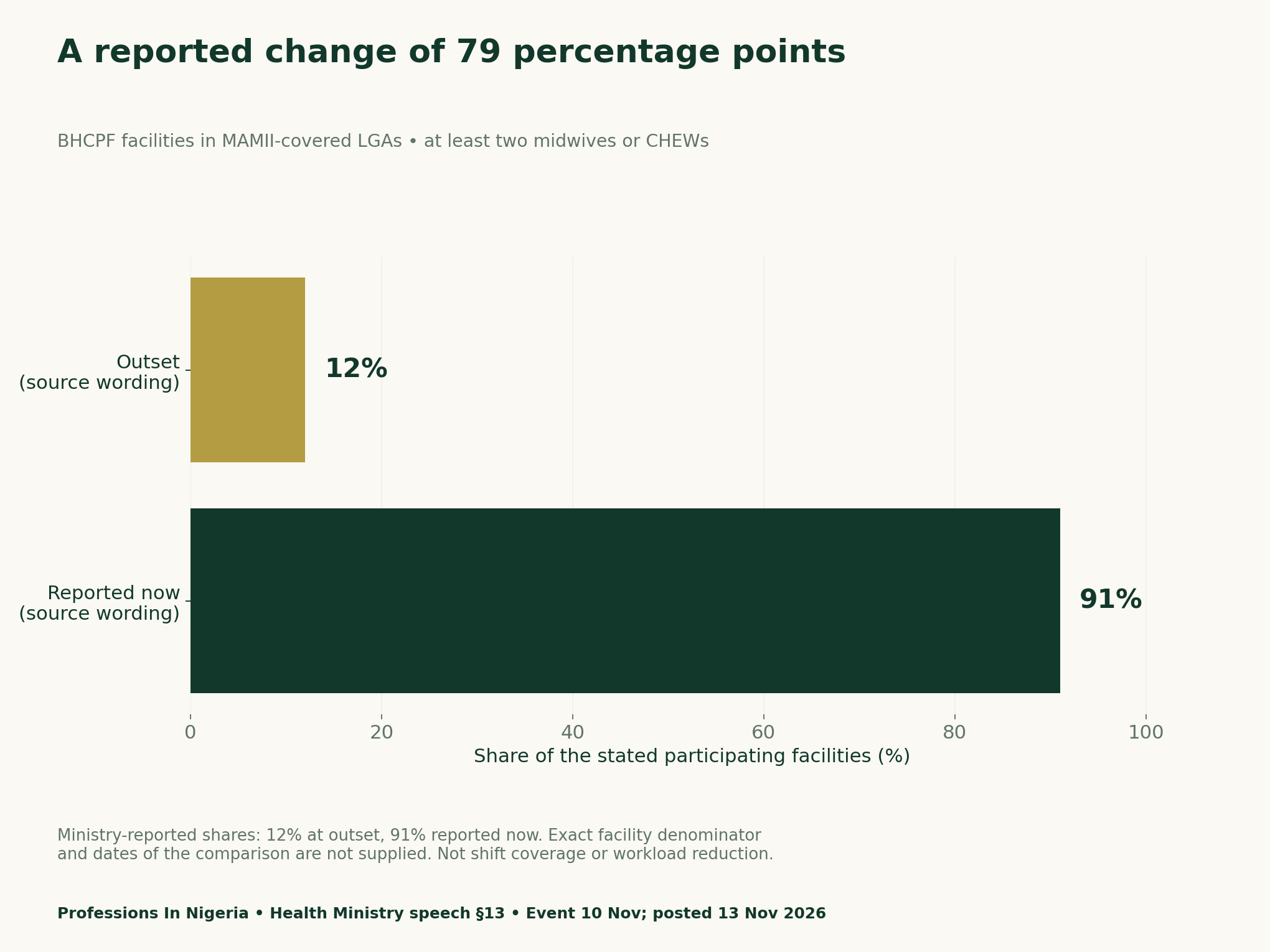
The scope matters. The speech places this comparison in local government areas covered by the Maternal and Newborn Mortality Reduction Innovation Initiative, or MAMII. It refers to BHCPF facilities within those areas. We do not relabel that subset as all primary healthcare facilities in Nigeria.
Subtracting 12 from 91 gives 79 percentage points. That is a difference between two reported shares. It is not 79 additional workers, a 79% workload reduction or an estimate of care quality. Without the denominator, we also cannot calculate the number of facilities represented by the change.
The source uses “at the outset” and “now” without exact dates for these two values. The chart therefore retains those labels and avoids a fabricated annual trend. A publication date does not automatically become the reference date of every underlying indicator.
A nominal roster is not a shift-availability record
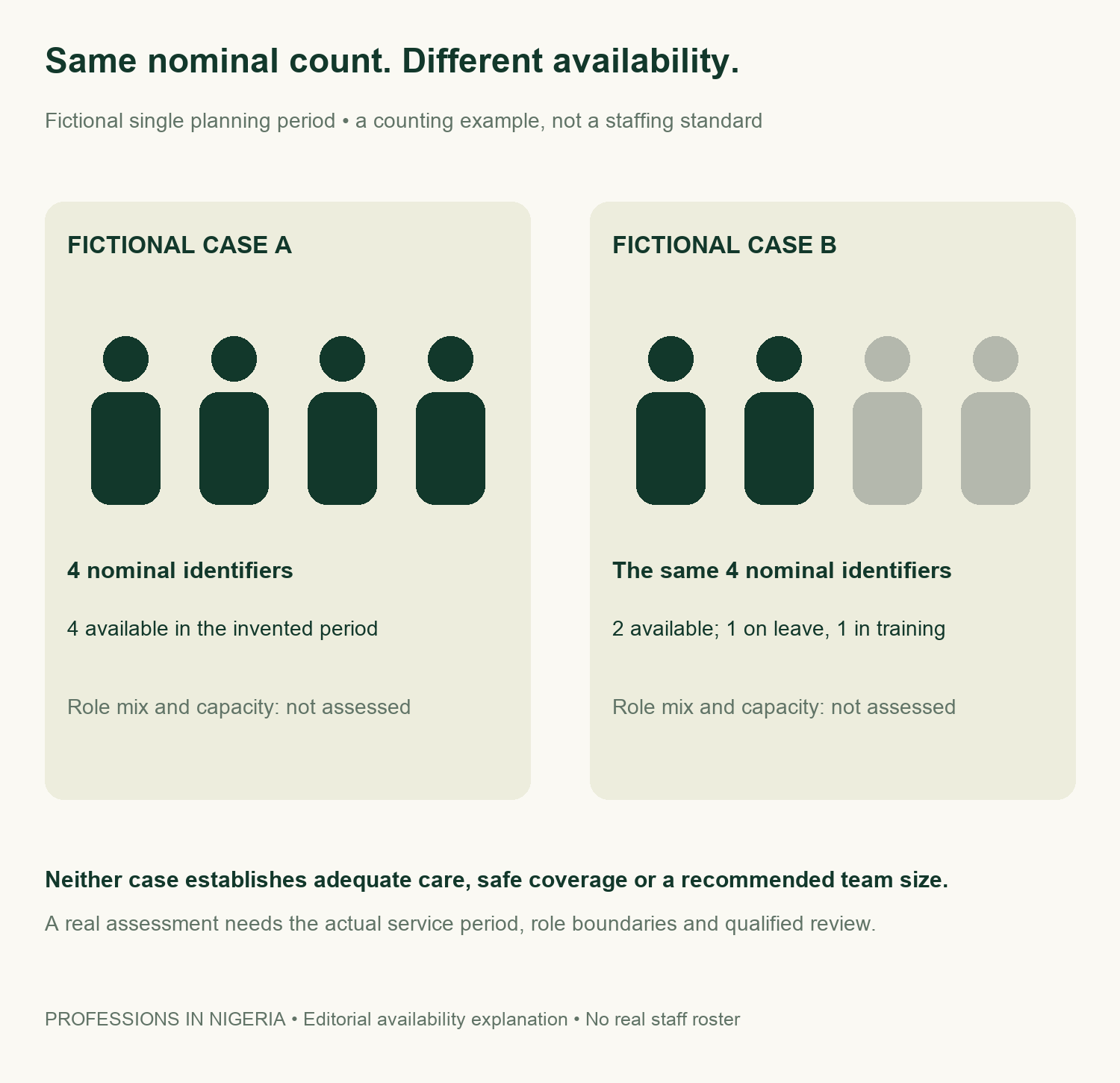
A nominal list tells you which people or roles appear on a roster. An availability record asks who is actually planned to be available during a defined period. Leave, training, work patterns and other authorised arrangements can make the counts differ.
However, a count of available people still does not establish capacity or safety. Role boundaries, supervision, the service being provided and the actual setting matter. Our diagram isolates the counting distinction. It is not a model for organising care or assigning clinical work.
Ask facility-specific questions through the authorised employer
First, clarify the actual role, location and expected work pattern. Ask which shifts apply and who can confirm the terms. A national progress figure cannot answer those questions for your offer or placement. Retain a dated account of the information you are authorised to receive.
Next, ask about supervision and induction. Who provides role-specific support? What is the appropriate escalation route? How does the institution assign duties within the relevant role boundaries? These are questions for the actual employer and qualified supervisors, not assumptions to fill from a headline.
Also discuss how the institution covers planned leave, training and unexpected absence. The answer may identify further questions rather than provide a simple reassuring number. Record an unresolved point as unresolved. Missing information does not prove either unsafe conditions or adequate coverage.
Use the availability worksheet as a discussion aid
The worksheet contains two fictional cases and a blank planning row. Define the period before entering availability. Keep nominal status, availability, absence reason, role boundary and authorised escalation contact in separate fields. The example identifiers do not represent actual workers.
For a real internal discussion, follow the institution’s access and information-handling arrangements. Do not collect patient information or publish staff rosters, personal contact details or sensitive absence records. A public portfolio can use the fictional worksheet without revealing anyone’s workplace information.
If an issue requires a safe-staffing assessment, refer it to the appropriate qualified authority with the actual context. This article neither sets a staffing ratio nor authorises a care model. The blank tool cannot substitute for that assessment.
Distinguish an activity count from a measured outcome
Recruitment, training and deployment are related but separate stages. To evaluate retention, for example, a study would need a defined starting population, follow-up date and retained-worker rule. To assess shift availability, it would need a defined service period and current authorised information.
The speech does not supply those inputs for the workforce counts used here. Consequently, we do not estimate vacancies, migration, burnout or retention from them. We also do not treat the release as an open recruitment notice. For another example of keeping duration and outcomes separate, read our temporary-work measurement guide.
Download the indicator register and discussion tools
- Workforce indicator register with scope and date limits (CSV)
- Facility-threshold shares and percentage-point arithmetic (CSV)
- Fictional examples and blank availability worksheet (CSV)
- Facility-specific job-discussion checklist (CSV)
Keep the source, period, population and unit beside any figure you reuse. Browse further dated reports in Research & Reports.
Methodology and limitations
We checked the ministry speech and the FIC summary on 16 November 2026. The source register preserves the 13 November posting date, 10 November event date, stated state coverage and MAMII/BHCPF subset. The sole derived source statistic is 91 − 12 = 79 percentage points.
The source does not provide exact facility denominators, a precise common measurement window, staff-overlap rules or facility rosters. One substantive chart is appropriate for the comparable two-point share. We leave the incompatible workforce activity counts in a qualified table rather than imply an additive total. The availability example is fictional and non-clinical; no worker survey or facility assessment occurred.


