







Bank technology leadership responsibilities in Nigeria need more definition than an executive title. Before evaluating a role, ask which decisions you would own, who approves them and which delivery teams you depend on. A broad mandate can describe the desired outcome while leaving the authority, resources and evidence requirements unclear.
An Access Holdings announcement offers a concrete starting point. It explains a move of executive technology responsibility into Access Bank and states intended benefits. This guide reads that disclosed mandate carefully, then provides an original blank decision-rights matrix and metric-definition worksheet. The fictional example does not describe undisclosed arrangements at the bank.
Read the appointment dates and organisational move precisely
The NGX-hosted Access Holdings filing dated October 31, 2026 records Oluseyi Kumapayi’s appointment as Deputy Managing Director, African Subsidiaries, effective October 27. It records Olanrewaju Bamisebi’s appointment as Executive Director, Information Technology and Digitalisation, effective October 28. Bamisebi moves from Access Holdings to Access Bank.
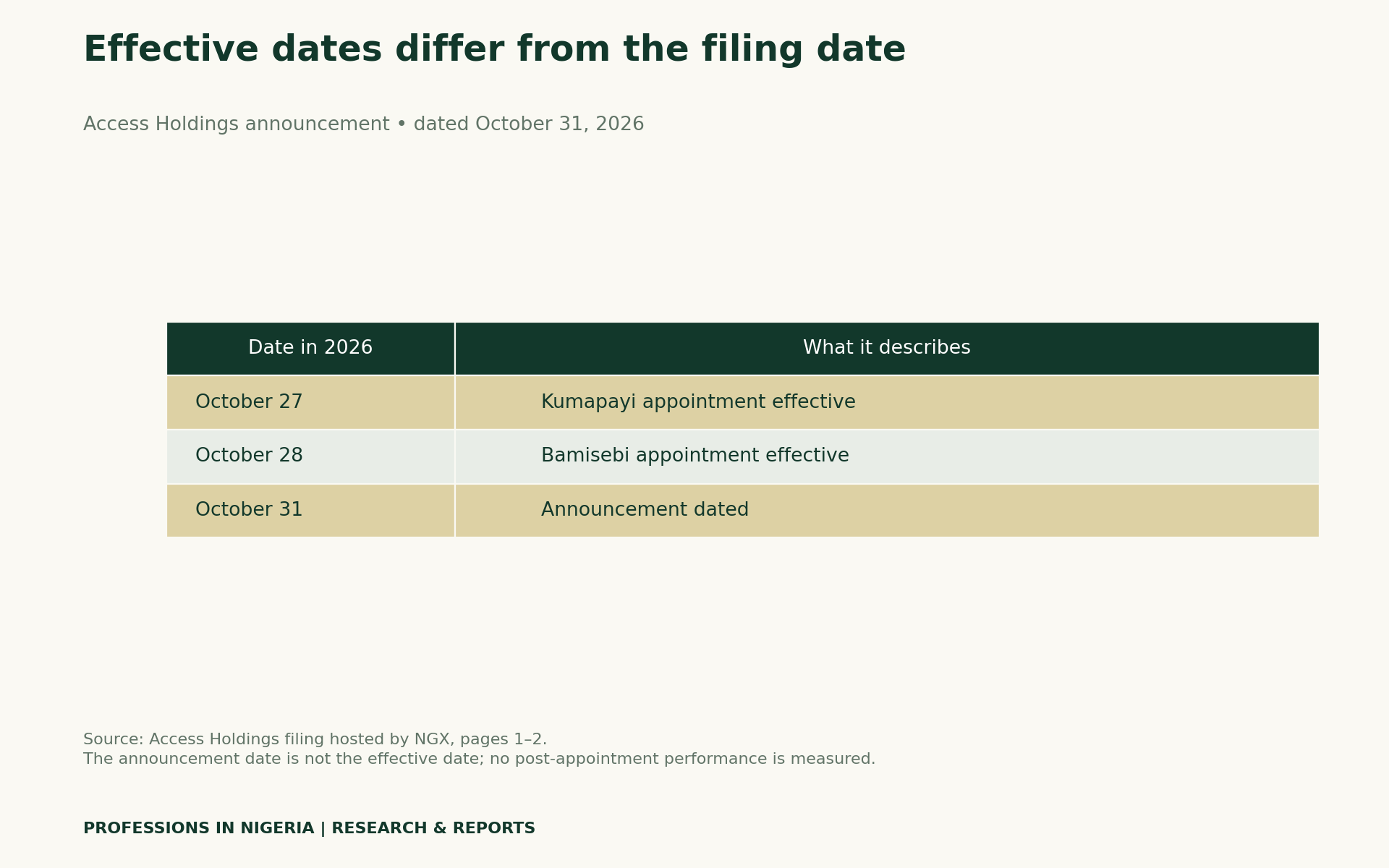
The filing links the technology move to banking operations, efficiency, resilience and customer experience. These are disclosed priorities and intended benefits, not demonstrated improvements after the appointment. Its biographies describe Kumapayi as having over 25 years of banking experience and Bamisebi as having over 20 years of experience; the filing dates Kumapayi’s Group CFO service to 2007–2020.
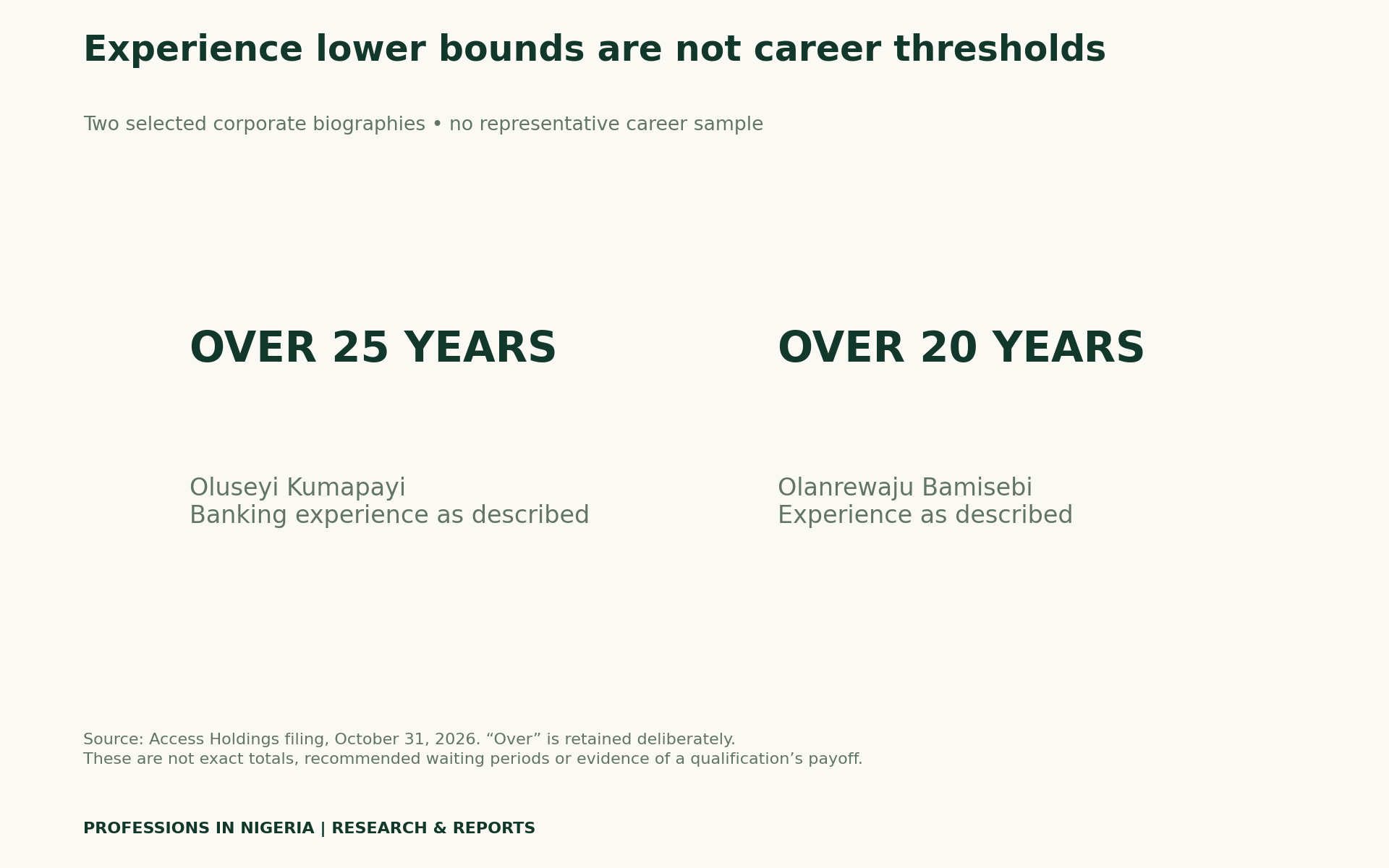
Those two selected profiles are not a representative career dataset. They cannot establish how long another person should wait, what a qualification will earn or the probability of reaching an executive position. Use them to understand the disclosed cases, not to rank courses, predict pay or infer a universal promotion path.
Bank technology leadership responsibilities in Nigeria: five questions
For a role you are actually considering, separate five issues: accountable owner, approval authority, delivery partner, escalation route and evidence requirement. A person can be responsible for a roadmap while depending on another team for budget, risk approval, operational capacity or implementation. Ask who resolves those dependencies before assuming the title grants control over them.
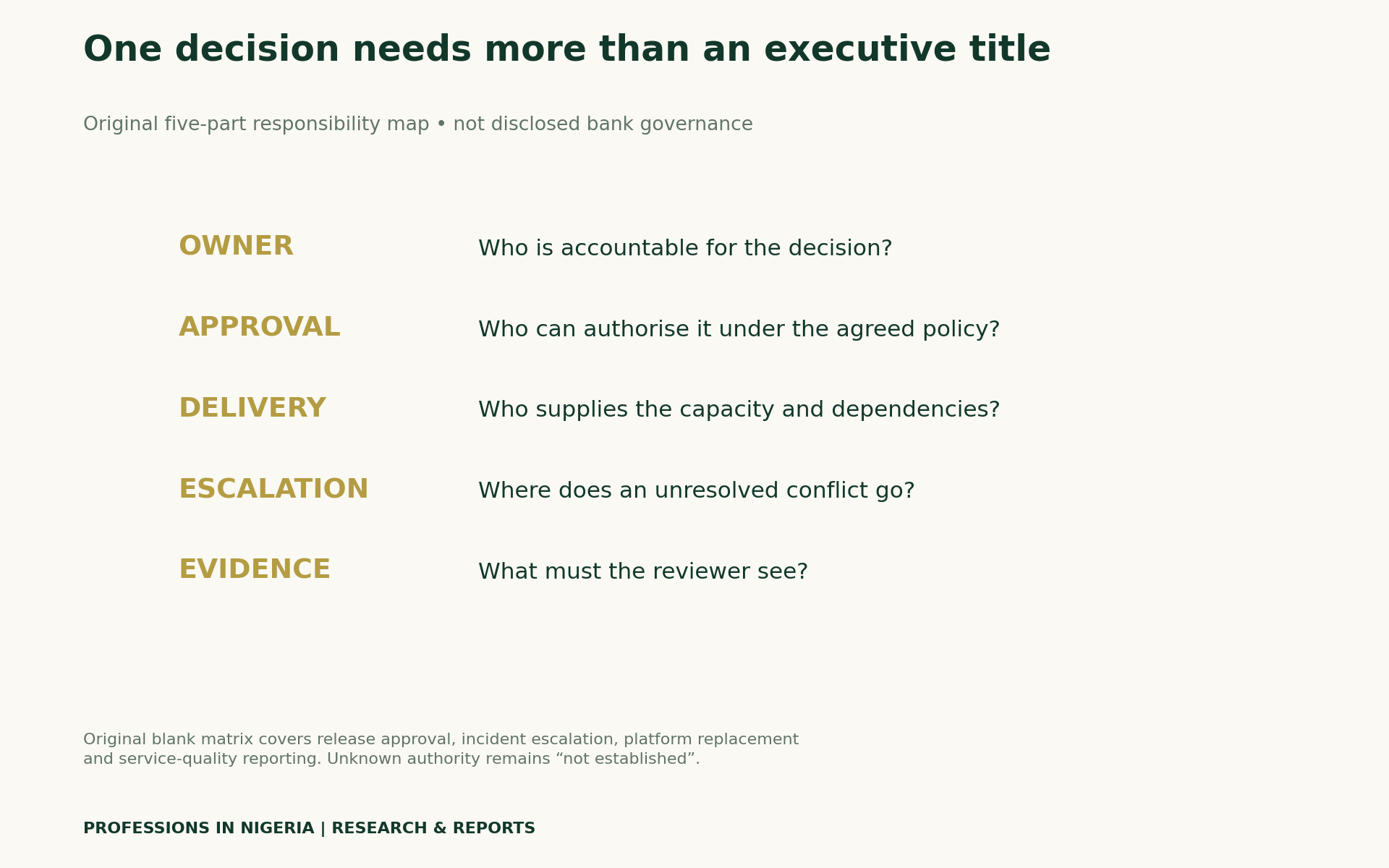
The blank matrix uses four decision areas: release approval, incident escalation, platform replacement and service-quality reporting. Each row asks for the five responsibility fields and a status. Leave an unknown arrangement marked “not established.” A neatly filled table is less useful than an honest record of what still needs clarification.
Release approval raises a policy question: who can authorise the change? Incident escalation needs a response coordinator and a route for unresolved conflicts. A platform replacement requires clarity about inherited commitments and delivery dependencies. Finally, service-quality reporting needs a definition and reviewer that make the result meaningful.
Use a fictional matrix example without guessing bank governance
Our fictional release row names a service owner, a change approver under an agreed policy, a release team and an operations lead for escalation. It proposes test results, a risk note and a rollback plan as evidence for discussion. These are invented role labels in a teaching example, not Access Bank’s actual approval chain or a recommendation to override an organisation’s policy.
The point is to make a conversation concrete. If the owner is accountable for a result but cannot obtain the needed decision or delivery capacity, ask who manages that dependency and how. Do not assume a specific answer. A candidate needs the role’s actual arrangements, documented through appropriate channels, before evaluating whether the mandate and resources fit.

Define a service metric before comparing performance
For a hypothetical transaction-success ratio, divide eligible successful transactions by eligible attempted transactions, then multiply by 100. That formula alone is incomplete. The worksheet also asks for the business purpose, measurement period, source system, exclusions and reviewer. This guide supplies no bank transaction volumes, calculated rate or performance benchmark.
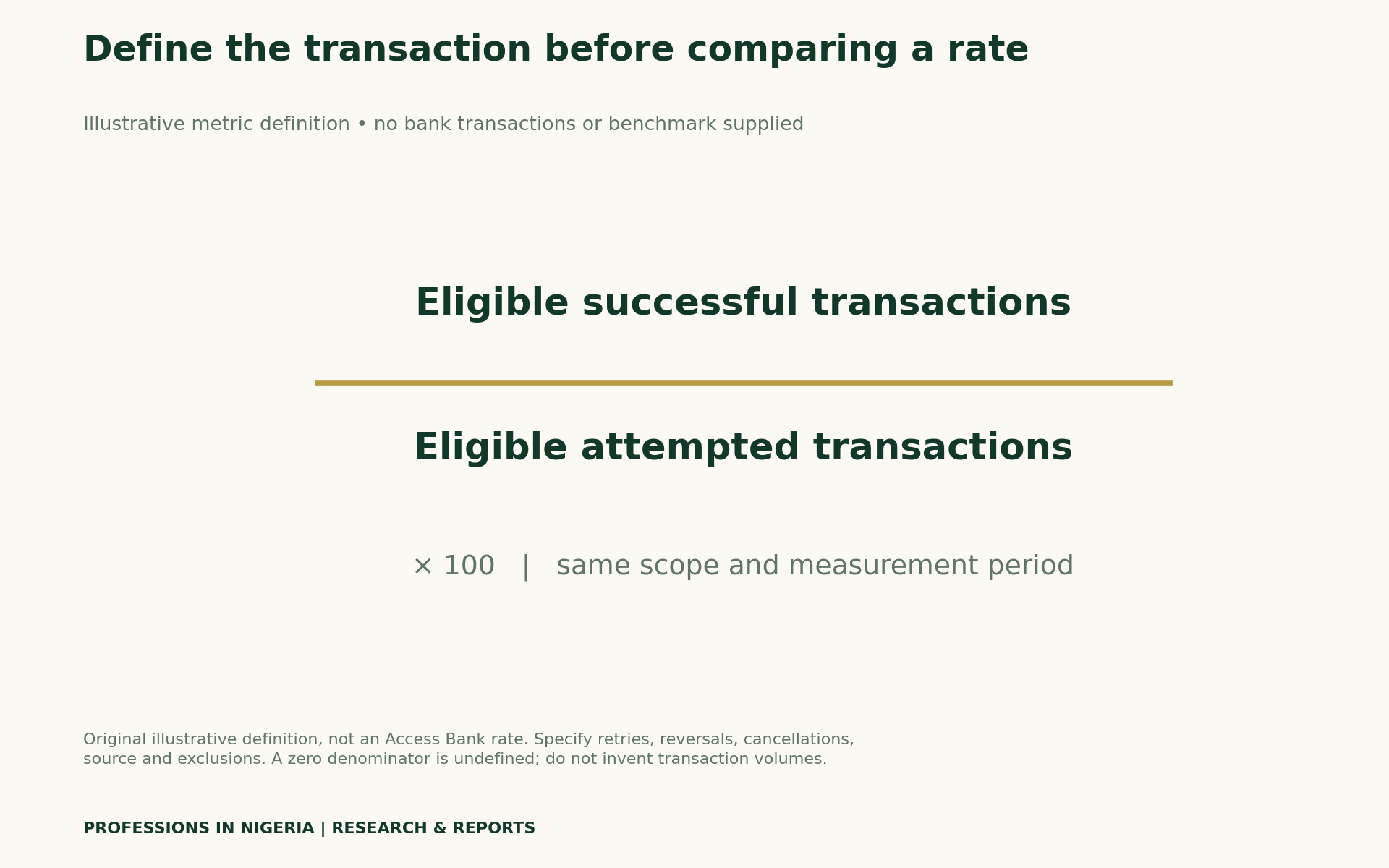
Decide how to count retries before comparing periods. Explain whether a reversal changes the success classification and how a user cancellation enters the denominator. These choices can change what the ratio means. Keep the rules consistent or describe the change explicitly. If the denominator is zero, the ratio is undefined rather than a zero-percent outcome.
Also, ask what a single ratio leaves out. An aggregate can conceal differences between services, periods or transaction types. A useful discussion names the scope and the question being answered. It does not invent additional measures or confidential data to make an interview example look more sophisticated. Use synthetic or authorised material and label it clearly.
Turn the disclosed mandate into due-diligence questions
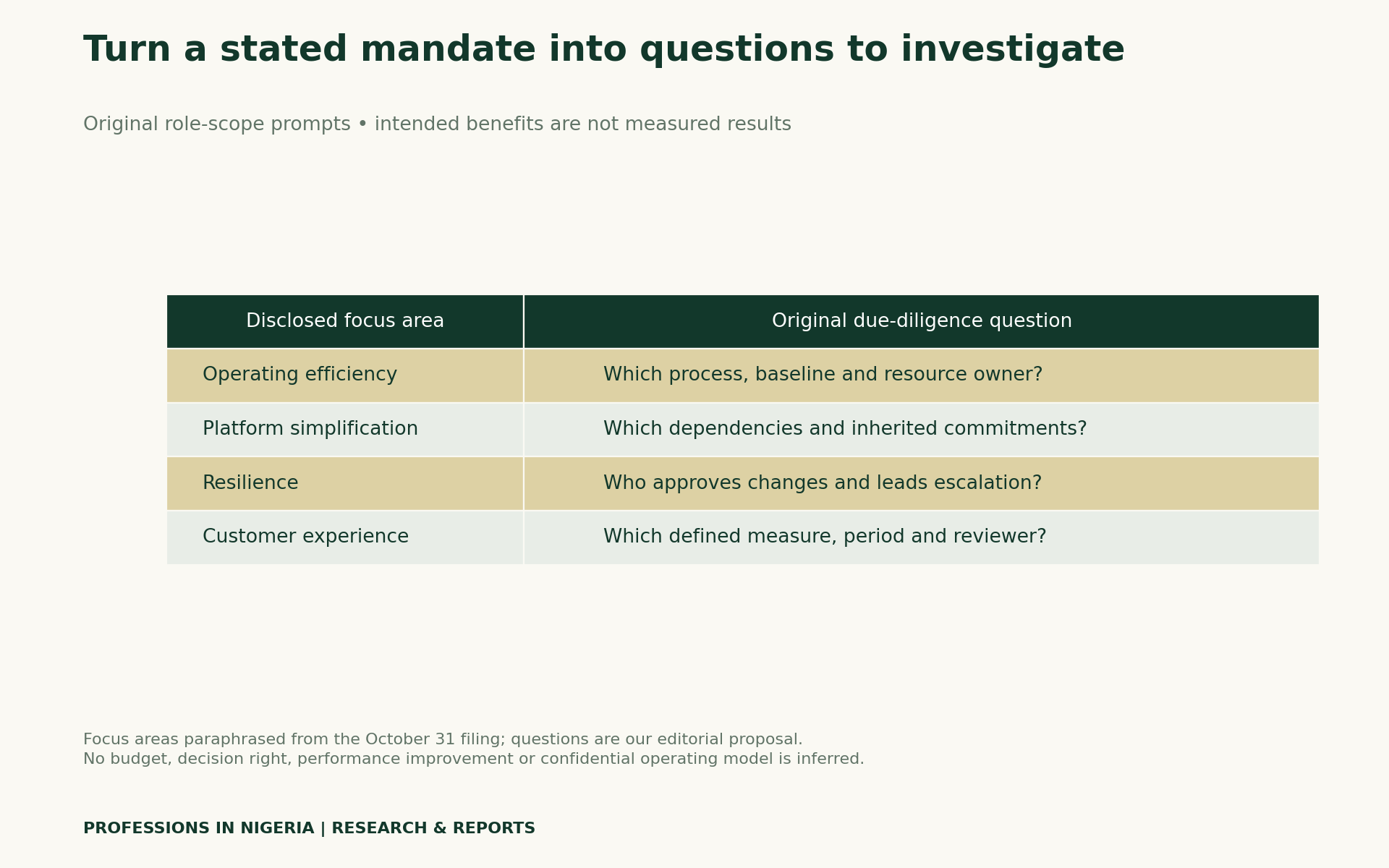
Begin with efficiency: which process and baseline define the expected improvement? Then examine platform simplification: which systems and inherited commitments fall within the role? Resilience requires questions about change approval and escalation. Finally, customer experience needs a measure, period and reviewer to establish whether the intended benefit occurred.
Budget authority deserves a direct question too: who controls the resource decision, what commitments already exist and who resolves competing priorities? A candidate should understand the answer without demanding confidential documents in a public conversation. Record the information you can appropriately discuss and identify the remaining questions for the authorised review process.
A professional-development exercise can use a fictional matrix and explain its limitations to a nontechnical reviewer. That shows how you reason about ownership and evidence. It does not establish that you have held the real role or delivered the bank’s intended outcomes. Our evidence-pack guide offers another way to distinguish learning practice from authorised professional responsibility.
Download the filing facts and role-scope worksheets
Download the appointment and biography facts (CSV), blank responsibility matrix (CSV), fictional release-decision example (CSV), and blank metric-definition worksheet (CSV). These are original professional-learning resources, not corporate governance documents or investment advice.
Research checked November 3, 2026. We retained the two-page NGX-hosted filing, checked the effective dates and preserved the experience descriptions as lower bounds. We did not infer salary, new hiring demand, promotion probability, qualification returns or causal performance improvement. The matrices, prompts and illustrative metric are editorial proposals; we analysed no actual bank transactions or undisclosed operating arrangements.
Suggested citation: Professions In Nigeria, “Nigerian Bank IT Leadership: Assess Role Scope Before Chasing an Executive Title,” November 3, 2026. Attribute appointment facts and the stated mandate to Access Holdings’ October 31 filing, and identify the blank tools and fictional example as original editorial resources.


