







BPP procurement training practical skills should be visible in the work a learner can explain. A completion certificate records a learning milestone. A useful evidence pack shows how you identify a requirement, find its supporting document and escalate an unresolved gap. Those are different forms of evidence, and none guarantees a government contract.
For Nigerian procurement assistants, administrative professionals and bid coordinators, the practical question is what to produce after the lessons. This guide proposes a five-part learning exercise, a wholly fictional worked example and four downloadable CSV tools. It does not reproduce the portal’s curriculum or assess a real supplier’s eligibility.
What the BPP announcement actually establishes
The BPP release published by the Federal Ministry of Information on October 28, 2026 describes a free digital learning portal launched on Tuesday, October 27. It announces five interactive modules, practical examples, quizzes and a completion certificate. It also describes access through computers, tablets and smartphones, including limited-connectivity users.
These are announced features, not independent test results. We have not completed the portal, tested its connectivity performance or evaluated its assessments. The release itself distinguishes training from a guaranteed award. Therefore, this article makes no claim about accreditation, procurement authority, salary gains, employment or contract-win outcomes.
Turn lessons into a five-part evidence pack
Our five parts are editorial exercises, not the official BPP module titles. Begin with an opportunity summary, then create a requirement checklist. Add a document-expiry register, a clarification log and a submission/version register. Each artifact answers a different question and should refer back to the permitted notice used for practice.
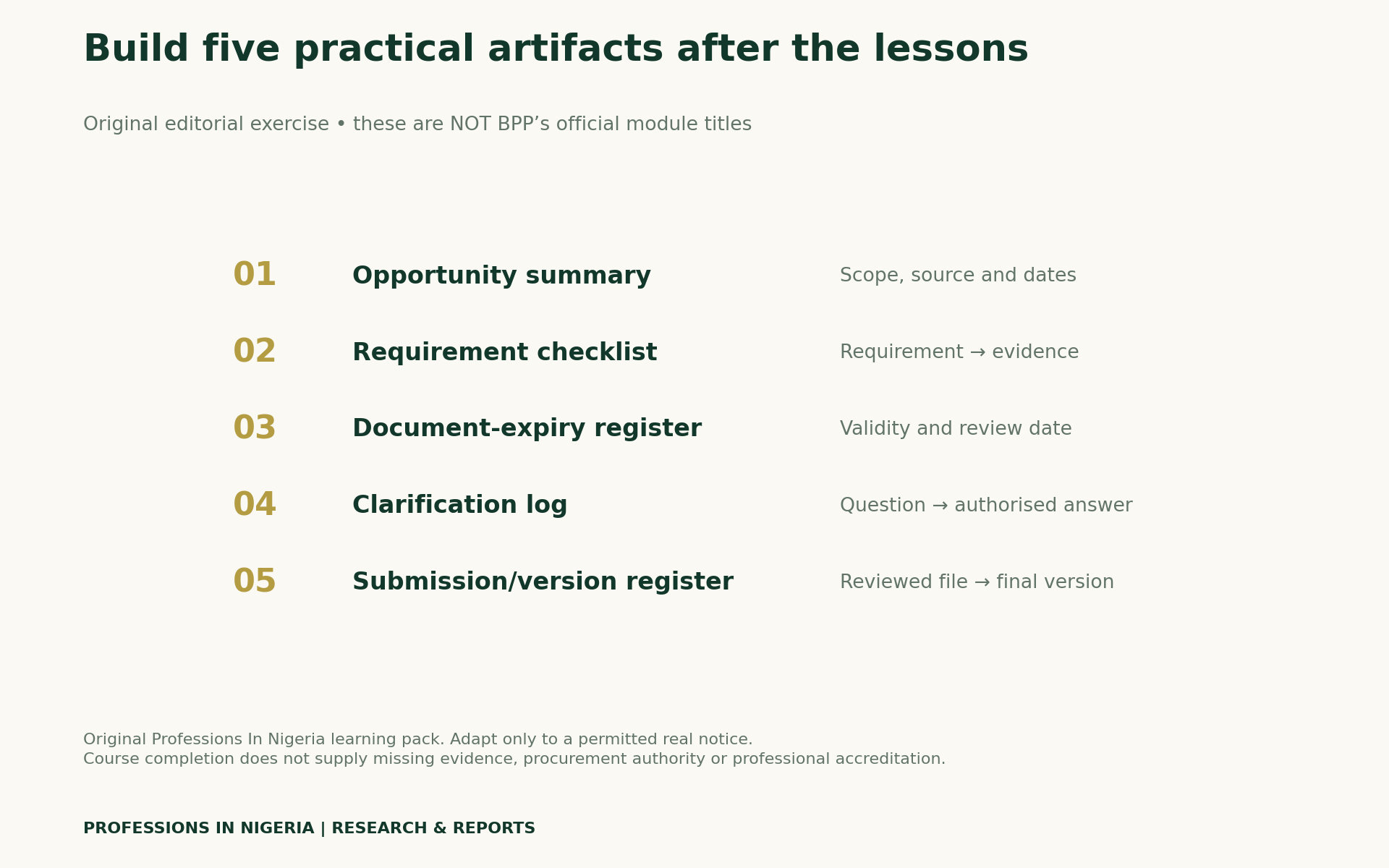
| Artifact | Practical question | Evidence to retain |
|---|---|---|
| Opportunity summary | What is requested, and by when? | Source, scope, dates and unresolved assumptions |
| Requirement checklist | What supports each requirement? | Notice paragraph, owner and evidence location |
| Document-expiry register | Is the document valid for this use? | Validity dates and authorised review |
| Clarification log | Who can resolve the question? | Question, route, answer and date |
| Submission/version register | Which file was reviewed? | Version, reviewer, decision and final-file location |
Use synthetic records for a public portfolio. For a real workplace exercise, obtain permission and keep confidential material in the appropriate private system. A learner can demonstrate the method with invented supplier details without publishing signatures, commercial prices, identity documents or private contact information.
A fictional bid with one missing mandatory item
Every tender requirement, supplier record, file path and deadline in the following example is invented. The exercise has six mandatory requirements. Five have verified supporting evidence; the technical-conformance evidence for R03 is unavailable. Four optional documents are complete. These categories belong only to this teaching scenario.
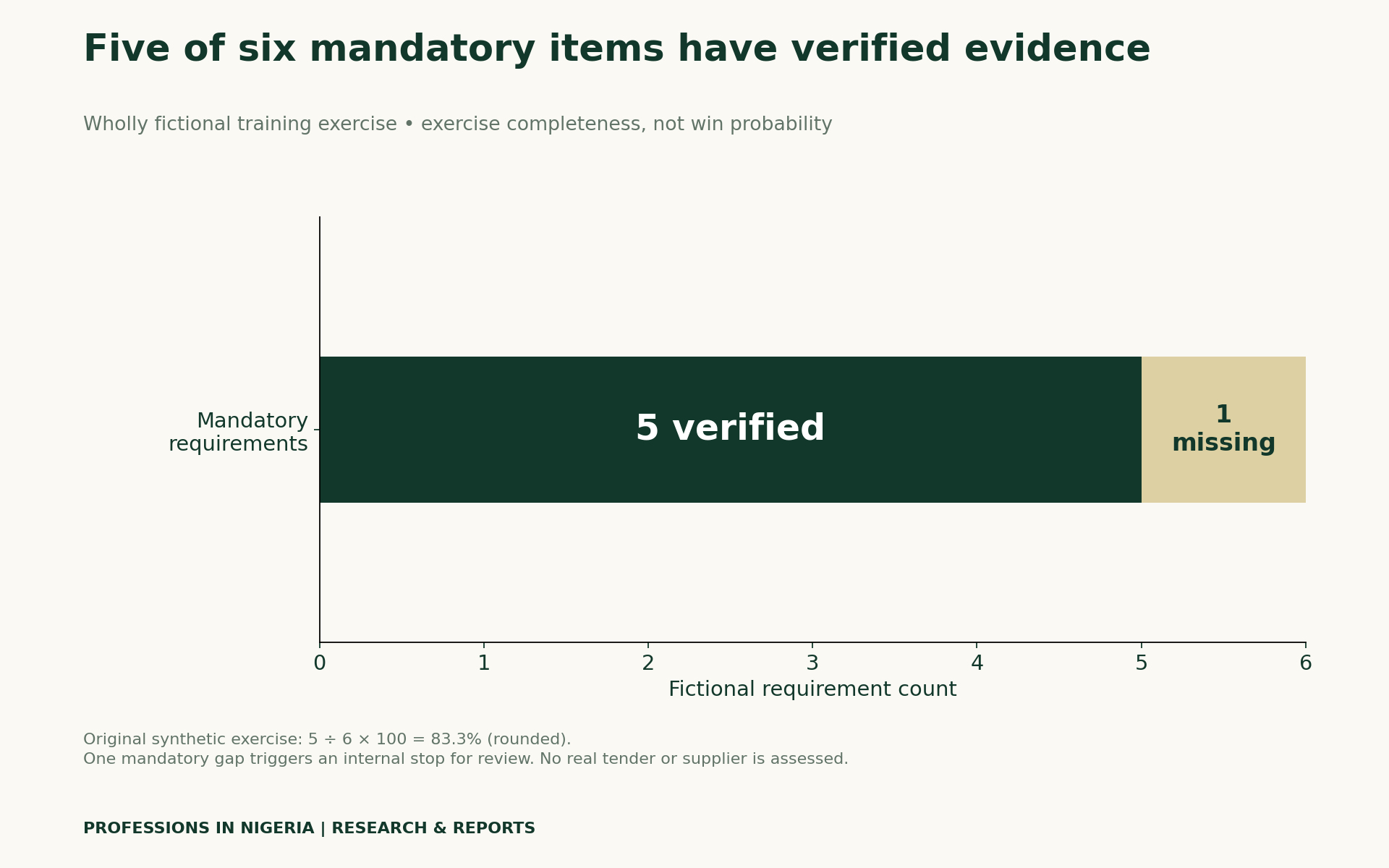
The calculation is simple, but the decision needs care. Define completeness as mandatory requirements with verified evidence divided by total mandatory requirements. Use six as the denominator here. The resulting 83.3% describes this invented register; it does not measure bid quality, legal compliance or the chance of an award.
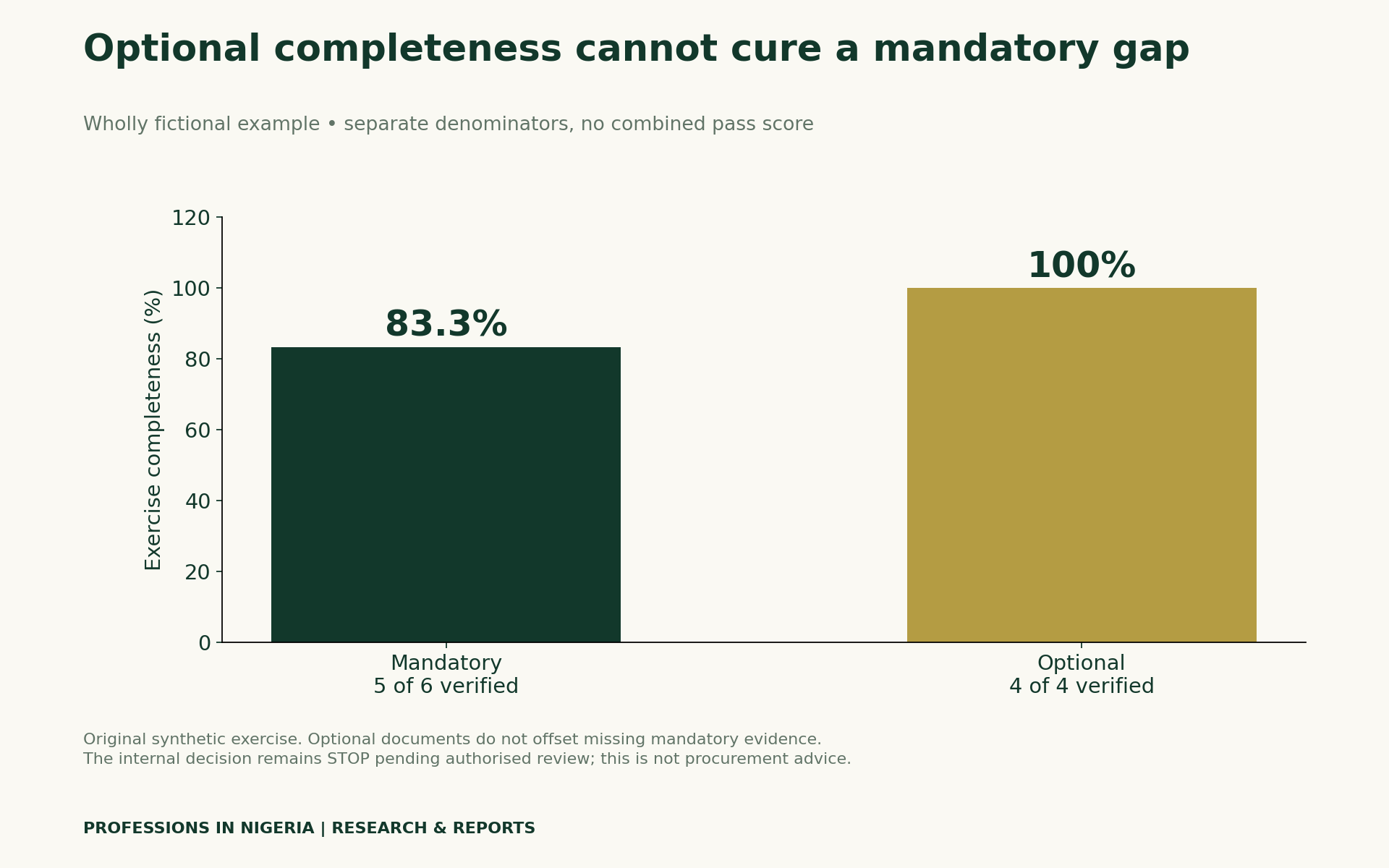
A polished cover, consistent formatting and complete optional attachments do not supply R03. In the exercise, the coordinator stops the pack at internal review and asks the technical lead and authorised supervisor to resolve the gap. This is a teaching decision, not a ruling that any real bid must receive a particular legal outcome.

Map each requirement to a source and responsible role
The fictional notice references make the missing item traceable. R03 points to paragraph F2.1 and names the technical lead as the responsible role. Its evidence-location field stays blank. The unresolved-question field explains what is unavailable. This is more useful than marking the whole pack “almost ready” without identifying the gap.
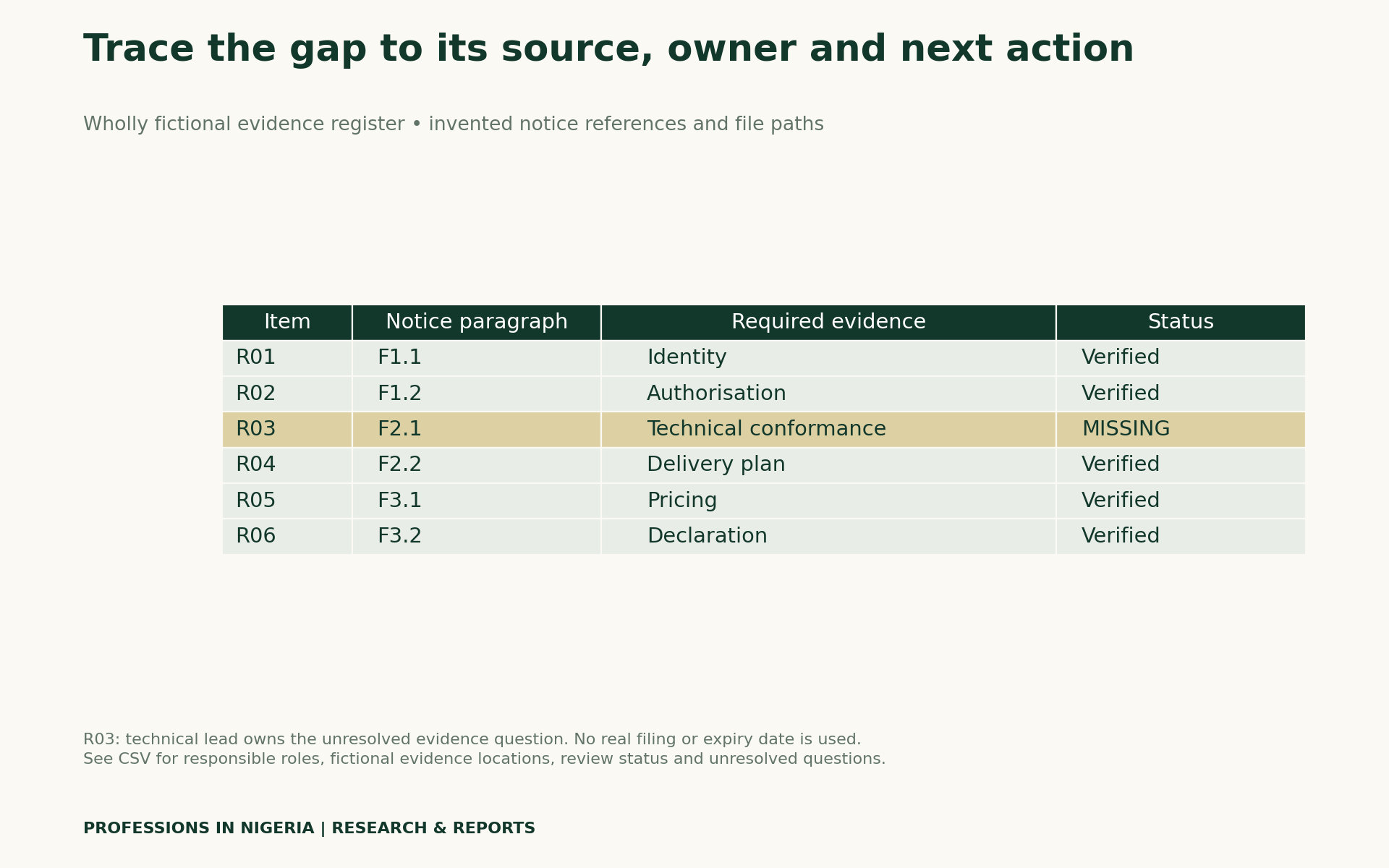
For a permitted real notice, use its actual wording and paragraph reference. Do not assume that our six invented items are an official checklist. Record the current notice’s deadline, authorised clarification route and review requirements. When a requirement is unclear, keep the question unresolved until a suitable authorised answer is available.
Also, distinguish a file existing from evidence being reviewed. A filename alone does not establish that a document answers the requirement or remains valid. Record who checked it, what they checked and when. If your role does not authorise that review, identify the appropriate supervisor rather than describing your own check as formal approval.
Demonstrate understanding, assembly and judgement separately
A learning log can connect a lesson to a small work sample. Explain the term you learned, show how you mapped one requirement to evidence, then describe the decision you escalated. These three activities demonstrate different aspects of practice. A course certificate does not make them interchangeable.
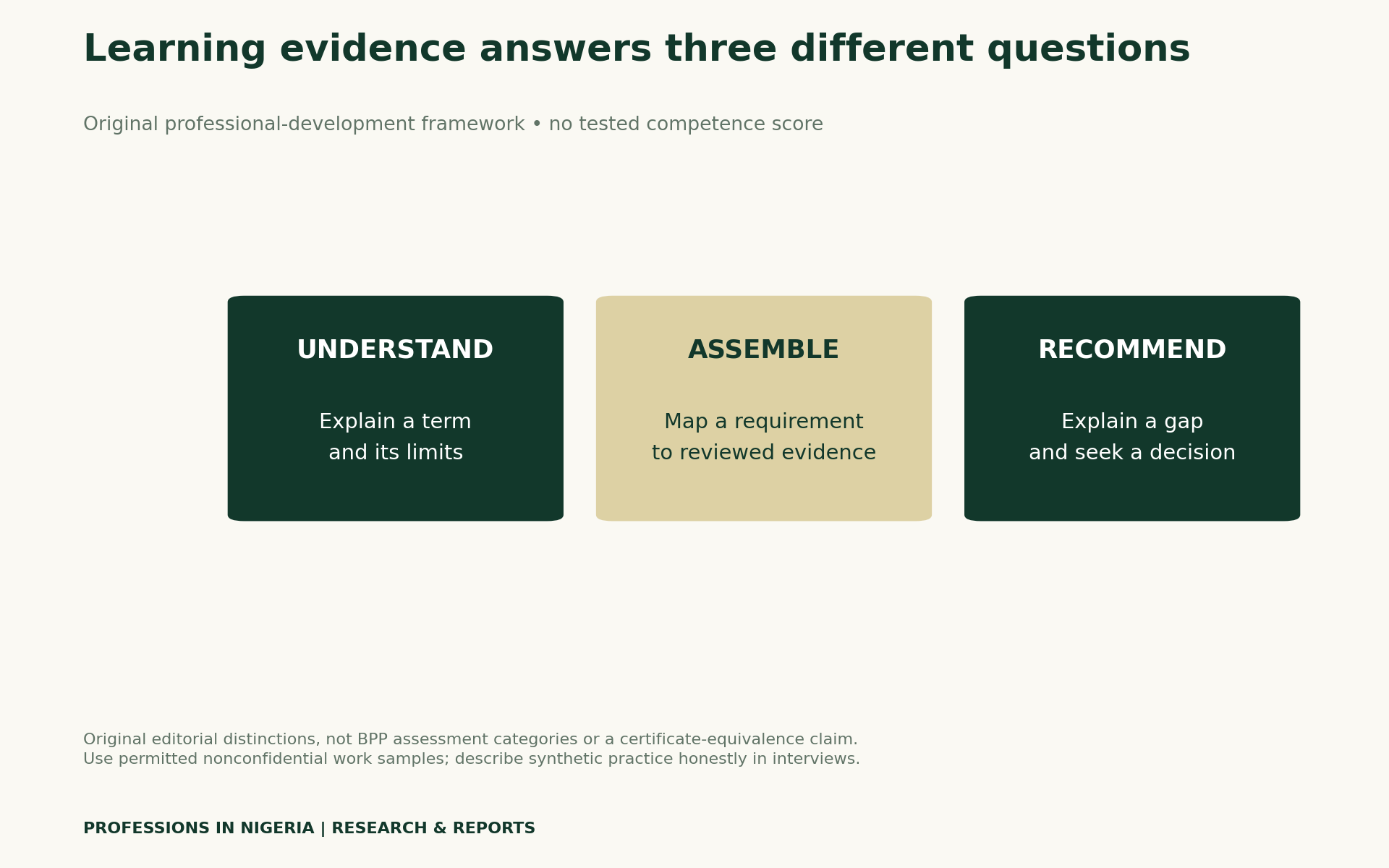
In an interview, describe the example honestly: “I built a synthetic evidence register and identified a missing mandatory item for supervisor review.” Do not imply that you won a contract or processed a real public submission. A clear explanation of limits can be more informative than an unsupported claim of procurement expertise.
Similarly, our workplace verification portfolio guide explains why a finished-looking output still needs evidence and review. Keep the learning record focused on work you are permitted to discuss. Use a blank or synthetic sample when the actual material is confidential.
Download the editable exercises
Download the blank requirement-to-evidence register (CSV), fictional six-item evidence register (CSV), fictional completeness calculations (CSV), and five-part learning-pack planner (CSV). Blank fields are intentional; none is an official procurement form.
The blank register includes the source paragraph, responsible role, evidence location, deadline, review status and unresolved question. The learning planner leaves artifact location, reviewer, review date and next action for you to complete. Adapt these records to the permitted task rather than treating our example as a universal list.
Methodology, limitations and citation
Research checked November 3, 2026. We verified the dated primary announcement and kept its stated features separate from measured outcomes. All exercise records are synthetic. The mandatory count is six, the verified count is five and the optional count is four; charts and CSVs use those same inputs.
The exercise has not been validated as a competence test or used to evaluate a real supplier. No course-completion, usability, employment or contract-award study was conducted. Follow the current notice and applicable rules for any real submission, and seek authorised professional advice where needed. This is professional-development guidance, not legal advice or BPP endorsement.
Suggested citation: Professions In Nigeria, “BPP’s Free Procurement Training: Build a Bid-Readiness Evidence Pack,” November 3, 2026. Attribute programme features to the BPP release published October 28. Identify the five-part pack, synthetic register and completeness calculation as original editorial exercises.


