







An accessible recruitment checklist in Nigeria should start with the actual job task. Can a qualified applicant discover the vacancy, submit evidence and demonstrate the required skill? A process can exclude someone before a hiring team ever sees their work. This guide offers a six-stage manual audit that keeps the capability, access route and evidence separate.
A small Oyo State study motivates the questions. It does not measure every Nigerian employer or establish the cause of national employment outcomes. Our blank worksheet and fictional assessment example are original editorial tools. They are not a certified accessibility assessment, a legal-compliance checklist or a promise of a hiring outcome.
What the Oyo study actually reports
NISER’s October 30, 2026 news account describes research presented at an OWSD webinar on October 27. It covered 40 women aged 18 or above in Oyo State, including women with physical disabilities, visual or hearing impairments, and albinism. The account reports 50% unemployed and 30% self-employed.
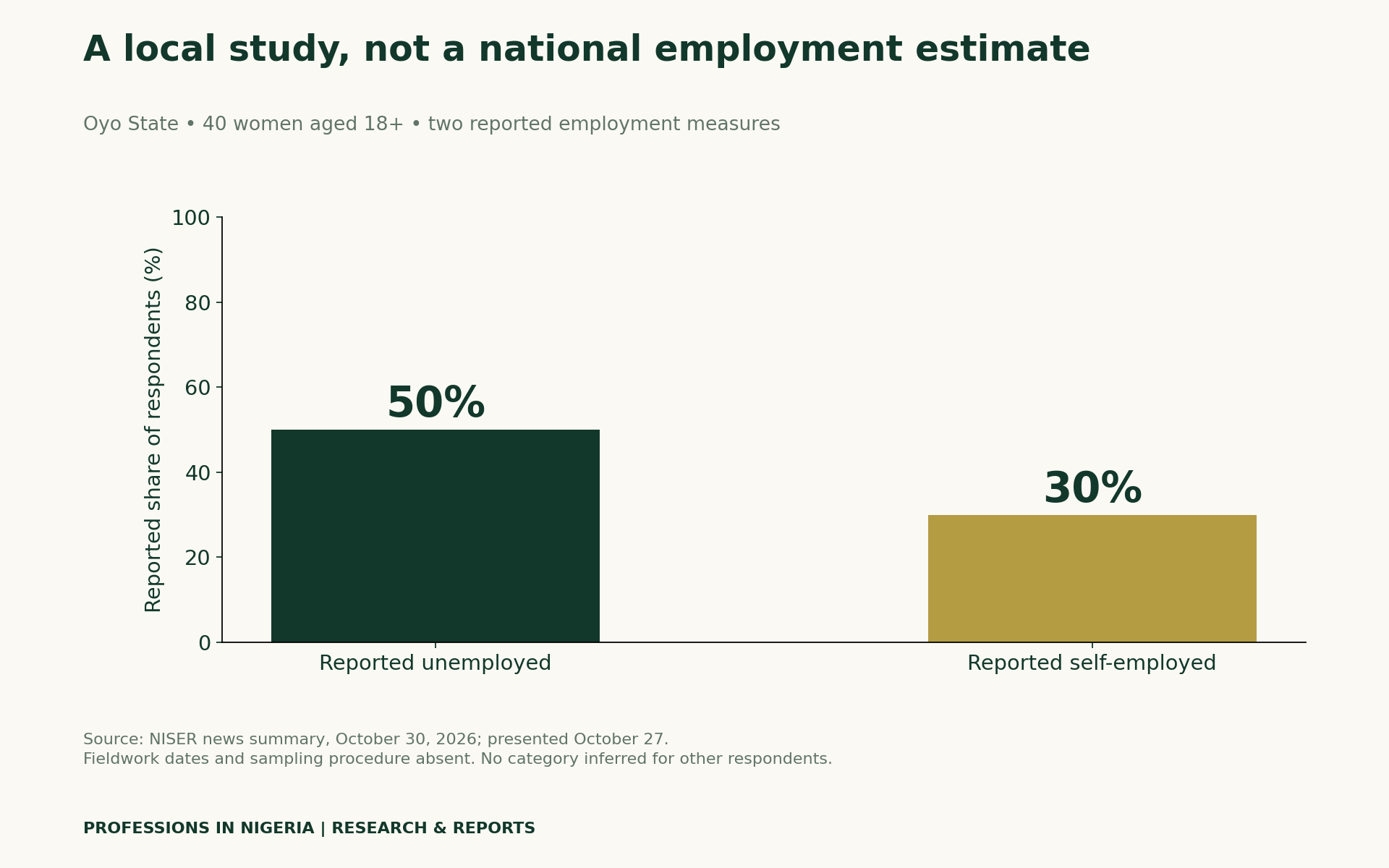
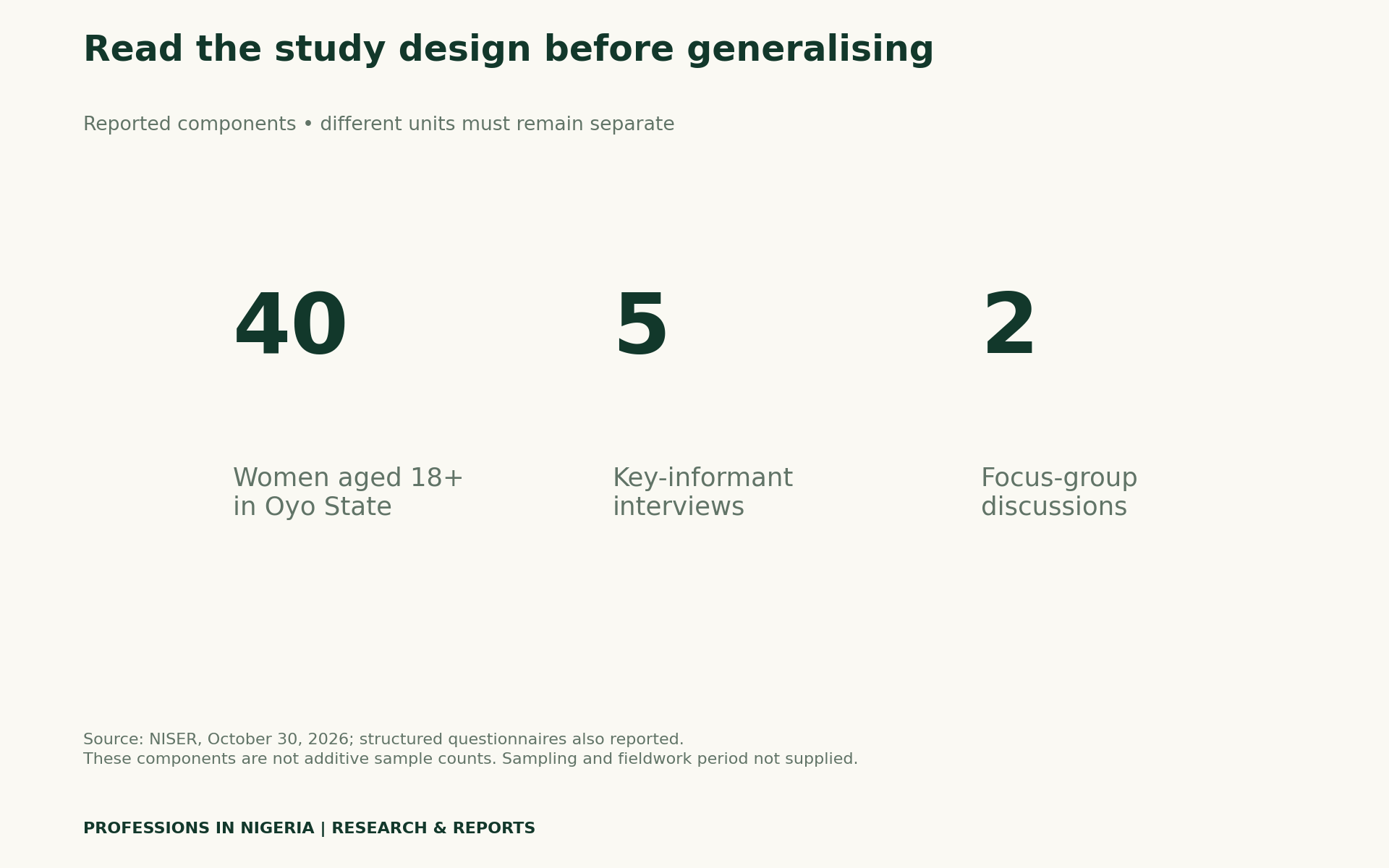
The reported methods include structured questionnaires, five key-informant interviews and two focus-group discussions. The accessible summary describes communication barriers and workplace discrimination. It does not supply the fieldwork dates or complete sampling procedure. Therefore, the employment shares should remain attached to this local sample rather than being presented as national estimates or causal effects.
An accessible recruitment checklist for Nigeria: six stages
Start with one real vacancy and the route a person must use to apply. Write down the essential capability before reviewing the format. For example, accurate written analysis and fast public speaking are different capabilities. A team should be able to explain why its assessment format tests the work the role actually requires.
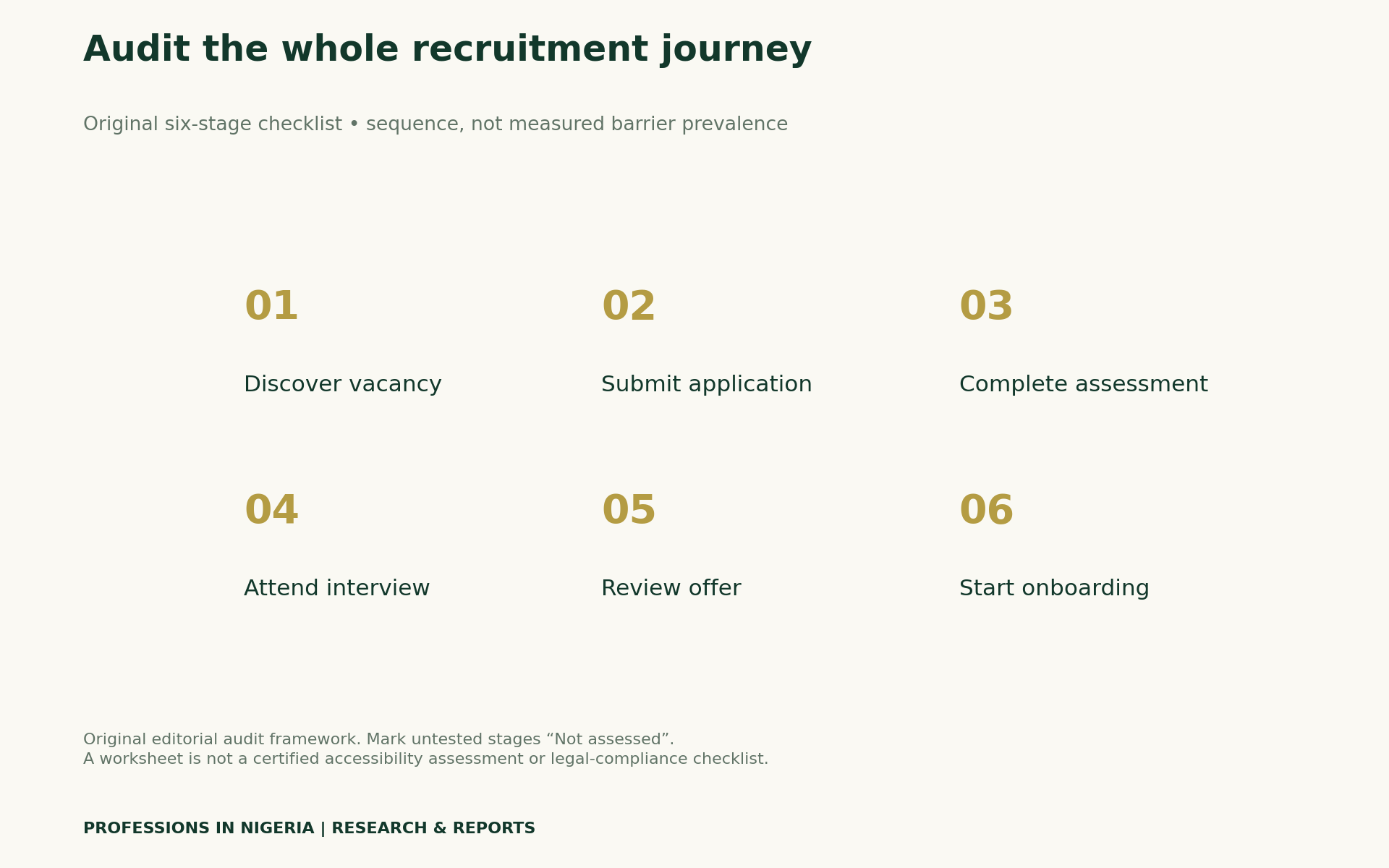
Vacancy discovery: test whether someone can find and read the role information through the published route. Record the actual file or page checked and the task attempted. A general statement that the organisation welcomes applicants does not establish that the vacancy content can be accessed.
Application: inspect the submission process, including attachments, required fields and any stated alternative route. Record whether the test was completed and what evidence supports the result. If a step has not been tested, mark it “not assessed” rather than treating silence as a pass.
Assessment and interview: name the essential task, the format used and any access problem observed. Invite a private discussion of arrangements that would help the applicant demonstrate that capability. A written task, a presentation and a conversation may assess different things. Do not substitute one automatically without checking the purpose.
Offer and onboarding: review how the person receives information, asks questions and prepares to start. Include the practical access route to the workplace or systems where relevant. An application can work while a later stage still creates a barrier. Keep each stage visible rather than giving the entire process an unsupported pass label.
Keep a fictional example separate from audit findings
Imagine a fictional support role whose essential task is to summarise a sample customer request accurately and set priorities. The proposed assessment is a timed oral presentation. A reviewer asks whether speaking speed is essential to that stated written task. The alternative to discuss is a role-relevant written exercise with person-led arrangements.
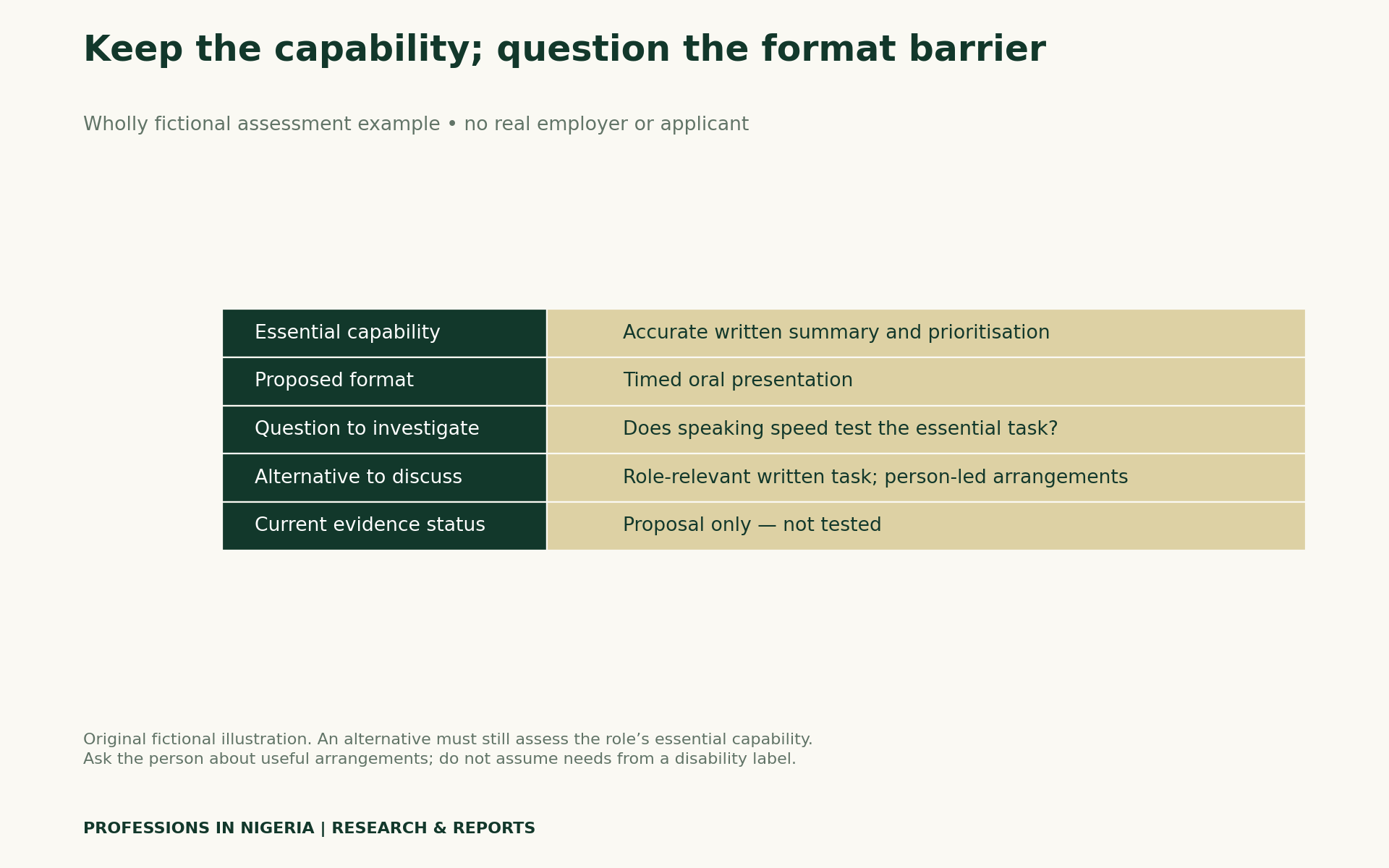
This example does not establish that every presentation is unnecessary or that a written task suits every applicant. It demonstrates a question: which part of the format is needed to assess the capability, and which part may introduce an avoidable barrier? The answer depends on the actual role and the person’s circumstances.
The downloadable example remains labelled “illustrative proposal; not tested.” We have not audited an employer, counted real issues or measured a before-and-after change. A future report could publish such results only after documenting the actual checks, scope, evidence and comparison method. Do not convert a planning worksheet into an impact claim.

Ask about arrangements, not a diagnosis
A useful planning prompt is: “What arrangements would help you demonstrate the skills for this task?” Give the person a clear, private way to respond and explain who will use the information. Do not infer an individual’s needs from a disability label or assume that everyone in one group wants the same format.
Keep diagnosis, health history and private narratives out of a public audit log. The process worksheet can record a format, an observed barrier, an agreed alternative and an owner without naming an applicant. Store any necessary private planning information in an appropriate restricted location. A public portfolio should use fictional material or authorised, non-identifying evidence.
Also, avoid making the applicant responsible for fixing the whole recruitment system. The team should name an accountable owner for each process issue and a date for reviewing the next action. Person-led discussion informs the response; it does not replace the organisation’s responsibility to investigate its own route and task design.
Record evidence and review the revised route
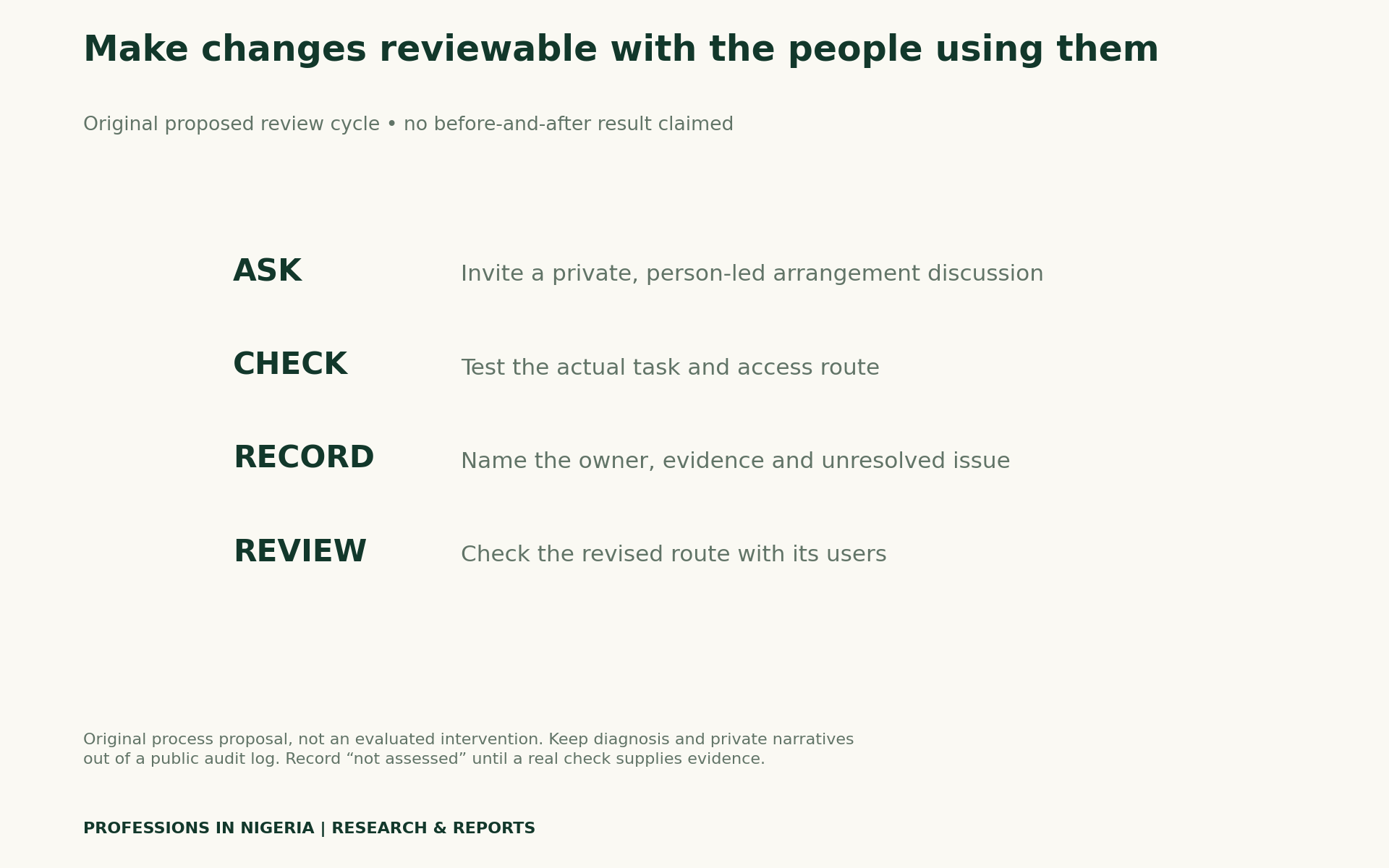
For each stage, record the task, essential capability, available format, observed barrier, alternative route, accountable owner and completion date. Add an evidence reference and a clear status. Use “not assessed” where a check has not happened. Use “proposal” where a change exists only on paper. Reserve “verified” for a completed check with evidence.
When a route changes, keep the earlier observation and record what was checked again. Ask people who use the route whether the change addresses the issue identified. A completed action and a useful outcome are different facts. For example, publishing an alternative contact route does not prove that a response arrives in time for an applicant to use it.
For another guide to choosing the right denominator before interpreting workforce figures, see our civil-service representation analysis. Both resources separate an observation from a claim about individual outcomes. That distinction helps HR teams communicate evidence without overstating what a small dataset or a process check can prove.
Download the source observations and audit tools
Download the two source observations (CSV), blank six-stage recruitment audit (CSV), and fictional assessment example (CSV). The blank audit contains no applicant records or measured issue counts. Each stage starts as “not assessed.”
Research checked November 3, 2026. We retained the dated NISER primary news account and reproduced only its two stated employment measures. We did not infer headcounts, a residual employment category, a national rate or a causal relationship. Figures 3–5 and both audit tools are original process proposals. No actual employer audit or legal-compliance assessment was performed.
Suggested citation: Professions In Nigeria, “Accessible Recruitment in Nigeria: What an Oyo Study Can Teach HR Teams to Check,” November 3, 2026. Attribute the local study observations to NISER’s October 30 account and identify the manual checklist and fictional example as original editorial resources.


