



Nigeria’s 2026 oil bid round offers a useful way to study bid-team evidence skills without claiming access to a live bid. A junior analyst can practise tracing requirements, recording unknown status, documenting provenance and controlling versions. These skills do not require inventing a company’s participation.
This guide uses the published schedule and a fictional public-teaser exercise. It separates corporate prequalification from later bidding and authorised data access. The four-gate register is a learning tool, not an application portal, a permit route or a recruitment forecast.
Nigeria 2026 oil bid round: keep the stages separate
The NUPRC licensing-round portal opened on November 20, 2026. Its official FAQ distinguishes a prequalification stage from a bid stage. The FAQ gives January 15, 2027 at 4:30 p.m. WAT for registration submission, subject to any official change.
Those are company-process milestones. A student reading the public site has not thereby registered a company, passed prequalification or gained project data rights. Keep the public source and your own role clearly labelled in any exercise or portfolio.
Read the conditional window on the timeline
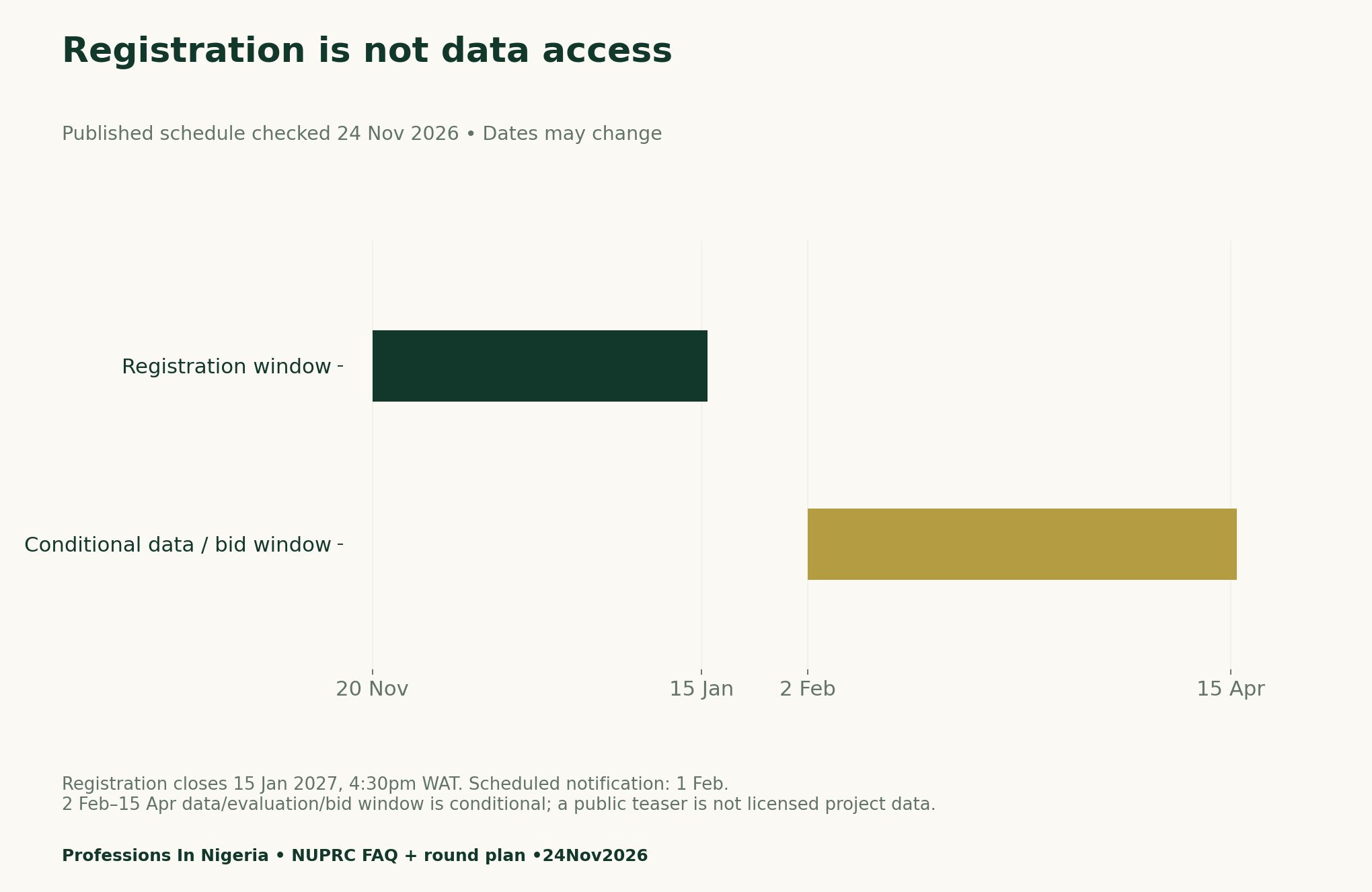
The published round plan schedules notification of prequalified applicants for February 1, followed by data access, evaluation and bid submission from February 2 to April 15. The plan allows schedule amendments. Save the document version and date checked instead of treating a screenshot as permanently current.
A junior team member can help by maintaining a dated milestone register and flagging a change. The team’s responsible reviewer must interpret which current instruction governs its work. Do not substitute a website summary for the applicable guidelines or an authorised project instruction.
Gate one: trace company documentation to a requirement
In the original worksheet, the first gate asks for a requirement reference and its version. Record what the requirement says, where it appears and which responsible person will review the response. Do not mark a pack complete merely because a folder contains several files.
For a fictional exercise, use blank references or openly invented records. Avoid copying a real company’s confidential material into a demonstration. The skill you are showing is traceability: someone else should be able to understand why a particular record is relevant.
Gate two: record status without assuming approval
The second gate separates a submitted pack from the relevant status notification. If you have not seen a dated official result, record that status as unknown. A planned notification date does not establish that a particular company has prequalified.
This distinction also improves handoffs. A colleague can see whether a task is awaiting a decision, awaiting evidence of that decision or ready for the next responsible review. Keep the decision itself separate from your record of it.
Gate three: a public teaser is not authorised project data
The FAQ describes confidentiality and data-leasing requirements, with evidence linked to the bid. Registration alone does not settle those requirements. For real work, only the responsible authorised team can confirm the permitted access and use of a particular dataset.
Fictional Candidate A sees a public teaser but has no proprietary dataset or access evidence. The correct exercise entry is unavailable, not diligence complete. The candidate can identify what evidence would be needed without seeking an account, copying restricted files or claiming a licence.
Gate four: control the reviewed package version
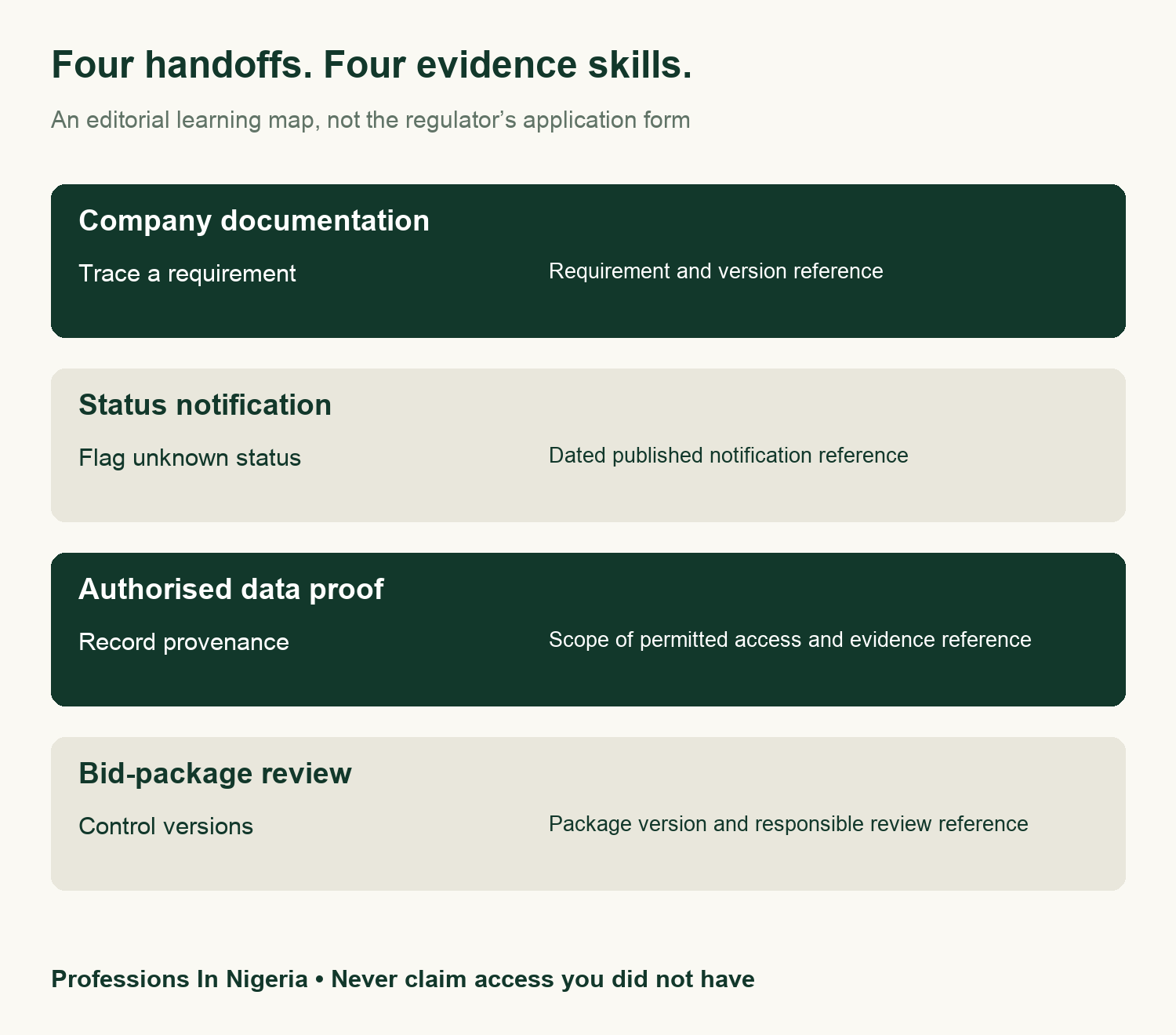
A file called latest is not a reliable review trail by itself. Record the package version, source references and responsible review status. If an input changes, flag which draft relied on it. Do not quietly update the source while leaving the old conclusion attached to the package.
A useful demonstration might say: this fictional register links requirements, leaves unverified status open and identifies a missing data-access reference. It should not say that you supported an actual licensing bid unless that claim is true and can be shared appropriately.
Show the method on a CV without overstating experience
Describe a clearly labelled simulation in terms of the work you performed. For example, you traced published milestones and designed a source-controlled handoff register. Do not call the exercise company due diligence, proprietary subsurface analysis or a successful bid.
For broader role context, see our oil-and-gas project-management career guide. This report addresses documentary handoffs rather than project operations. No real bid account, commercial commitment or data purchase is created here.
Methods, limits and four reusable downloads
We compared NUPRC’s public portal, FAQ and round plan on November 24, 2026. The timeline records scheduled dates, while the four handoff gates are our editorial framework. The teaser-only case is invented. We do not infer job numbers, hiring demand, award chances or professional authorisation.
One conditional timeline and one skills-map infographic answer the question. Further numerical charts would require additional data that this learning exercise does not contain. Recheck official changes before relying on a date, and retain confidential company evidence only within approved systems.
- Dated licensing-round milestone register (CSV)
- Blank four-gate bid-team handoff register (CSV)
- Fictional public-teaser evidence case (CSV)
- Official-source and scope register (CSV)
Suggested citation: Professions In Nigeria, “Nigeria’s 2026 Oil Bid Round: What Junior Bid-Team Staff Should Track,” November 24, 2026. Cite NUPRC for official instructions and this report for the original learning framework.