



Songhai agribusiness training skills evidence in Nigeria can begin with a small, dated record of work actually handled. An attendance certificate documents participation. A starter pack is an input. Neither, by itself, shows that a learner can manage a production task or has built a profitable business.
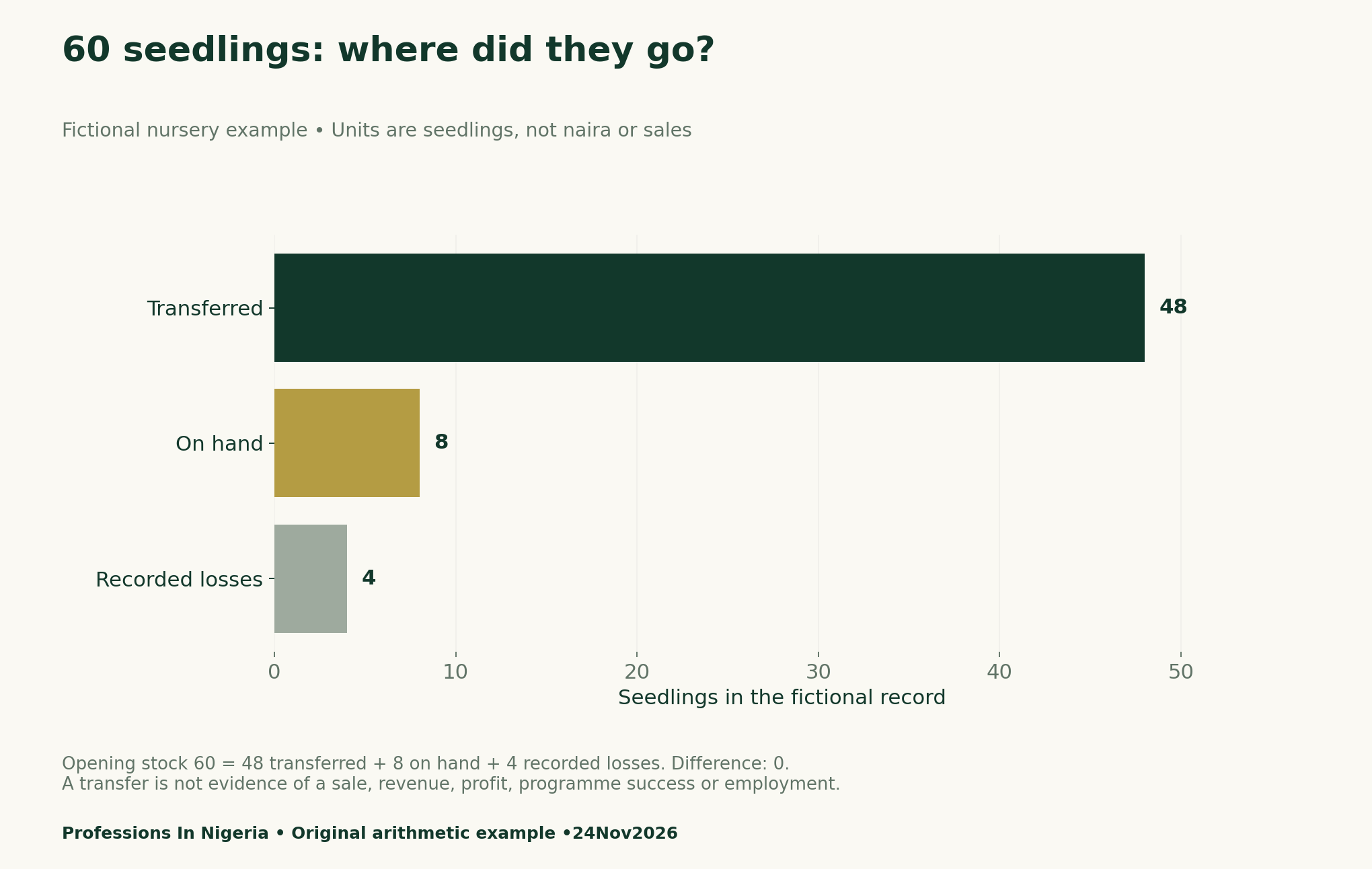
This guide explains how to keep a blank four-week work log and a simple stock reconciliation. Its nursery example is fictional: 60 seedlings at the start become 48 transferred, eight on hand and four recorded losses. The arithmetic does not turn those transfers into sales.
What the latest Songhai graduation report says
The November 20 FIC Imo report describes another completed AIRBDA Songhai–Mastercard Foundation training batch. It mentions practical agriculture and agribusiness management, alongside attendance certificates, startup packs and transport tokens. It does not give a cohort size, pack contents or value, or measured enterprise outcomes.
The September 3 kickoff report calls the initiative a five-year programme. That is not a statement that every participant receives five years of training. Neither report is used here as an announcement of a fresh intake or a guarantee of a recognised qualification.
Songhai agribusiness training skills evidence: start with one task
Choose a task you actually handled and can describe accurately. Record its date, the unit counted and the source of the count. If you observed another person’s work, label it observed rather than performed. Keep supervision and your own responsibility visible.
For example, a learner might record a nursery stock movement under supervision. That can support a narrow statement about the record they maintained. It does not, without further evidence, establish independent production competence, a yield benchmark or the ability to run an enterprise.
A useful first line is modest and checkable: what entered the task, what happened and what remained. If an input quantity is unknown, leave it unknown. Do not backfill a pleasing result from a remembered estimate after the fact.
A fictional stock check: 60 = 48 + 8 + 4
| Fictional stock movement | Seedlings | Evidence question |
|---|---|---|
| Opening stock | 60 | Which dated count supports the starting quantity? |
| Transferred | 48 | Which recipient or transfer record supports the movement? |
| Still on hand | 8 | When was the closing count made? |
| Recorded losses | 4 | Where is the loss recorded, without inventing a cause? |
The check is 60 − 48 − 8 − 4 = 0 unexplained seedlings. A zero difference means the fictional quantities reconcile. It does not prove that the entries are true, that losses are acceptable or that the work met a technical standard.
Likewise, transferred could mean moved to another unit, handed to a recipient or otherwise taken out of this stock record. Without evidence of a transaction, do not label the 48 as sales. A sales value would still not establish profit without the relevant costs and accounting basis.
What a supervisor or recipient can actually verify
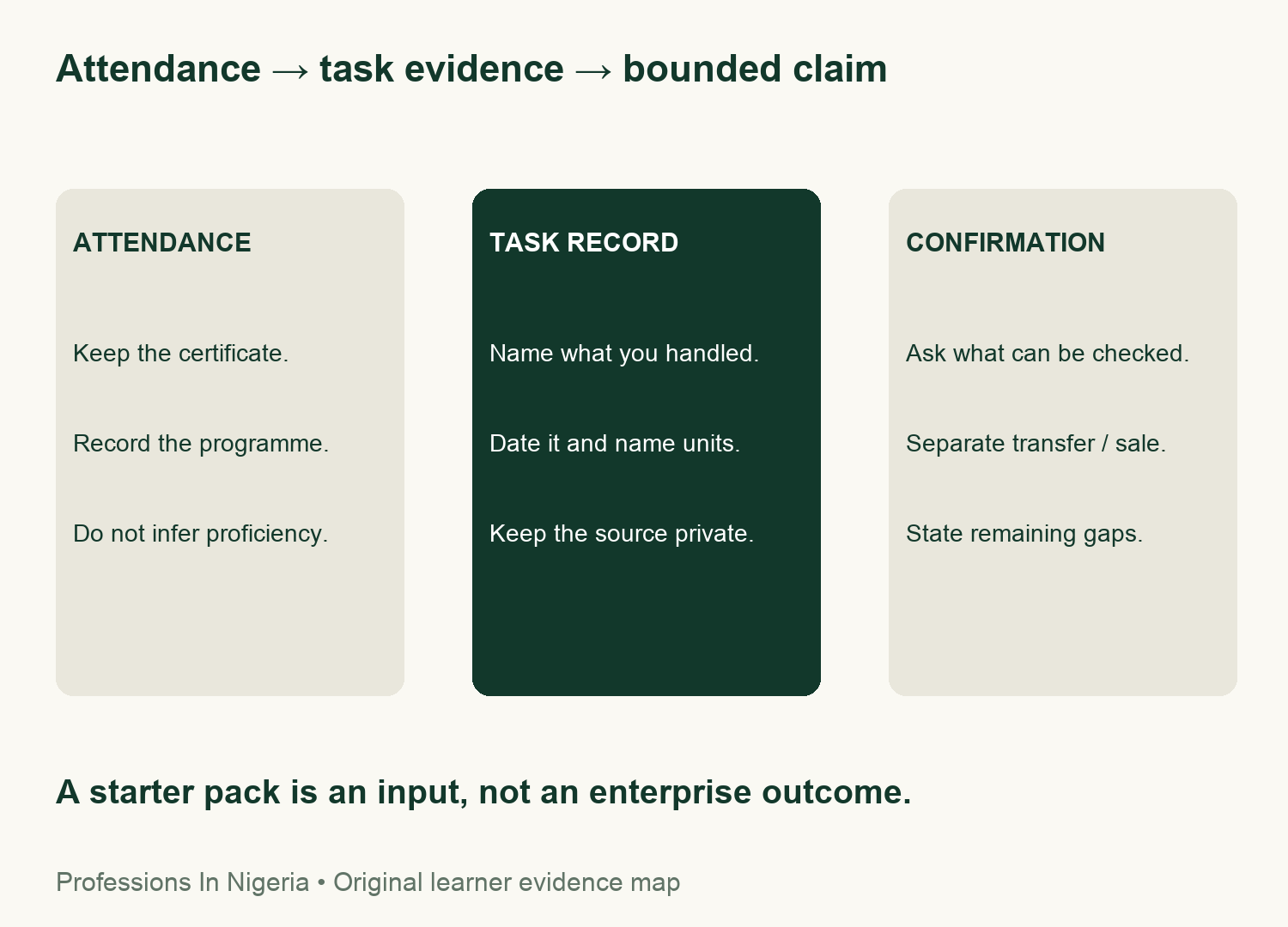
Ask a supervisor which part of the record they can confirm. They may have seen a count, reviewed the log or supervised a specific action. A recipient may be able to confirm a transfer quantity. Those are different observations, so keep them in separate fields.
Do not ask someone to endorse a wider claim than their observation supports. A supervisor’s confirmation of a stock count does not automatically establish agribusiness management proficiency. Record the date and scope of confirmation and leave the remaining questions visible.
Use four weeks as a recording scaffold
The blank log has four weekly rows so a learner can begin a manageable evidence habit. Four weeks is our editorial scaffold, not the programme’s course length or a minimum period for becoming competent. Add rows when your actual task requires them.
Keep units consistent within each record. If a later task concerns kilograms rather than seedlings, use a separate entry and state the unit. Avoid combining unlike quantities into a total merely because they appear in the same training notebook.
A missing signature or count should remain a question, not become a fabricated confirmation. If a correction is needed, retain the earlier entry and the reason for the change. This makes the record easier to explain during a supervised review.
Show a work sample without exposing private records
In an interview or placement conversation, explain the task, the record and the narrow claim it supports. A redacted sample can demonstrate care with quantities and evidence. Obtain appropriate permission before sharing a farm’s records, a supervisor’s details or a recipient’s personal information.
For broader responsibilities, our agricultural operations-management guide covers a different scope. This worksheet concerns the first verifiable task record, rather than enterprise funding, technical production advice or a general route into management.
Methods, limits and editable downloads
We checked the two official FIC reports on November 24, 2026. The graduation items and programme wording are reported context. All nursery quantities are invented for the exercise. No participant outcome, starter-pack valuation, recognised credential, salary or employment result is inferred.
One reconciliation chart and one evidence-map infographic serve this question. We do not create programme success statistics from a ceremony report. Keep the blank tools locally, record actual work honestly and use responsible supervision for technical farm decisions.
- Blank four-week practical work log (CSV)
- Fictional nursery stock reconciliation (CSV)
- Graduation and programme source register (CSV)
- Blank task-evidence and claim check (CSV)
Suggested citation: Professions In Nigeria, “Songhai Agribusiness Training: What to Record After the Starter Pack,” November 24, 2026. Cite FIC for programme context and this report for the original recordkeeping tools.