




CONTEDISS 15 polytechnic non-teaching staff guidance needs more than a promotion headline. The new government release describes conditional progression, approved duties and HND career routes. This guide turns those distinct questions into a document-request matrix so staff can ask HR for evidence relevant to their own post.
CONTEDISS 15 polytechnic non-teaching staff: what changed
The Federal Ministry of Information’s 17 November release reports a 16 November NBTE circular to federal and state polytechnic rectors. It covers consideration for CONTEDISS 15 (GL 17), protection of approved non-teaching duties and HND progression under applicable service documents. This is a report of the circular, not an institution-specific promotion decision.
Keep the publication date separate from the circular date. Also distinguish the scope of the directive from evidence that a particular management has applied it to a particular post. Our register records those limits instead of filling gaps with assumed implementation dates or salary figures.
Four conditions are separate questions
The release makes progression subject to eligibility, a vacancy, approved staff establishment and applicable public-service regulations. State polytechnics must also observe relevant state regulations and approvals. Those qualifications prevent a headline from becoming a reliable individual entitlement calculation.
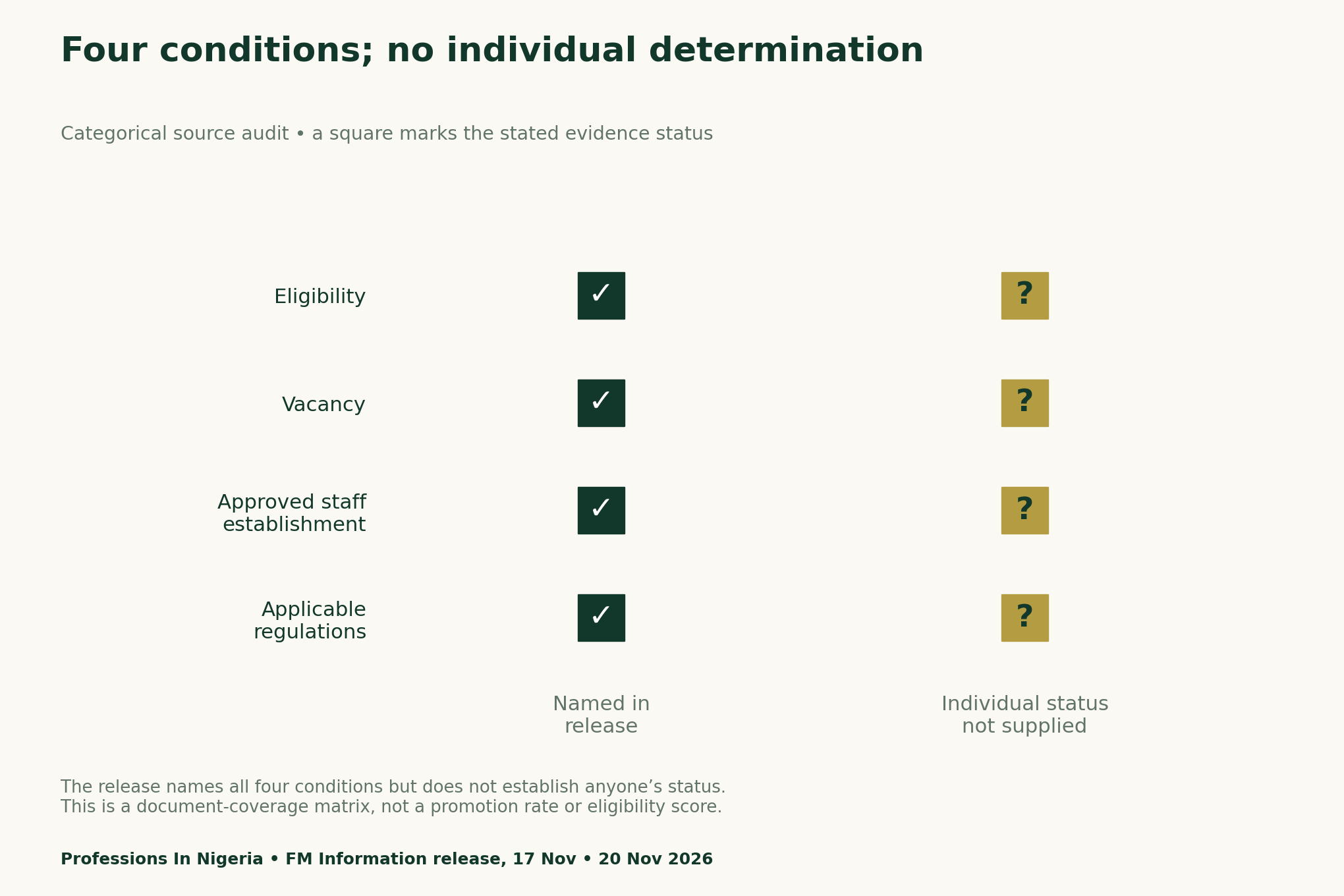
A qualification record may help answer one question without establishing the other conditions. For example, confirming which criteria apply does not prove that an authorised vacancy exists. Keep each response in its own row and identify the document behind it. Do not treat the number of completed boxes as a probability of promotion.
Ask which scheme applies to your actual cadre
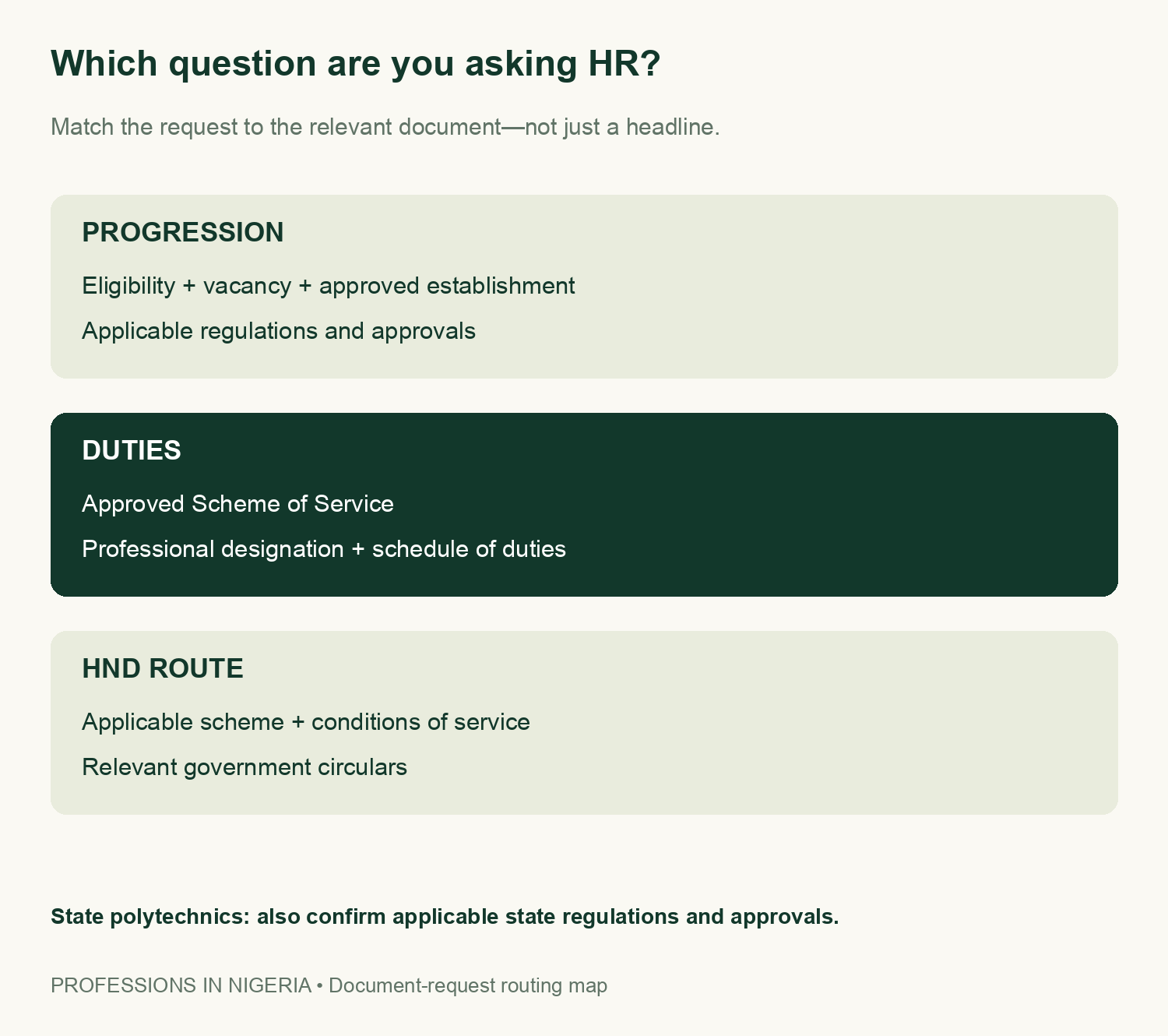
Start with your approved designation and the scheme that HR says governs the post. Request its version or date, the relevant provision and any applicable conditions of service or circular. This is more precise than asking whether an HND, in the abstract, is enough for every senior role.
The release’s HND provision concerns placement and advancement through applicable schemes and service conditions. It does not provide a universal salary table or establish equivalence for every profession, employer or recruitment advert. Our job-qualification evidence guide addresses a different question: reading requirements before a study or job decision.
Separate the three directive areas
| Area | Document to request | Scope |
|---|---|---|
| CONTEDISS 15 progression consideration | Applicable eligibility criteria and vacancy/establishment evidence | Qualified non-teaching staff; conditions apply |
| Protection of approved non-teaching duties | Approved Scheme of Service and schedule of duties | Responsibilities and professional designation |
| HND career progression | Applicable scheme, conditions of service and relevant circulars | Placement and progression; not universal qualification equivalence |
Progression, assigned duties and qualification routes can overlap in someone’s working life, but they are not interchangeable. A response about duties may not answer a vacancy question. Likewise, a scheme identifying a progression route does not show that a particular institution has issued a promotion letter.
How to raise an approved-duty question
For a duty concern, compare the assigned task with the approved schedule and designation that apply to your post. Describe the task, the document provision and the point needing clarification. Avoid assuming that an unfamiliar assignment is automatically improper or making public allegations about a colleague from incomplete records.
Keep confidential staff and institutional information out of public worksheets. A private evidence reference is enough for your working note. Use the institution’s appropriate internal process for clarification and any further action. The release does not supply a finding about a specific assignment or employee.
A focused HR request you can adapt
A practical enquiry could ask HR to identify the current scheme and conditions governing your cadre, explain the applicable progression criteria and clarify the vacancy and approved establishment position. If the institution is state-owned, ask which additional state regulations or approvals apply. Make clear which question remains unanswered.
Attach only the relevant records through the authorised internal channel. Ask for the date or reference of the document used in the response. Where the answer is provisional, retain that qualification. An informal assurance should not silently become a confirmed implementation entry in your notes.
Use the matrix to track evidence, not score eligibility
The blank request file separates the question, document version, private reference, response status, unresolved point and next action. You can label a response as received, awaiting clarification or not applicable with a reason. These are organisational labels, not NBTE status categories.
Do not publish named personnel records or build a ranking of colleagues from the worksheet. It is intended for an individual’s document-led discussion, not a screening tool or a substitute for professional advice. The article does not decide promotion, pay, legal entitlement or the validity of a particular HR action.
What would establish local implementation?
For your own record, distinguish a general directive from the relevant institution’s authorised response and the personal decision communicated to you. Check the scope, date and status of each document. Do not infer that a national announcement has already changed every establishment or payroll record.
The source release does not supply institution-by-institution outcomes. Therefore, this article does not report how many employees progressed, what percentage qualified or how much any salary changed. Browse our Education coverage for wider context while retaining that evidence boundary.
Download the document-request tools
- Three-area directive-to-evidence matrix (CSV)
- Four-condition source-coverage register (CSV)
- Publication, circular and scope register (CSV)
- Blank HR document-request worksheet (CSV)
Method and limits
We checked the government release on 20 November 2026 and coded its three areas and four progression conditions. The matrix shows whether a condition is named and whether the release supplies individual evidence. It does not measure how often a condition is met. The document questions and worksheet are our editorial additions.
The linked release describes the circular; we have not treated it as proof of a personal promotion or local implementation. Ask your institution for the current applicable documents and an authorised explanation. Recheck the official report before relying on a shared headline about CONTEDISS 15 polytechnic non-teaching staff.


