






Health campaign payment delays Nigeria evidence should measure the wait as carefully as the amount. A newly published study reports faster overall processing in two states, alongside a rise in one stage’s median delay. Those findings need separate clocks and a clear unit of analysis.
Mbaka and colleagues’ study, published in Frontiers in Tropical Diseases on 6 November 2026, examines 348 administrative payment batches from Rivers and Oyo campaigns during March 2023–December 2024. The publication date is new; the underlying campaign records are older.
Our four charts reproduce the relevant batch summaries and explain their limits. The proposed worker log and handover register are blank editorial tools. They contain no participant records and do not authorise anyone to approve payments.
Health campaign payment delays Nigeria: read the three medians separately
The reported median total processing time fell from 35 days in 2023 to 12 in 2024. The operational median fell from 33.5 to 10 days. However, the finance median increased from one to three days.
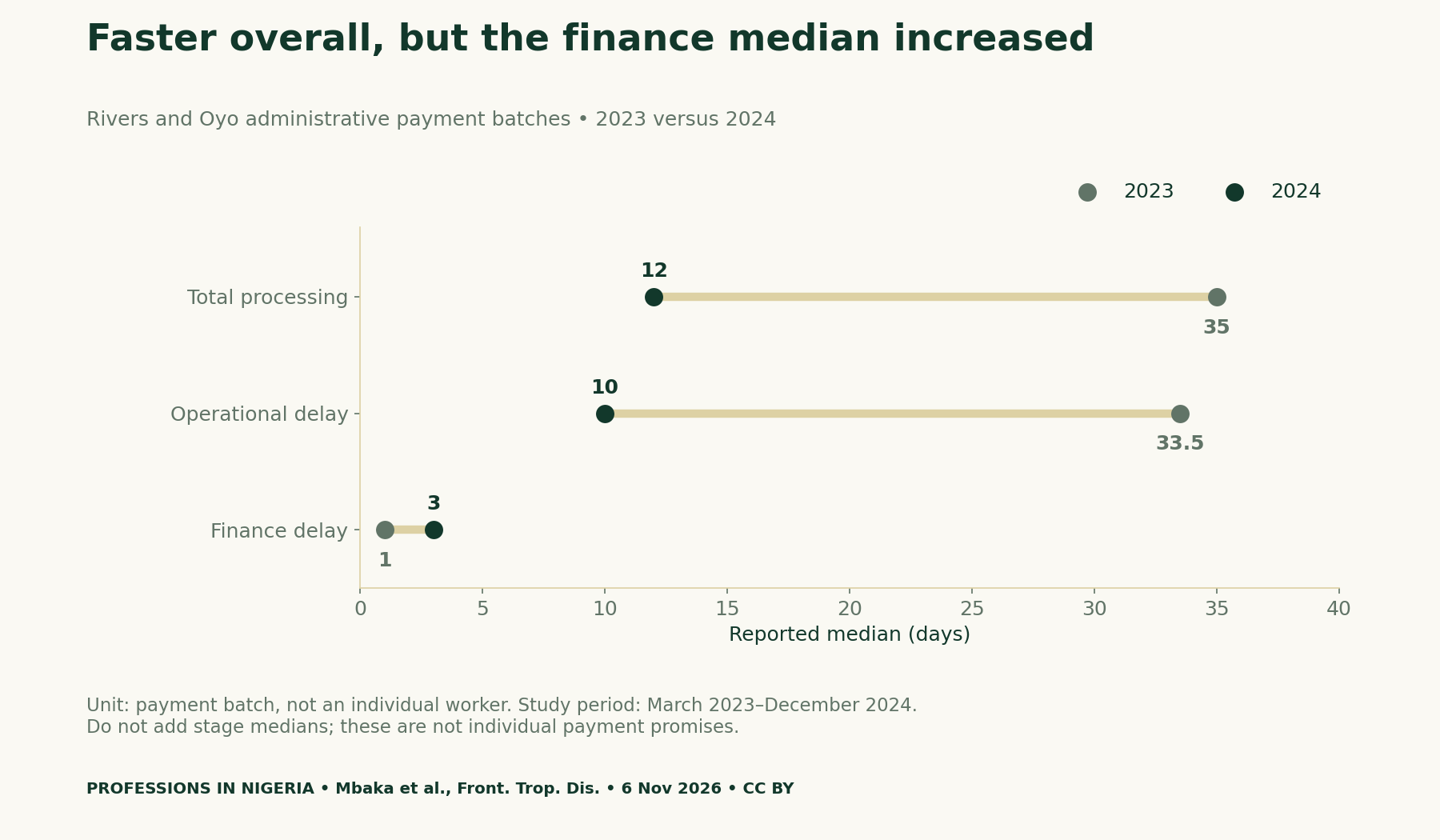
These are batch-level summaries, not individual payment promises. The authors define a payment batch as an administrative disbursement unit that may include one or multiple participants. A count of batches cannot be relabelled a count of workers.
The stage labels also belong to the study’s workflow. For a personal assignment, an agreed expected date and an actual receipt date are different records. Keep those dates explicitly rather than assuming they are identical to a study processing measure.
Why the operational change is 23.5 days before rounding
Subtracting the displayed medians gives a 23-day reduction in total processing, a 23.5-day operational reduction and a two-day finance increase. Table 2 displays the operational decrease as 24 days.
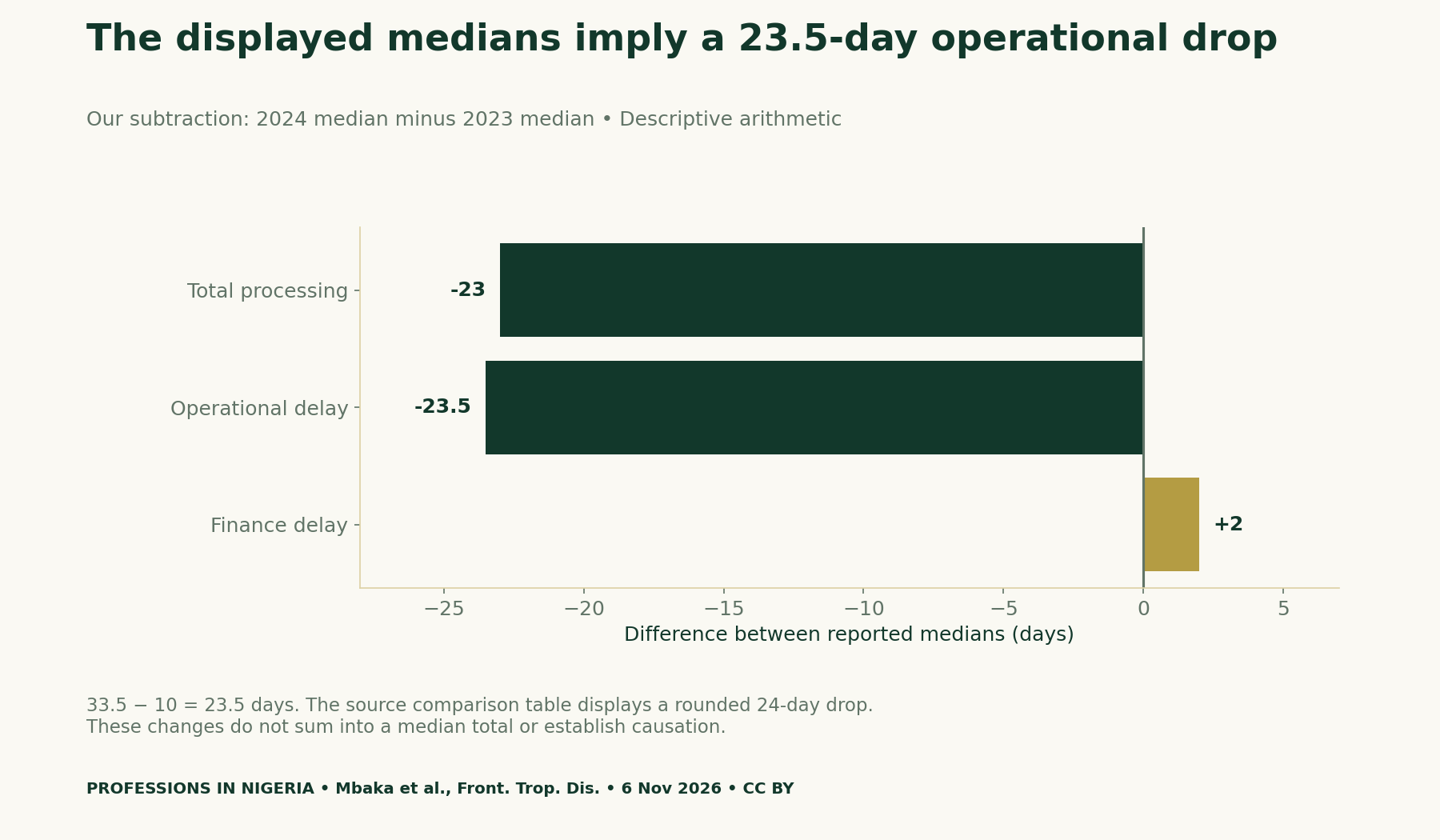
Our calculations retain 33.5 minus 10 as 23.5 before whole-day rounding. This is a small presentation distinction, but preserving it makes the downloadable arithmetic reproducible. It also prevents a rounded figure from appearing to be a different underlying observation.
Do not add the stage medians to reconstruct the median total. Each median describes the middle of its own distribution. The batch occupying the middle position for one stage need not occupy the middle position for another.
| Measure | 2023 median | 2024 median | Our 2024 minus 2023 calculation |
|---|---|---|---|
| Total processing | 35 days | 12 days | −23 days |
| Operational delay | 33.5 days | 10 days | −23.5 days |
| Finance delay | 1 day | 3 days | +2 days |
A typical batch is not every batch
The total-processing interquartile range was 14–57 days in 2023 and 7–22 in 2024. An interquartile range describes the middle half of observations. It is neither the full minimum-to-maximum range nor a confidence interval.
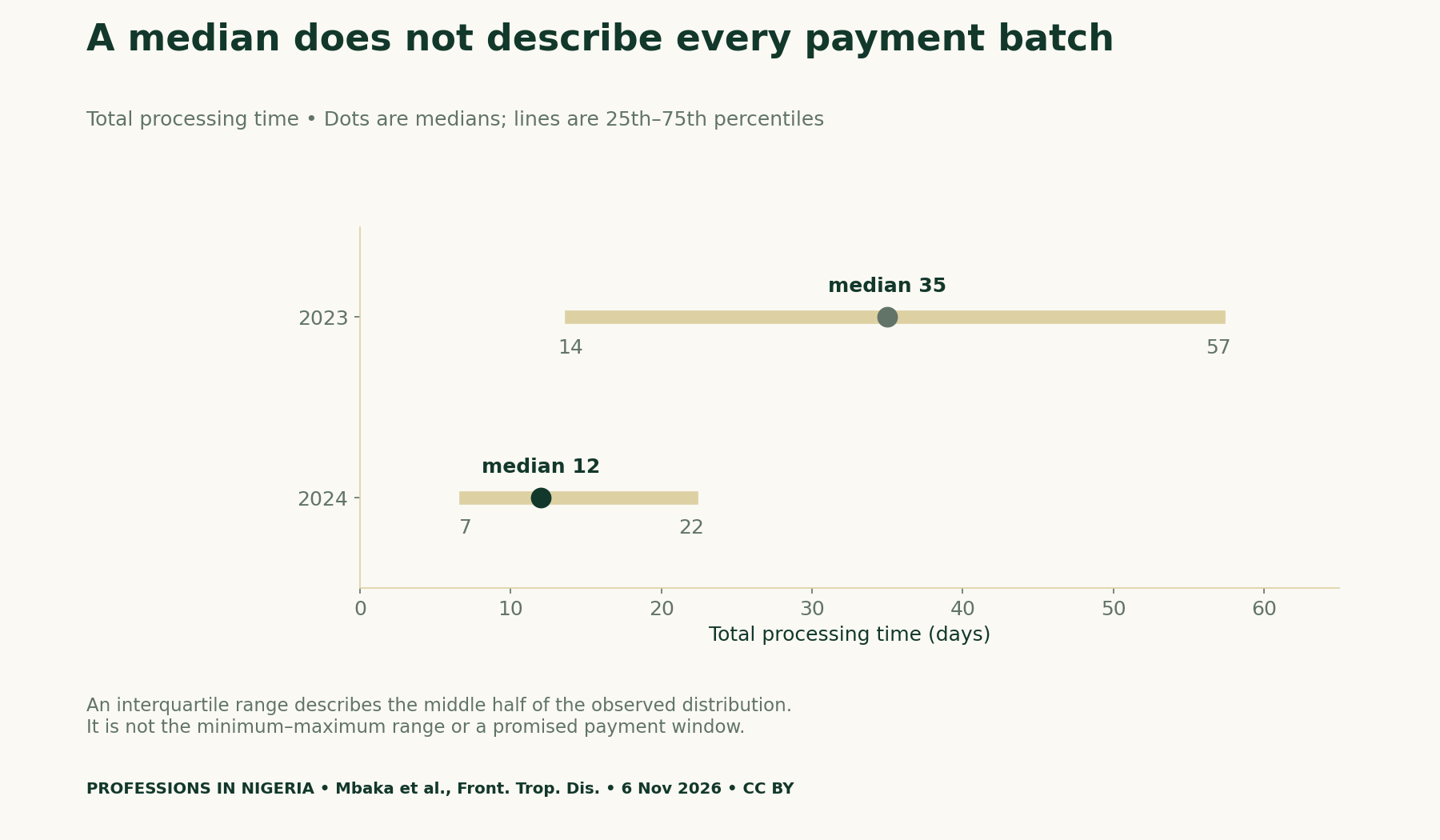
Therefore, neither the 12-day median nor the 7–22-day middle-half range establishes a service deadline for a new assignment. Nor does it tell an individual worker exactly how long a payment will take.
The paper uses statistical comparisons and regression, but our charts are descriptive replots. We did not obtain the underlying batch records or rerun the authors’ models. A comparison of years cannot isolate every change in implementation, scale or experience.
Check what the 348 observations represent
The study includes 156 batches in 2023 and 192 in 2024. That is 36 additional batches, or a descriptive increase of 23.1%. The comparison spans a transition from pilot implementation towards expanded routine use.
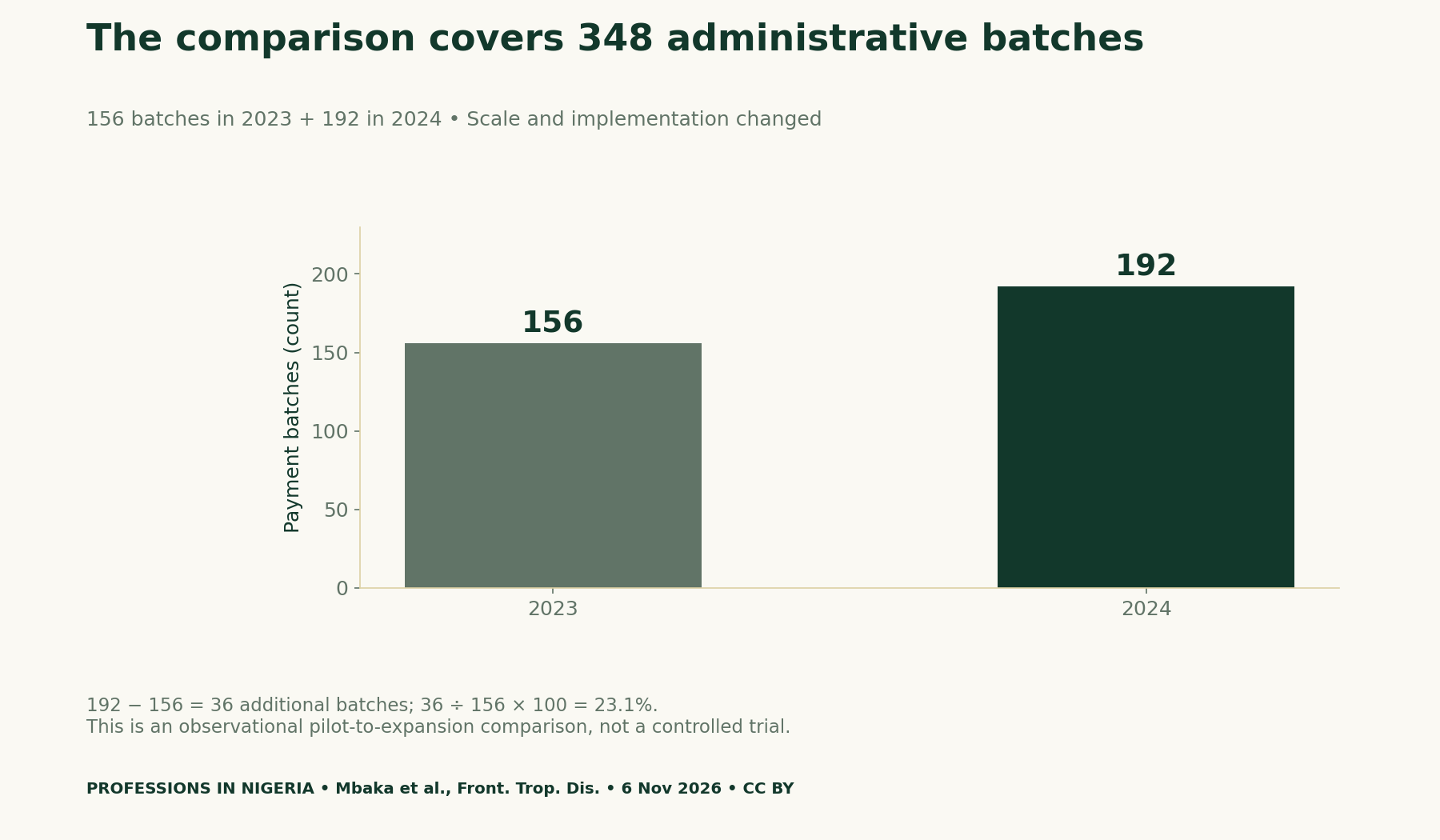
This is not a controlled experiment establishing that a digital tool alone caused the observed changes. We also do not use these administrative summaries to estimate retention, a national allowance rate or per-worker earnings.
The paper reports participant and transaction totals using counting conventions we have not reconciled. Dividing its payment amounts by a convenient count would risk creating an unsupported earnings figure. The charts instead stay with the clearly identified batch measures.
Settle the payment questions before accepting an assignment
Ask what amount and currency are agreed, when payment is expected, what evidence is required, and who handles an exception. Distinguish an allowance from reimbursement of expenses. Keep the original written terms privately.
A fictional worker might need to fund transport before receiving an agreed reimbursement. That creates a timing question even when the nominal amount is clear. It does not justify treating this study’s median as the worker’s guaranteed receipt date.
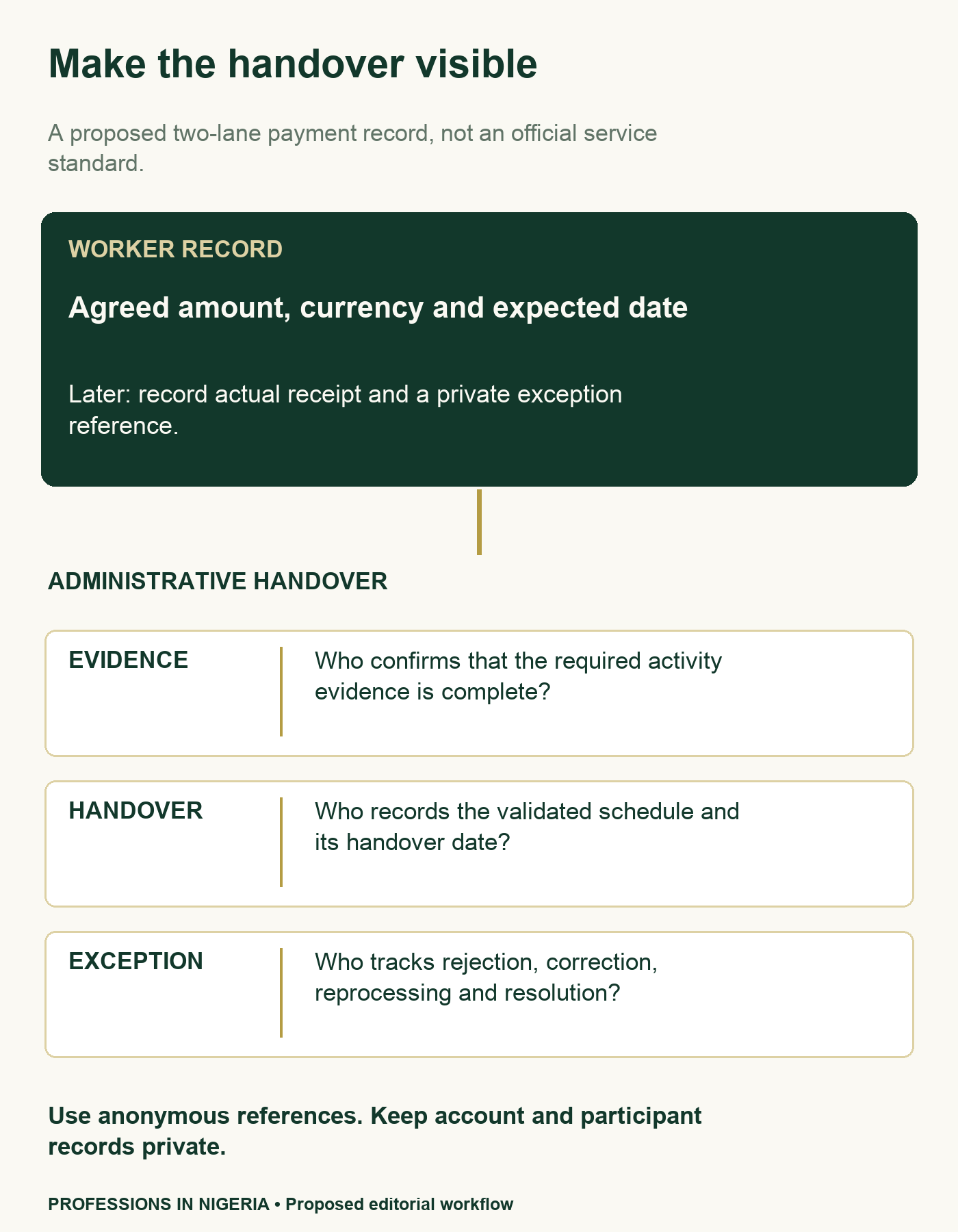
For programme administrators, the proposed handover register records evidence completion, validated-schedule transfer and exception resolution separately. Name the responsible role for each action. A field marked “submitted” should not silently become “received” or “resolved.”
A training exercise could give a trainee an anonymous case code, a missing handover date and an unresolved exception. Ask what evidence is needed next. This is a proposed non-clinical exercise, not proof of competence or permission to release funds.
Download the data and blank payment tools
- Published batch summaries (CSV): medians, quartiles, batch counts and source references.
- Difference and batch-count calculations (CSV): transparent formulas and qualifications.
- Blank worker payment log (CSV): agreed terms, expected date, actual receipt and private follow-up.
- Blank administrative handover register (CSV): evidence, ownership, handover and exception fields.
Use anonymous or private reference codes. Keep bank-account details, participant identifiers and sensitive payment correspondence out of public records. These downloads are not payment portals or official forms.
For the wider professional context, see our community outreach skills analysis. That article concerns service-delivery operations; it does not validate this study’s payment timings in another state. Our health workforce targets guide similarly distinguishes programme activity from verified outcomes.
Methodology, source credit and limitations
We checked the full primary study and Tables 1–2 on 12 November 2026. We transcribed the published summaries, checked the 156-plus-192 batch total, calculated differences and retained the operational rounding note. No new worker survey, payment audit or clinical evaluation was conducted.
Source: Mbaka et al. (2026), Motivating and retaining the health workforce for neglected tropical disease mass campaigns with innovative digital payment solutions, doi:10.3389/fitd.2026.1873885. The open-access article is published under CC BY; our branded charts replot selected published values.
Health campaign payment delays Nigeria conclusions remain limited to the reported administrative setting. Use the evidence to ask better timing and handover questions, while checking the actual terms and current process for each new assignment.


