




Telecom resilience skills Nigeria can be demonstrated through careful reasoning, not just a list of technical terms. Nigeria’s ITU Council re-election provides the news context. The cable-resilience advisory work offers a separate learning framework. This guide maps it to fictional portfolio exercises while keeping governance, guidance and domestic requirements distinct.
Telecom resilience skills Nigeria: start with the right evidence
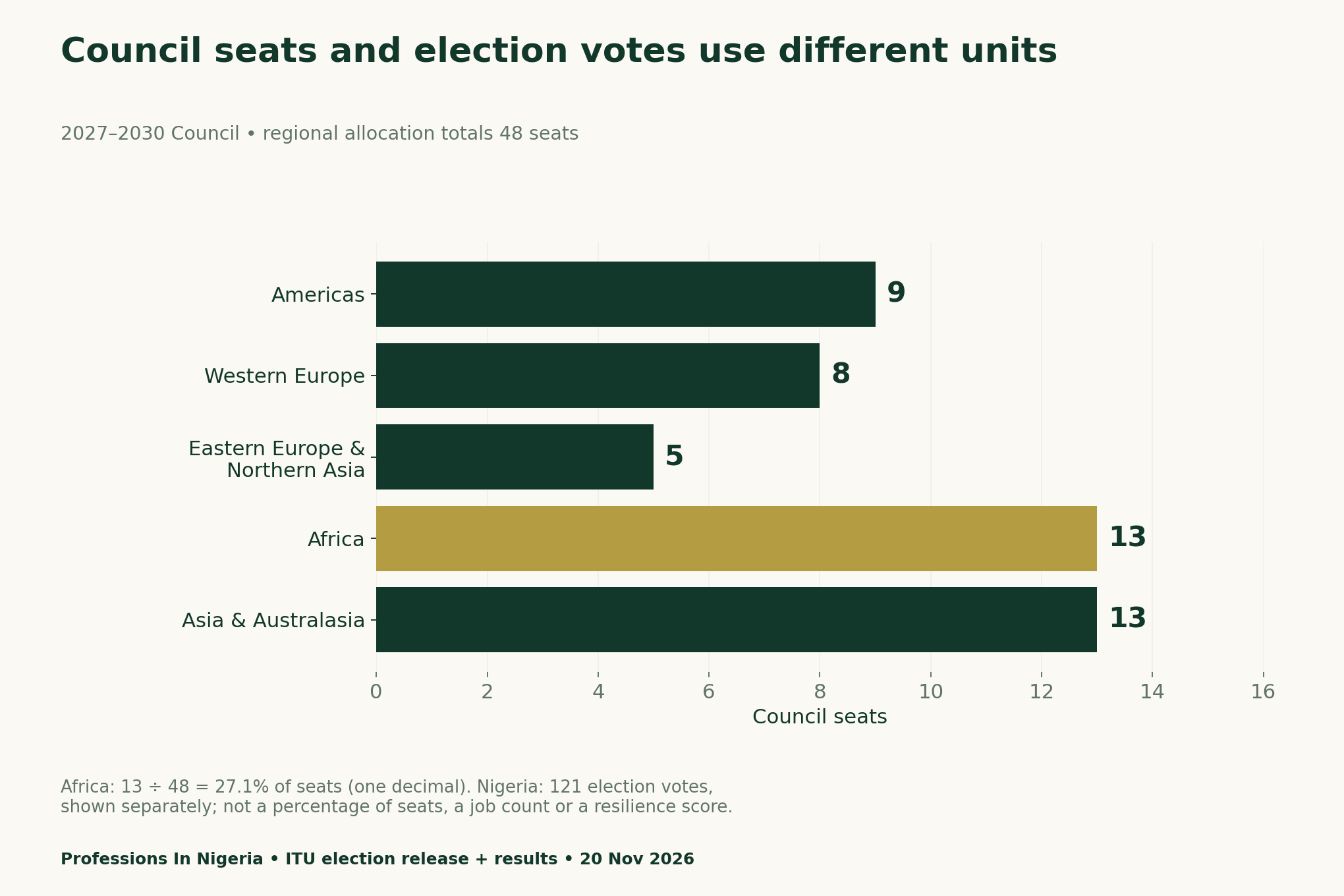
ITU’s 16 November 2026 election release lists Nigeria among the Council members for 2027–2030. Its regional allocations total 48 seats, including thirteen for Africa. The official results record 121 votes for Nigeria. Seats and votes are different units and cannot share a meaningful denominator.
The Council governs ITU between Plenipotentiary Conferences. That international governance role does not by itself create a domestic job, certify a candidate or prescribe an employer’s operating procedure. Therefore, use the election as context rather than evidence that a particular Nigerian role is open.
What thirteen out of forty-eight measures
Thirteen divided by forty-eight is 27.1%, rounded to one decimal place. That is Africa’s share of Council seats. It is not Nigeria’s share of election votes, a percentage of telecom workers or a measure of network resilience. The 121-vote result remains a separate reported count.
A good portfolio preserves units this carefully too. If a table mixes cases, people, hours or percentage shares, explain each measure before making a comparison. A neat chart cannot repair a denominator that answers a different question from the one in your headline.
The advisory work is a separate source
ITU’s International Advisory Body working-group page identifies three streams: timely deployment and repair; risk identification, monitoring and mitigation; and connectivity with geographic diversity. The 2026 working-group report brings their work together. ITU’s 10 July release describes approval of the final report.
That July material supplies background for the November news hook; it is not a newly issued November rule. Also, international advisory recommendations do not automatically become Nigerian law or an operator’s approved procedure. Check the applicable domestic and employer requirements separately for any real work.
Turn the workstreams into three proposed work samples
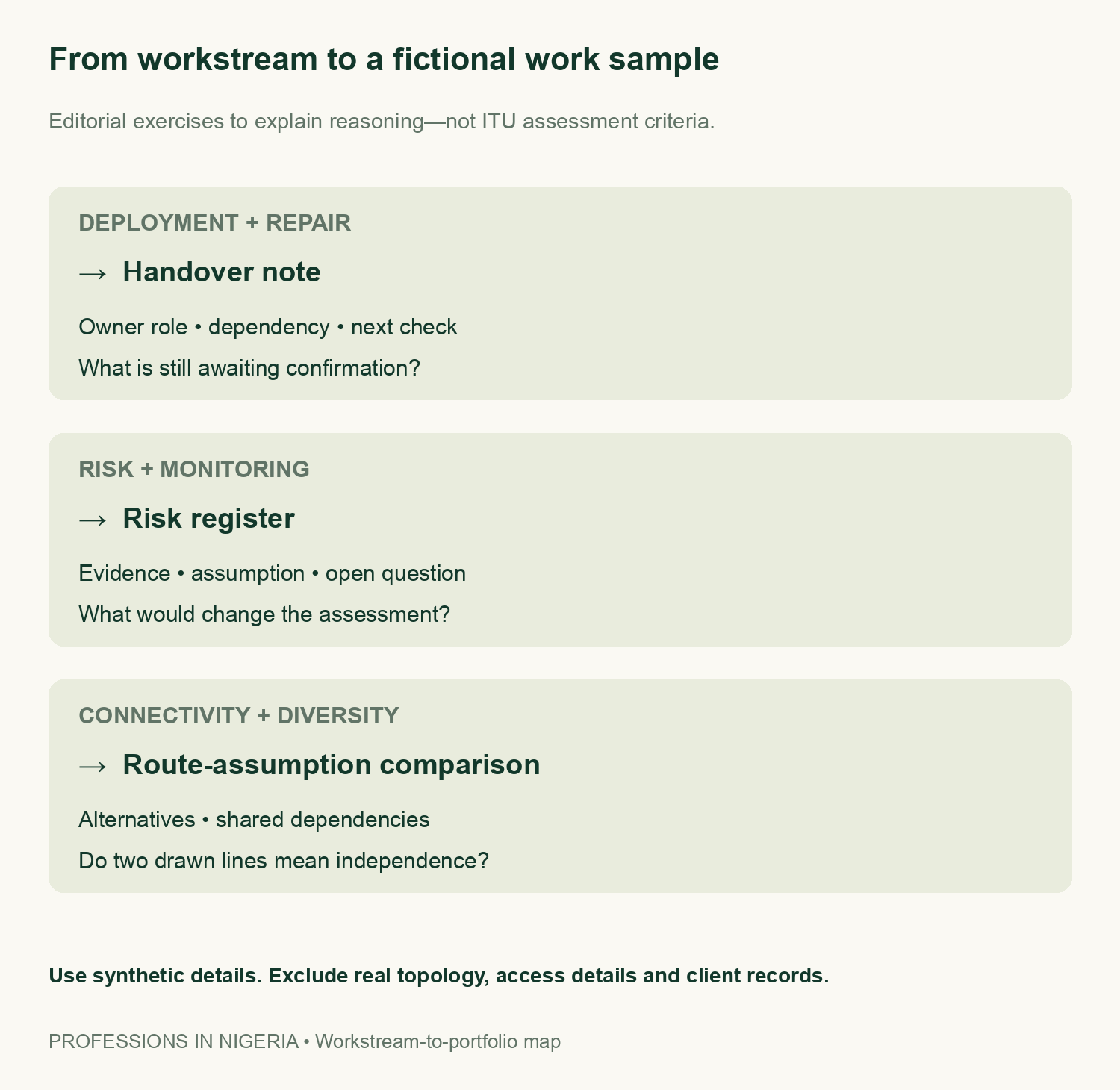
Choose a small synthetic scenario and state its limits at the top. Then build the artifact so a reviewer can understand the question, assumptions and unresolved issue. The purpose is to show your reasoning and communication. Do not imply that you assessed a real operator or solved an actual outage.
Work sample one: a fictional handover note
For a deployment or repair coordination exercise, write a brief handover with an owner role, a dependency and the next check. For example, a fictional review may remain pending because another role has not confirmed an assumption. State that dependency instead of describing the task as ready.
Keep the example free of real schedules, vessel arrangements, site identifiers or access details. A reviewer should be able to see what information the next person needs and which decision remains open. This is a communication sample, not a repair procedure or an instruction to contact a real operations team.
Work sample two: a fictional risk register
Separate a proposed risk statement from the evidence supporting it. Add an assumption, an unknown and the evidence you would need before revising the assessment. If your synthetic scenario supplies no likelihood data, leave that limitation visible instead of inventing a precise probability.
For example, write that a shared dependency is assumed and still requires confirmation. Explain what evidence could support or challenge that assumption. Avoid copying an employer’s incident register or presenting an invented entry as a finding about Nigeria’s telecom infrastructure. A clear unknown can demonstrate better judgement than an unsupported score.
Work sample three: compare route assumptions
Two drawn routes do not prove independence if the exercise assumes they share a support, corridor or other dependency. Use an abstract comparison with no real geography. Describe what is independent in the model, what is shared and what remains unknown. Do not calculate availability from a sketch alone.
This exercise tests whether you can expose an assumption, not whether you know a real cable route. Keep it distinct from an engineering design, security assessment or operating recommendation. Ask a reviewer whether the conclusion follows from the synthetic facts you actually supplied.
A review rubric without a certification claim
Our proposed worksheet asks whether the artifact has a clear question, traceable evidence, explicit assumptions and a revision path. It contains no pass threshold or employability score. A tutor or peer can use the questions to discuss the work, but their response does not become an ITU credential.
Also check that every factual statement points to an appropriate source. Label editorial suggestions and fictional details as such. For related evidence-writing principles, our subsea training evidence guide separates observed work, supervised practice and defined sign-off. Those distinctions also prevent a portfolio from overstating experience.
Keep operational and personal information out
Use invented roles and generic objects. Exclude real topology, cable coordinates, security weaknesses, credentials, access procedures, customer details and confidential incident records. Obtain the relevant permission before sharing any work-derived material; a public portfolio does not need those details to show sound reasoning.
Our blank files remain with you and do not submit information to ITU, a regulator or an employer. Browse our Telecommunications coverage for wider context. The official source links remain the basis for the Council and advisory-work claims in this article.
Download the evidence and portfolio tools
- Council seats, vote count and denominator register (CSV)
- Workstream-to-portfolio mapping and review questions (CSV)
- Clearly fictional portfolio example register (CSV)
- Blank portfolio evidence-review worksheet (CSV)
Method and limits
We checked the ITU election release, official result and advisory-work pages on 20 November 2026. Regional seat counts sum to forty-eight; the Africa share uses thirteen divided by forty-eight. We keep the 121-vote count separate and calculate no vote share. No operator data or hiring evidence enters the analysis.
The work-sample mappings, examples and review questions are our editorial proposals. They do not establish certification, Nigerian legal duties, a real network’s resilience or a candidate’s employment prospects. Use the source distinctions and synthetic exercises to explain telecom resilience skills Nigeria without turning a governance headline into a career guarantee.


