




NCDMB subsea training Nigeria has a new twelve-month cohort announcement. Its numbers describe selection and planned training, not job placement. This guide reads those denominators carefully and proposes a non-confidential learning log that separates observing a task, practising under supervision and recording a defined sign-off.
NCDMB subsea training Nigeria: what the announcement says
NCDMB’s 19 November 2026 release describes a programme with Chevron Nigeria and Marine Platforms for fifty selected graduates. It reports 150 selection-test participants, six months of classroom teaching and six months of structured on-the-job training. The partners have already chosen this cohort; the announcement does not invite new applications.
Keep a programme announcement distinct from a vacancy advert. Someone evaluating future training can use it to frame questions about delivery and assessment, but should not assume that the same entry route, numbers or timetable will apply again. Instead, check a future official call on its own terms.
What fifty out of 150 actually measures
Dividing fifty selected participants by 150 test participants gives 33.3% when rounded to one decimal place. The denominator is people who took the selection tests. It is not the full applicant pool, and the result is not a forecast of an individual’s chance in a future cycle.
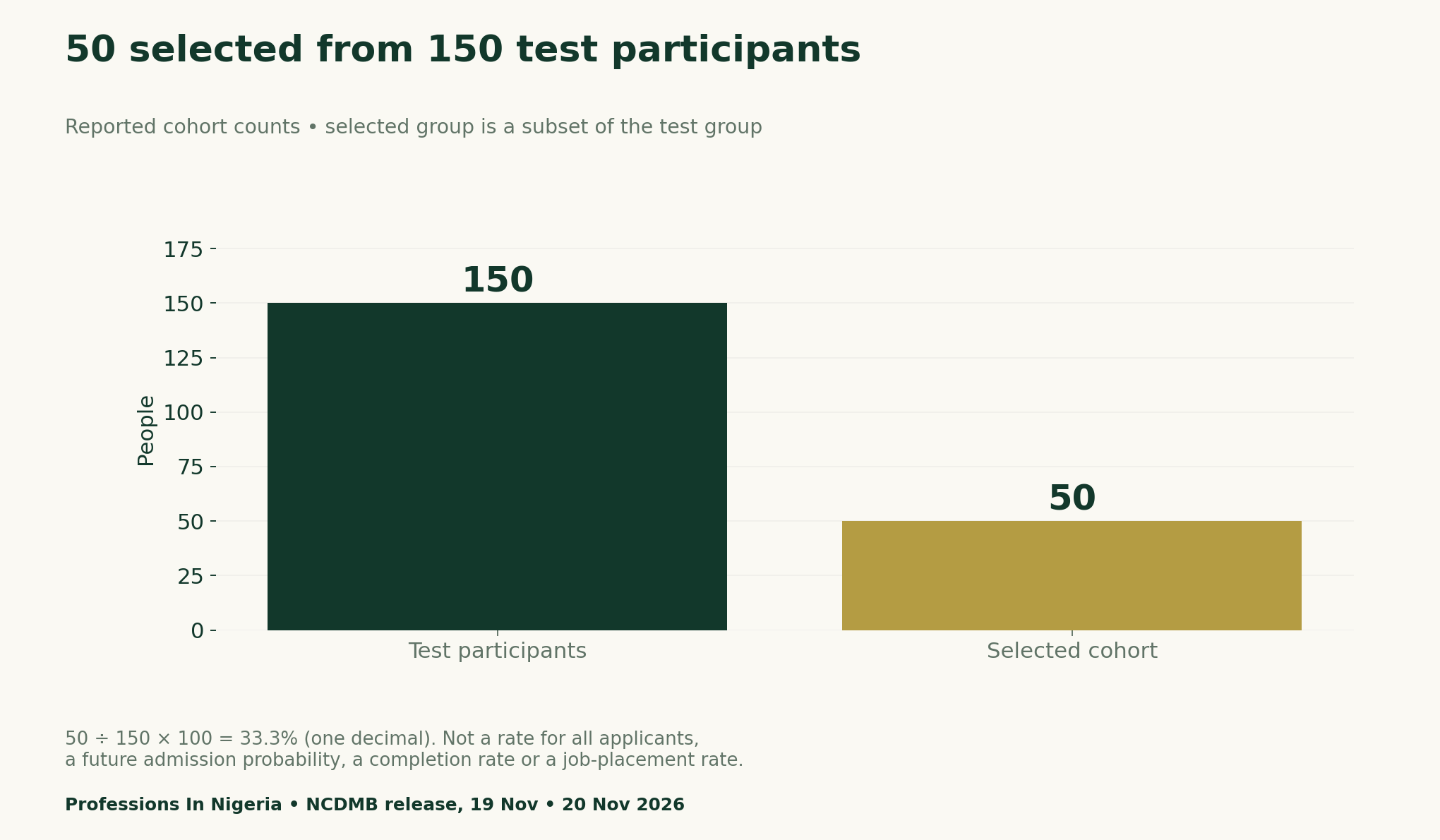
The announcement does not provide the total number who first expressed interest or submitted applications. Therefore, this article does not back-calculate a wider acceptance rate. It also does not turn the selected number into an employment outcome: entering a programme and securing a job are different events.
Six months in class and six months on the job
The two planned phases total twelve months, and each accounts for half of that planned duration. That arithmetic does not establish equal contact hours or equal learning value. Nor does a calendar plan tell you how many participants will complete particular tasks or meet assessment criteria.
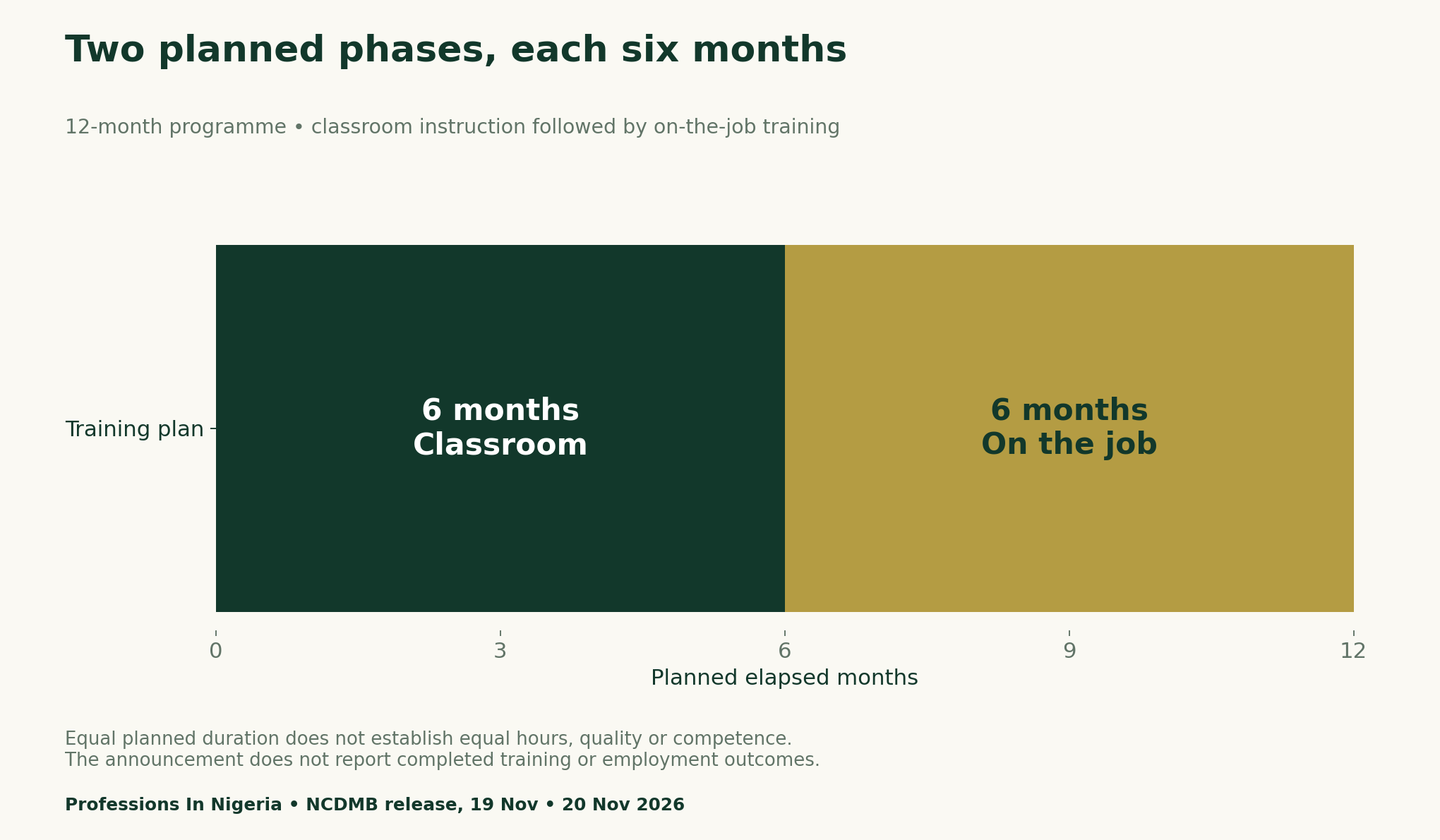
When comparing programmes, ask how the provider defines the practical phase, assigns supervision and records assessment. Request the boundaries of what a trainee may do and who authorises it. Our log helps describe evidence; it does not give operational instructions or permission to perform offshore work.
Familiarisation and certification are different claims
The release includes safety, subsea systems, installation, ROV familiarisation and integrity topics. It also states that participants must pass the relevant examinations for international certifications; attendance alone does not guarantee them. Do not describe familiarisation as a licence, certification or independent operating competence.
If a course describes exposure to a system, ask what the exposure involved. Was it a demonstration, a controlled supervised exercise or an assessed activity? As a result, those distinctions make a training account more useful than a list of equipment names. Preserve the context rather than upgrading the claim in a CV.
Three useful evidence labels
| Proposed label | Meaning | Boundary |
|---|---|---|
| Observed | Watched an authorised demonstration | Observation only; no independent competence claim |
| Practised under supervision | Performed an authorised task under supervision | Scope and supervision must be described |
| Signed off | Assessed evidence with authorised reviewer and criteria | Record scope; not automatic licence or certification |
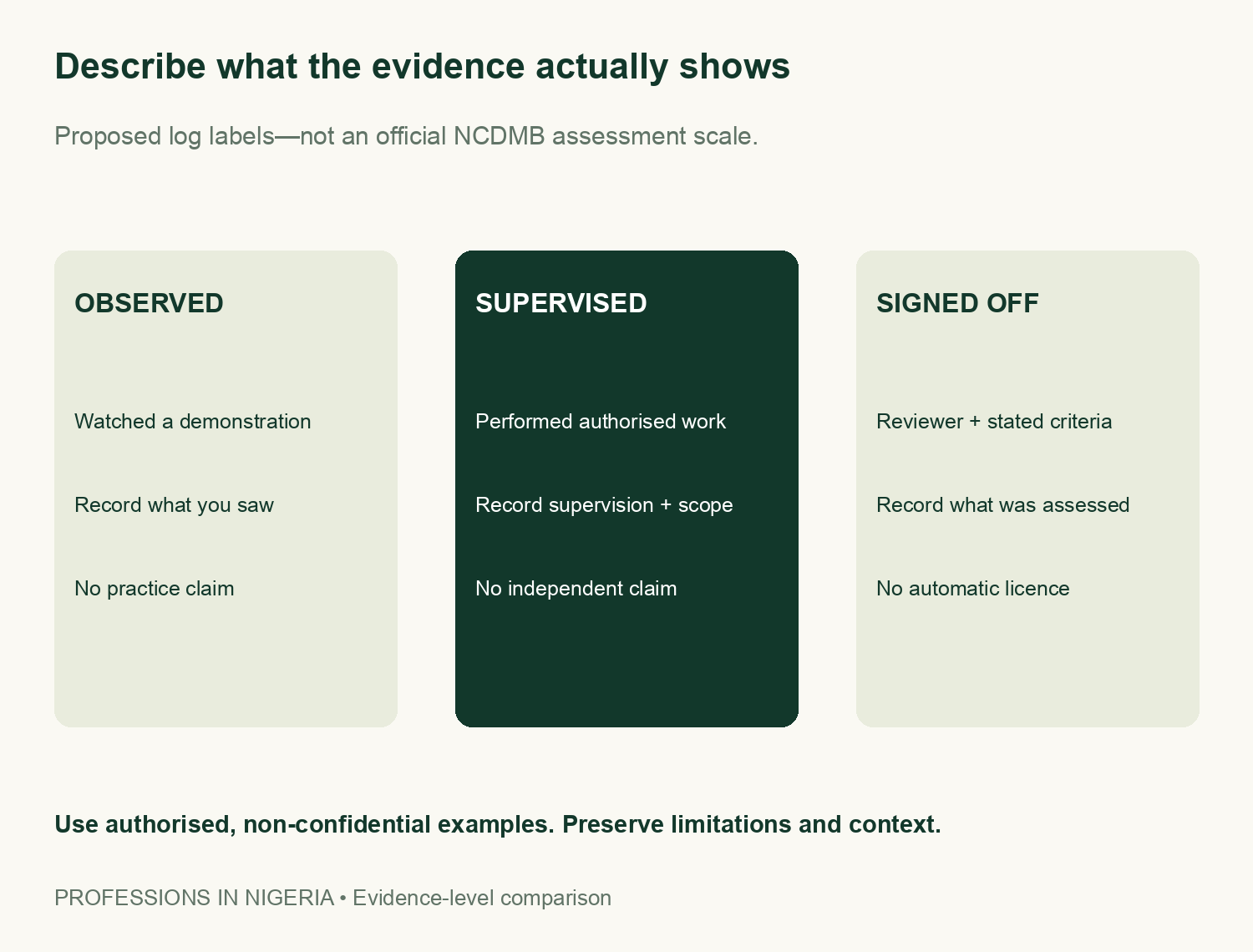
For observation, record the general learning area and what you watched without claiming performance. During supervised practice, describe the authorised activity and the supervisor’s role. For a sign-off, record the scope, criteria and reviewer role, then retain any limitation on what the result demonstrates.
Build a non-confidential learning log
First, keep the entry short enough for a reviewer to understand the task category and your contribution. Use a sanitised activity summary and a permitted reference to the assessment criteria. Ask the training provider what you may retain or share; access to a worksite does not make its information public.
Exclude vessel schedules, client records, coordinates, security arrangements, proprietary drawings, system access details and identifiable personnel records from a public portfolio. A general account of an authorised learning activity can explain your reasoning without disclosing operational information. Do not upload restricted material to this website or social comments.
An illustrative entry structure
A fictional entry might state that a trainee observed a classroom review of an installation-planning example, then identified a question to raise with the instructor. It would label the evidence as observed and leave performance and sign-off fields unclaimed. The activity is invented to demonstrate record structure, not a report about this cohort.
However, a later entry should not silently overwrite the earlier evidence level. Record the new authorised activity, date and review context separately. This preserves the difference between learning about a task and being assessed on a defined task. The log is not a procedure for carrying out installation, lifting or ROV operations.
Questions for a future training provider
Ask what classroom and practical phases include, how supervision works, what assessment is required and what outcome evidence will be available. If certification is discussed, ask who awards it and what must be passed. Treat employment support and confirmed employment as separate questions.
Our Oil and Gas coverage provides wider career context. Use the official provider’s current documents for any future programme decision. Do not treat our source analysis as an endorsement of a course or a promise that this selected cohort will achieve a particular outcome.
Download the source data and learning log
- Selection counts and denominator calculation (CSV)
- Planned training phases and shares (CSV)
- Proposed evidence-level dictionary (CSV)
- Blank non-confidential learning evidence log (CSV)
Method and limits
We checked the NCDMB announcement on 20 November 2026. The selection percentage uses fifty divided by 150; the phase shares use six divided by twelve. We label reported counts and calculated shares separately. The evidence labels and blank log are our proposed editorial tools, not official forms.
The announcement supplies no completed-cohort outcomes, placement results or independent competency findings. Revisit the primary announcement for its exact scope. Keep those boundaries when using this guide to discuss NCDMB subsea training Nigeria or compare a future learning opportunity.


