



A confidentiality checklist for public service secretaries in Nigeria should help staff make a specific handoff traceable. Which document, to whom, through which approved route, and with what unresolved question? A completed box alone cannot authorize a transfer.
BPSR’s November 24 training announcement provides the news context. Our original desk exercise turns the handling question into three fictional scenarios and a four-field register. The chart counts populated notes, not breaches prevented, legal compliance or employee competence.
Confidentiality checklist: separate the news from the tool
The FMINO report on BPSR’s programme describes a five-day event scheduled for November 23–27, 2026. It highlights responsible handling, recipient checks, approved channels and need-to-know. It also cautions against using confidentiality to withhold information lawfully required through authorised routes.
That announcement is not a new statute or a mandatory credential. Nor does it report a measured reduction in breaches. Therefore, the worksheets below are editorial training aids, not BPSR certification materials or evidence that a particular office has passed an audit.
Four fields that keep a handoff specific
| Field | Record in the exercise | Avoid this shortcut |
|---|---|---|
| Sensitivity | Applicable status or clarification from the responsible role | Guessing from a filename |
| Recipient | Identity, role and authority for this purpose | Assuming familiarity equals access |
| Channel | Approved route and correct document version | Treating any messaging app as authorised |
| Escalation | Responsible office and decision or incident reference | Leaving an unresolved issue without an owner |
For practice, use mock references and invented document descriptions. Keep actual confidential files, passwords and personal data out of a public worksheet or training screenshot. If a real issue arises, use the institution’s prescribed reporting and records procedures rather than copying the file into this exercise.
Scenario A: the address is wrong, although three fields are filled
In our fictional note, a secretary records an internal draft, an office-email channel and the wrong intended recipient. The escalation field is blank. Three of four fields contain text, but the known recipient mismatch is a reason to stop the proposed transfer and seek the correct handling route.
If a message has already gone to the wrong person, treat that as a possible incident under the organisation’s procedure. Do not assume an email-recall control undoes delivery. Preserve the relevant record and report through the prescribed route; do not create more uncontrolled copies while trying to explain what happened.
Scenario B: someone forwards an attachment “for convenience”
A second fictional note names a requester and a registry supervisor, but leaves sensitivity and the approved channel unresolved. Only two of four note fields are populated. The requester’s name does not establish a right to receive the attachment, and a convenient app does not establish an approved route.
Instead, confirm the document owner’s handling instruction, the recipient’s authority and the correct version before a new handoff. Record the clarification without reproducing the attachment’s sensitive contents. A secretary can maintain the decision trail without becoming the person who invents a release permission.
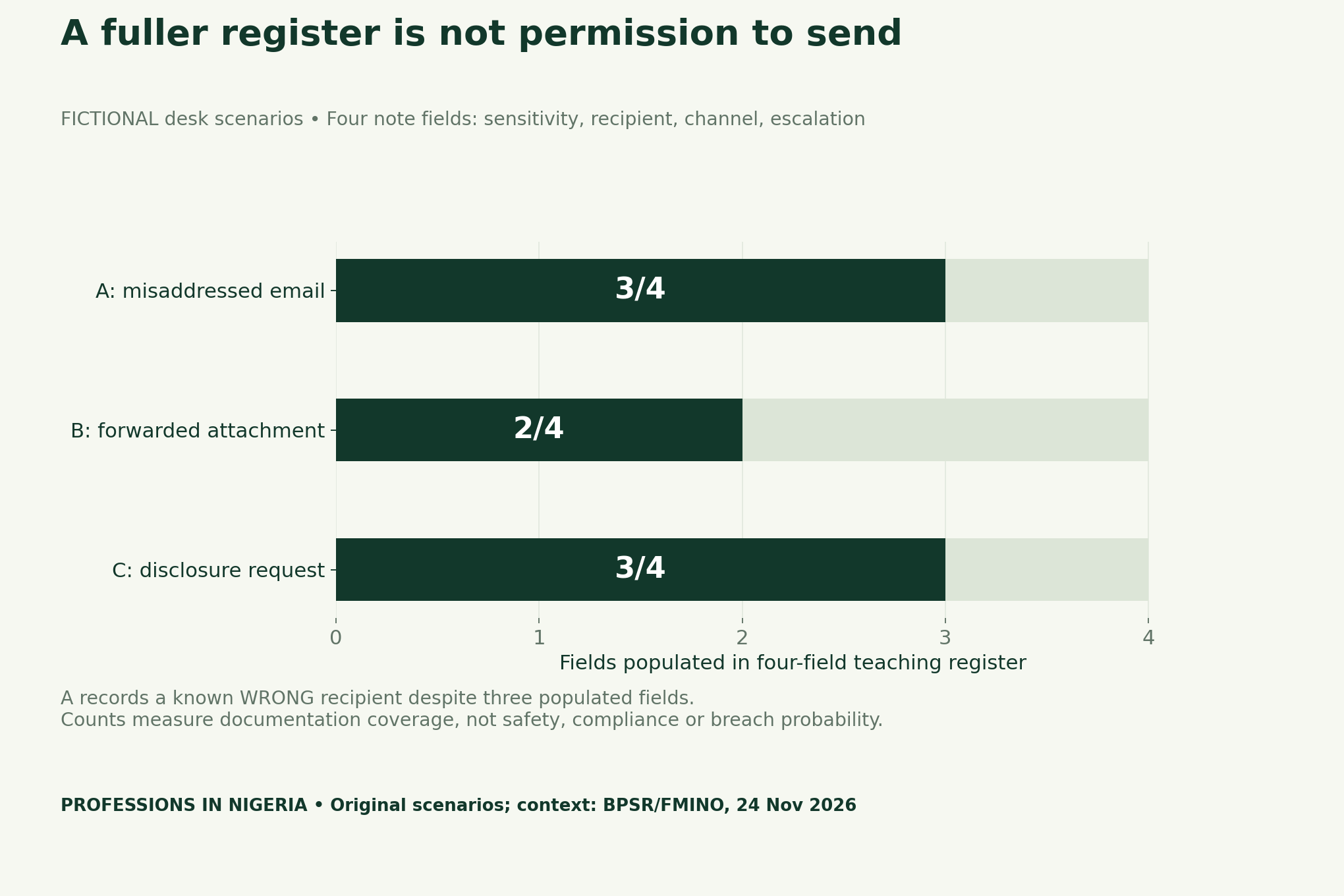
The arithmetic is deliberately modest. We count a field when the fictional row contains a note, including a note that records a mismatch. We do not award risk points, claim that three quarters of a process is safe, or estimate a probability of disclosure. The downloadable scenario table makes that counting rule reproducible.
Scenario C: a request for lawful access needs the proper decision route
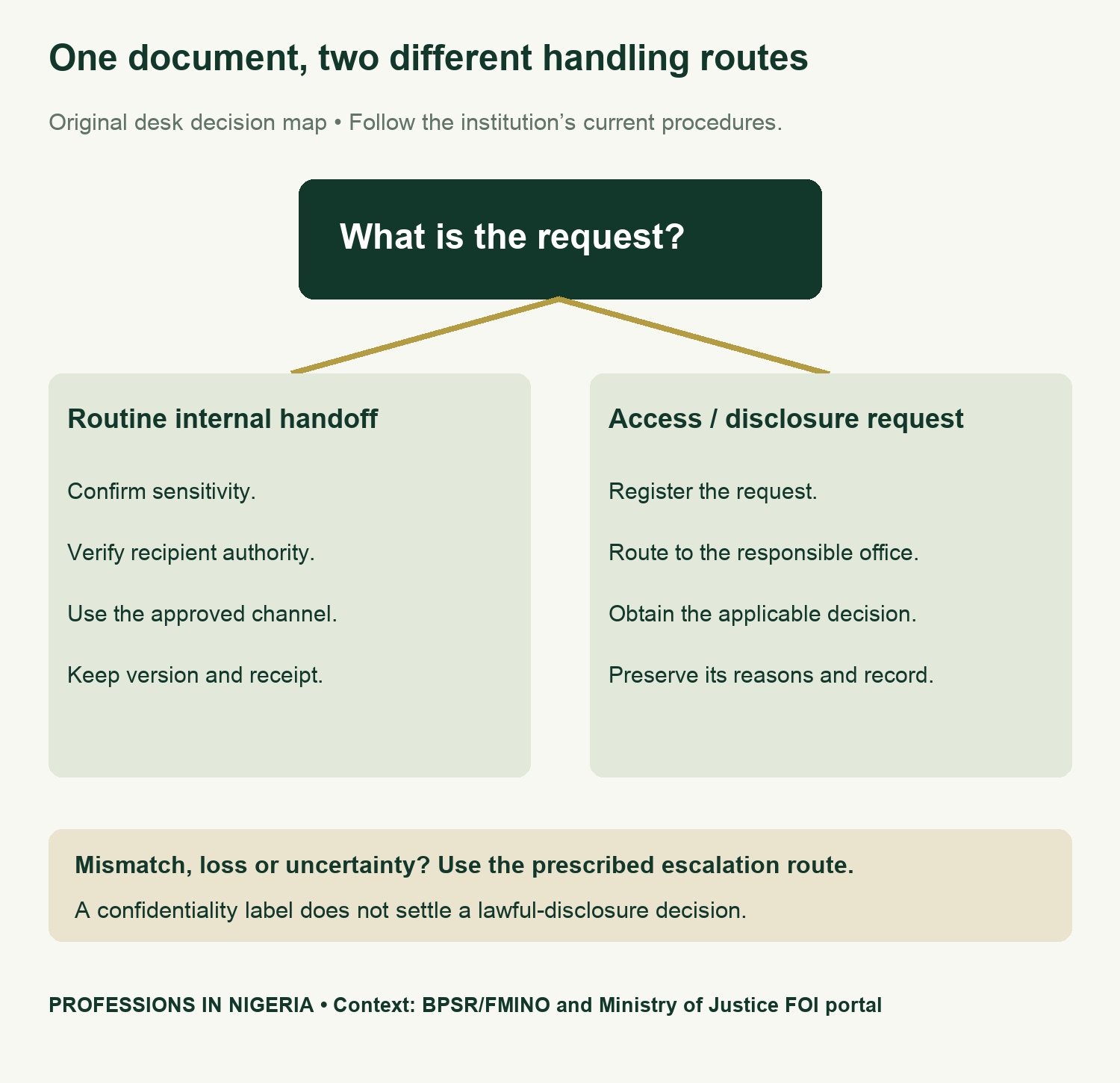
Our third fictional row records document status, the responsible FOI handling role and an official request route. It leaves the escalation or decision reference blank, so it also has three populated fields. This is a request to route and resolve, not automatic permission to send or an automatic reason to refuse.
The Federal Ministry of Justice FOI portal describes both public access and protection of records and personal privacy. Its linked Act and guidance provide the legal framework. A secretary should direct a real request to the designated handling office for the applicable assessment and decision, preserving the request reference and response trail.
In particular, do not treat “confidential” as a universal answer to an access request. Equally, this article cannot decide that a particular file must be released. Any exemption, disclosure obligation or contested decision depends on the actual record and applicable law; use the authorised institutional process and qualified advice where needed.
Run the exercise without turning it into an employee score
An office trainer can give staff the three mock rows, ask them to identify the unresolved issue, and compare their proposed routing notes. Next, revise the fictional register after an agreed clarification. Keep the original row so the change is visible; avoid calling the exercise a validated assessment of real staff performance.
For related career context, our medical-secretary interview guide includes questions about workplace handling arrangements. Our public-service evidence guide discusses a different official-record route. Neither replaces the current instructions governing this handoff.
Download the desk exercise
- Three fictional desk scenarios and field counts (CSV)
- Four-field handoff dictionary (CSV)
- Source claims and limits register (CSV)
- Blank mock document-transfer register (CSV)
Method, limits and citation
Professions In Nigeria checked the official announcement and Ministry of Justice portal on 28 November 2026. We created the three scenarios and counted populated fields in their retained CSV rows: 3, 2 and 3 out of 4. One documentation chart is sufficient; invented breach statistics would misrepresent the evidence. Targeted duplicate checks were not exhaustive.
Credit Professions In Nigeria for the original scenarios, chart, decision map and tools; BPSR/FMINO for the November 24 training announcement; and the Ministry of Justice for the FOI context. This article concerns practical record handling and does not establish a new credential, legal ruling or measured training effect.