



To learn how to compare NMCN pass rates at nursing schools, first ask who is counted. A 100% result can accurately describe a named group without describing everyone who entered the programme. The numerator, denominator and date must travel together.
UNIMED’s November 26 report says it inducted 59 nursing graduates and achieved a 100% NMCN qualifying-exam pass rate. However, the report does not publish the full breakdown needed to equate inductees, exam sitters, first-time candidates and the starting intake. Our guide separates that news from a clearly fictional arithmetic exercise.
How to compare NMCN pass rates: preserve the reported claim
The University of Medical Sciences report provides a timely example of a successful examination headline. Record its publication date, the 59 inductees and the reported 100% result as separate fields. Do not silently use the induction count as the examination denominator.
| Reported item | What the article supports | What remains unanswered |
|---|---|---|
| 59 inducted graduates | A reported induction count | Whether all exam sitters and inductees are identical groups |
| 100% qualifying-exam pass rate | The institution’s reported result | Candidate count and first-time/repeat breakdown |
| November 26, 2026 | Publication date | Full entry-cohort and outcome-cutoff reconciliation |
In particular, an absent breakdown does not disprove the reported result. It limits the comparisons a reader can make from that article alone. Ask the institution for a dated, aggregate explanation before treating the percentage as an intake-to-qualification measure.
A fictional example: 59 divided by 59
Imagine a wholly fictional nursing cohort with 59 people sitting a specified examination and all 59 passing. Its examination pass rate is 59 ÷ 59 × 100 = 100%. Both the numerator and denominator refer to the same sitting and candidate definition.
Now imagine that 75 people originally started that same fictional cohort. Holding the 59-person outcome fixed gives 59 ÷ 75 × 100 = 78.666…%, or 78.7% to one decimal place. This second calculation measures that outcome among starters; it is not the examination pass rate among sitters.
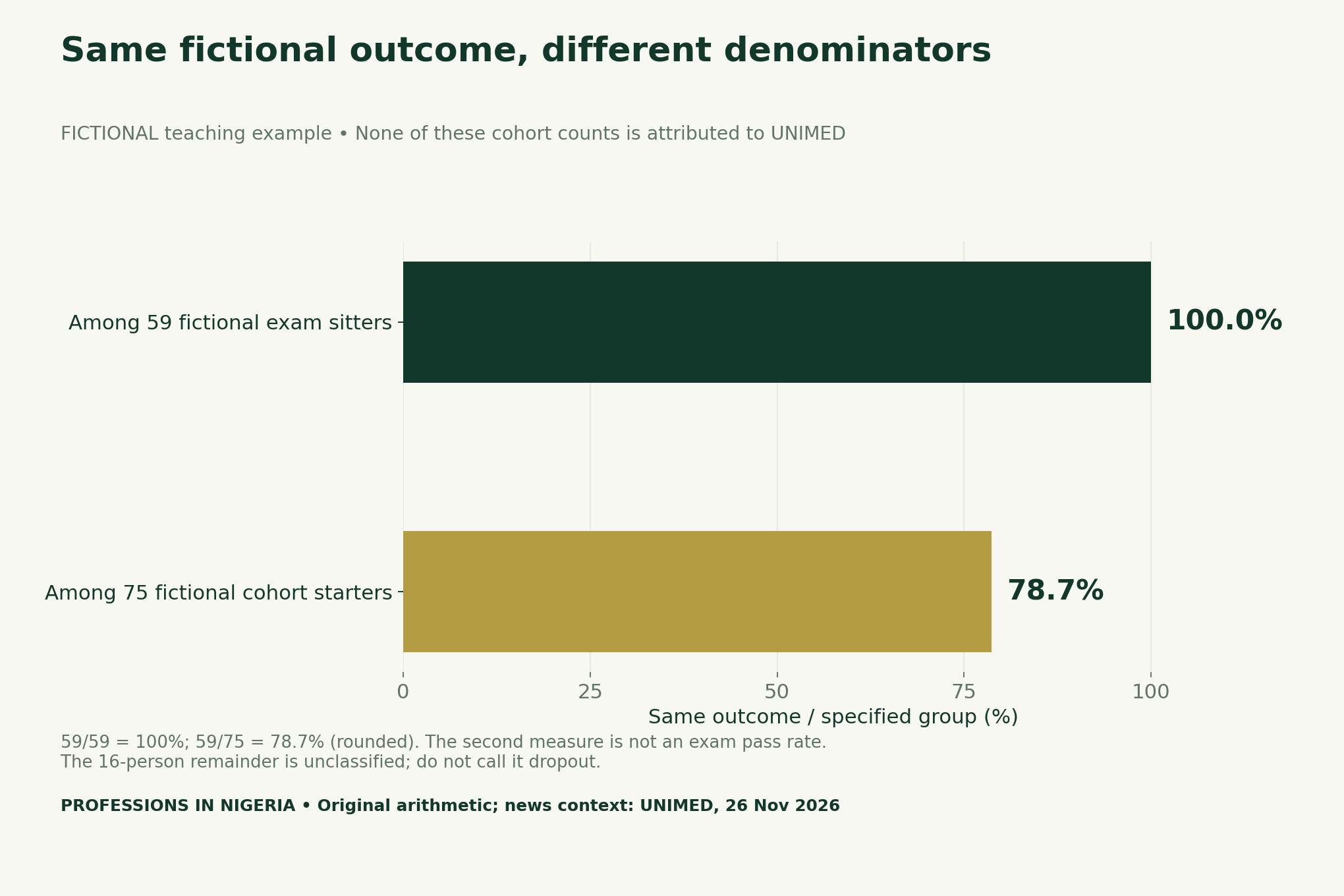
The difference is about 21.3 percentage points, not a 21.3-person loss. Also, 75 minus 59 equals 16 people outside the specified numerator at that cutoff. Their status is unresolved in this invented example. It could involve timing or other pathways; the arithmetic alone cannot label it dropout.
Match the denominator before comparing two schools
Suppose School A reports first-time sitters while School B combines first-time and repeat sitters. Even if both publish a percentage, the measures answer different questions. First align the candidate definition, examination, cohort and cutoff; then compare the underlying counts alongside the rates.
Similarly, do not add rates or average them without their denominators. A simple teaching example is 9 passes from 10 sitters and 1 pass from 1 sitter. The pooled rate is 10 ÷ 11, about 90.9%; the unweighted mean of 90% and 100% is 95% and answers a different question. These counts are fictional too.
For a real school comparison, request aggregate counts rather than identifiable student records. A small public worksheet should not collect names, registration numbers or health details. Where definitions remain unclear, mark the comparison unresolved instead of filling a blank with an assumption.

Check the exact programme’s accreditation separately
The NMCN approved-schools page links a list labelled December 2025 and explains that approval information is subject to periodic review. Therefore, retain the list’s own date as well as the date you checked it. Do not relabel that list a newly issued November 2026 accreditation decision.
NMCN’s accreditation guidance distinguishes provisional, final and withdrawn status. For an application decision, match the exact institution, programme and status date, then resolve stale or conflicting information through the regulator’s official channels. A pass-rate headline is not a substitute for that check.
Our checklist does not rank schools or issue an accreditation opinion. It separates programme approval from an examination outcome, just as it separates passing from employment. None of the calculations estimates a graduate’s chance of receiving a job offer.
Use a dated comparison sheet
Start a new row for each exact programme and cohort. Next, record the examination sitting and whether the result covers first-time, repeat or all sitters. Write the numerator and denominator definitions in words before entering their counts. Finally, keep a source link, outcome cutoff and unresolved-question note.
If a school supplies a revised figure later, preserve the older entry and explain the revision. Avoid combining one school’s latest sitting with another’s multi-year cumulative result. A useful comparison is one a reader can reproduce, including the limits that remain.
For broader professional context, see our overview of nurses’ roles in Nigeria and continuing-education guide. Those overviews do not verify a particular school’s current cohort outcome or approval status.
Download the source notes and comparison tools
- UNIMED reported-claim register (CSV)
- Fictional denominator calculations (CSV)
- Cohort-definition and accreditation questions (CSV)
- Blank dated school-comparison worksheet (CSV)
Method, limitations and reuse
Professions In Nigeria checked the linked university and regulator pages on 28 November 2026. We retained the reported headline separately from invented teaching quantities and calculated each example directly from its stated counts. One chart is sufficient for the central denominator comparison; extra outcome charts would imply data the report does not provide. Targeted archive searches were not exhaustive.
Credit Professions In Nigeria for the original arithmetic, denominator map and worksheets, UNIMED for its November 26 report, and NMCN for the approval and accreditation guidance. The examples are a method for reading evidence, not a finding about undisclosed UNIMED intake numbers.