



A stalled construction project restart checklist in Nigeria should begin with evidence, not an old percentage copied into a new schedule. Junior planners and quantity surveyors can help by tracing versions, identifying gaps and keeping proposed updates separate from approvals.
This report uses a public restart announcement as the context, then works through four fictional package records. Two are reconfirmed, one is superseded and one awaits verification. That is a documentation count—not a finding that any real project is half complete.
What the National Library announcement establishes
The Federal Government’s November 20 release describes renewed work on the National Library headquarters in Abuja and an 18-month delivery target. It says construction began in 2006 and contract augmentation received FEC approval in August 2026. It also reports approximately 48% progress before the project stalled.
The release does not present the measurement basis for that historical percentage. It does not establish how much work is currently usable, the residual cost, individual package durations or recruitment demand. Therefore, this article does not convert the figure into a current programme baseline.
Stalled construction project restart checklist: preserve the baseline
Start by retaining the old schedule with its exact version and date. Keep the original record distinguishable from your working copy. An old plan may explain what was intended, while a newer approved scope may change what must now be done.
Next, identify the evidence needed to support each proposed entry. A junior planner can record the source, date and responsible reviewer without deciding whether physical work is safe or acceptable. Do not overwrite an unknown with a confident duration simply to make a chart look complete.
For example, a file labelled final is not enough if its approval status and applicable scope remain unclear. Put those questions beside the file reference. A traceable missing answer is more useful than an unlabelled assumption passed to the next person.
Four fictional work packages, three evidence states
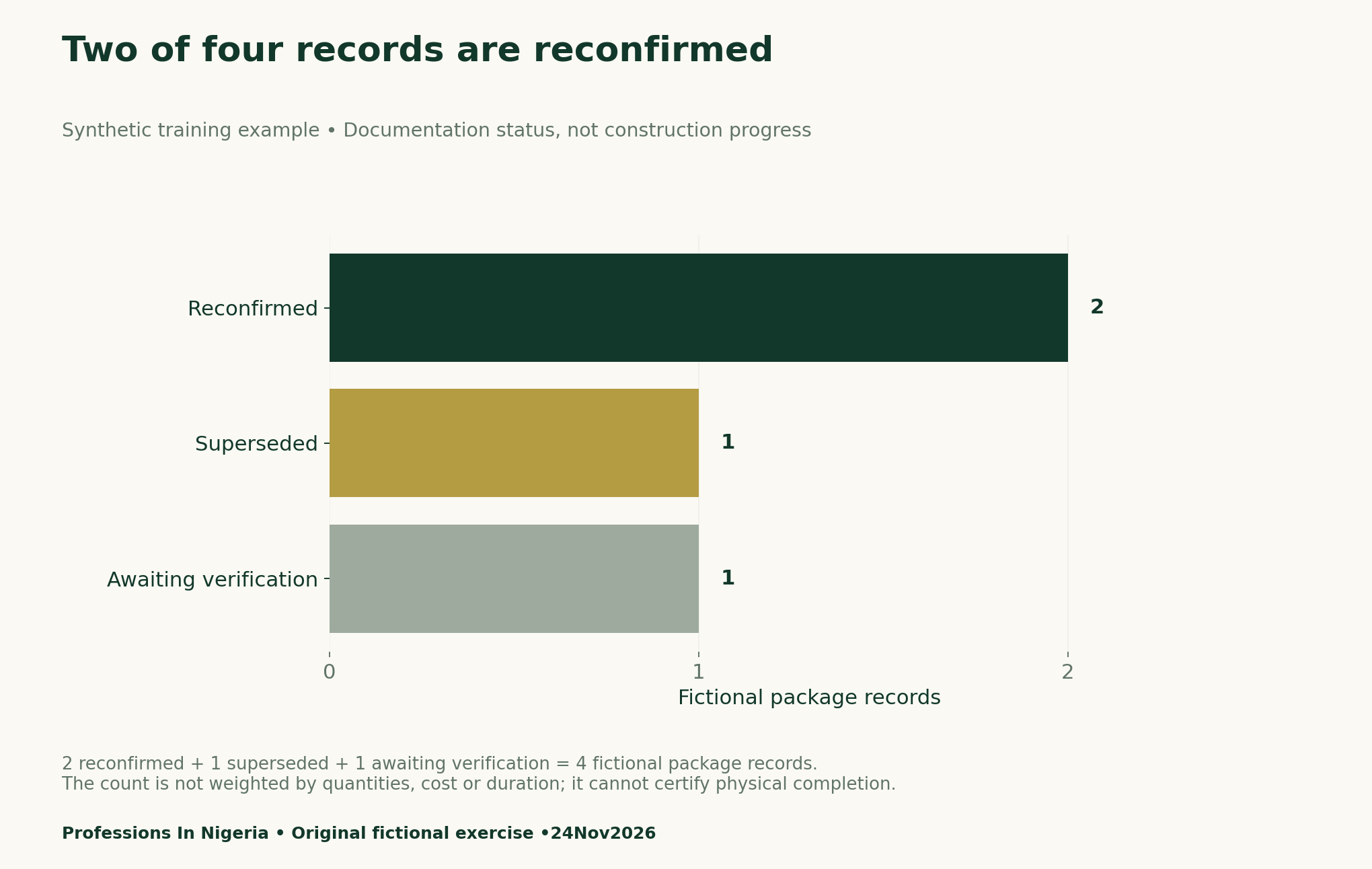
| Fictional package | Documentation state | What the planner records next |
|---|---|---|
| WP-A | Reconfirmed | Retain current evidence and responsible sign-off reference |
| WP-B | Reconfirmed | Retain current evidence and dependency |
| WP-C | Superseded | Link the applicable current revision; do not reuse the old entry |
| WP-D | Awaiting verification | Identify the responsible reviewer and unresolved evidence |
Two divided by four equals 50% of these fictional records. It does not mean 50% of construction is complete. A short activity and a complex package each count once here, regardless of their size, value or effect on a completion date.
Similarly, superseded does not mean defective. It means the retained record is no longer the applicable version in this exercise. Awaiting verification does not establish that work is unfinished; it records that the required confirmation is missing from the planner’s evidence set.
Separate current evidence, sign-off and dependencies
Use a different column for each part of the chain. Current evidence identifies the relevant record. Responsible sign-off identifies the confirmation needed from the person with authority. A dependency records what another proposed activity relies on. None should be silently inferred from another column.
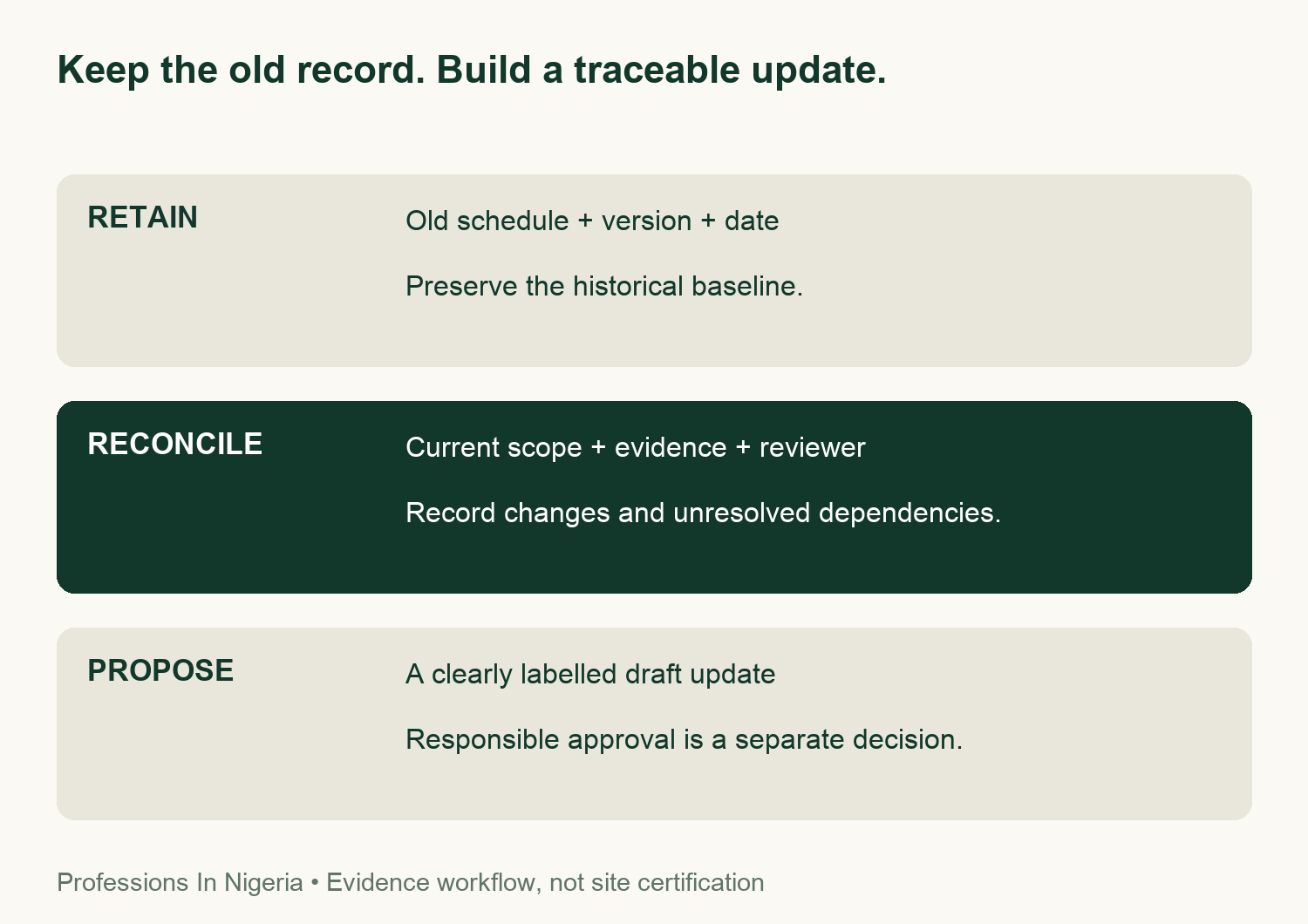
If a dependency has no current evidence, flag it before presenting a proposed sequence as settled. Keep a dated question log so the next reviewer knows what remains open. Do not claim that an announcement authorises release of a particular work package.
A useful handoff can be brief: the retained record is this version, the current evidence is this reference, and this dependency still needs confirmation. That sentence tells the reviewer what you checked and where your knowledge stops.
Use the exercise in a portfolio without inventing project access
A candidate can show the fictional register as an example of document control and careful reasoning. Label it synthetic throughout. Do not imply that you worked on the National Library project, inspected a site or accessed a contractor’s live records.
For wider role context, our building-inspector career guide discusses a different responsibility. This worksheet does not qualify a reader to assess structures, certify quantities, approve designs or direct site work. Those decisions remain with the appropriate responsible professionals.
Methods, limitations and four editable tools
We checked the official release on November 24, 2026 and built an original four-row teaching example. The historical percentage and delivery target are reported context; the package records are invented. No physical-condition assessment, cost estimate, critical-path calculation or employment forecast is offered.
The count chart and evidence-workflow infographic answer the document-reconciliation question. More numerical charts would imply project data that we do not possess. Before using the blank worksheet on real work, follow your employer’s document controls and protect confidential records.
- Fictional four-package evidence register (CSV)
- Blank restart and rebaseline worksheet (CSV)
- Source and measurement dictionary (CSV)
- Reproducible fictional documentation counts (CSV)
Suggested citation: Professions In Nigeria, “Restarting a Stalled Public Project: What a Junior Planner Must Verify,” November 24, 2026. Cite the government release for project context and this report for the original synthetic exercise.