




Community health outreach skills in Nigeria include the operational work that makes a service plan usable: checking records, preparing schedules, documenting transport assumptions and reconciling what happened. Kebbi’s newly published outreach figures offer a useful case for learning to read such evidence carefully.
Checked October 26, 2026. This report examines programme indicators and proposes a fictional, non-clinical planning exercise. It gives no vaccination protocol, treatment instructions or authority to practise. A portfolio exercise cannot replace the qualifications, registration, supervision or role limits that apply to a health post.
Community health outreach skills Nigeria: what the new figures measure
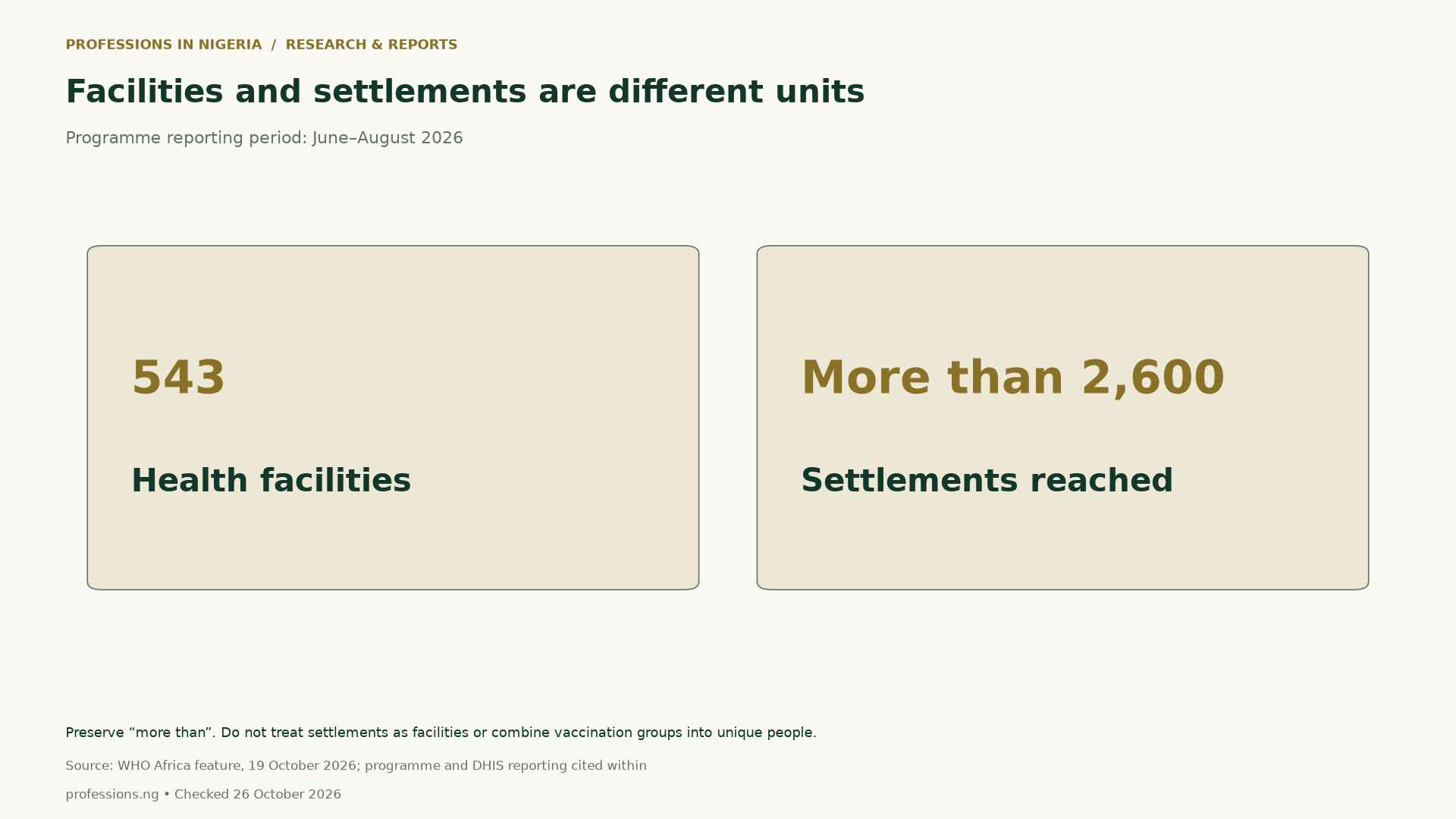
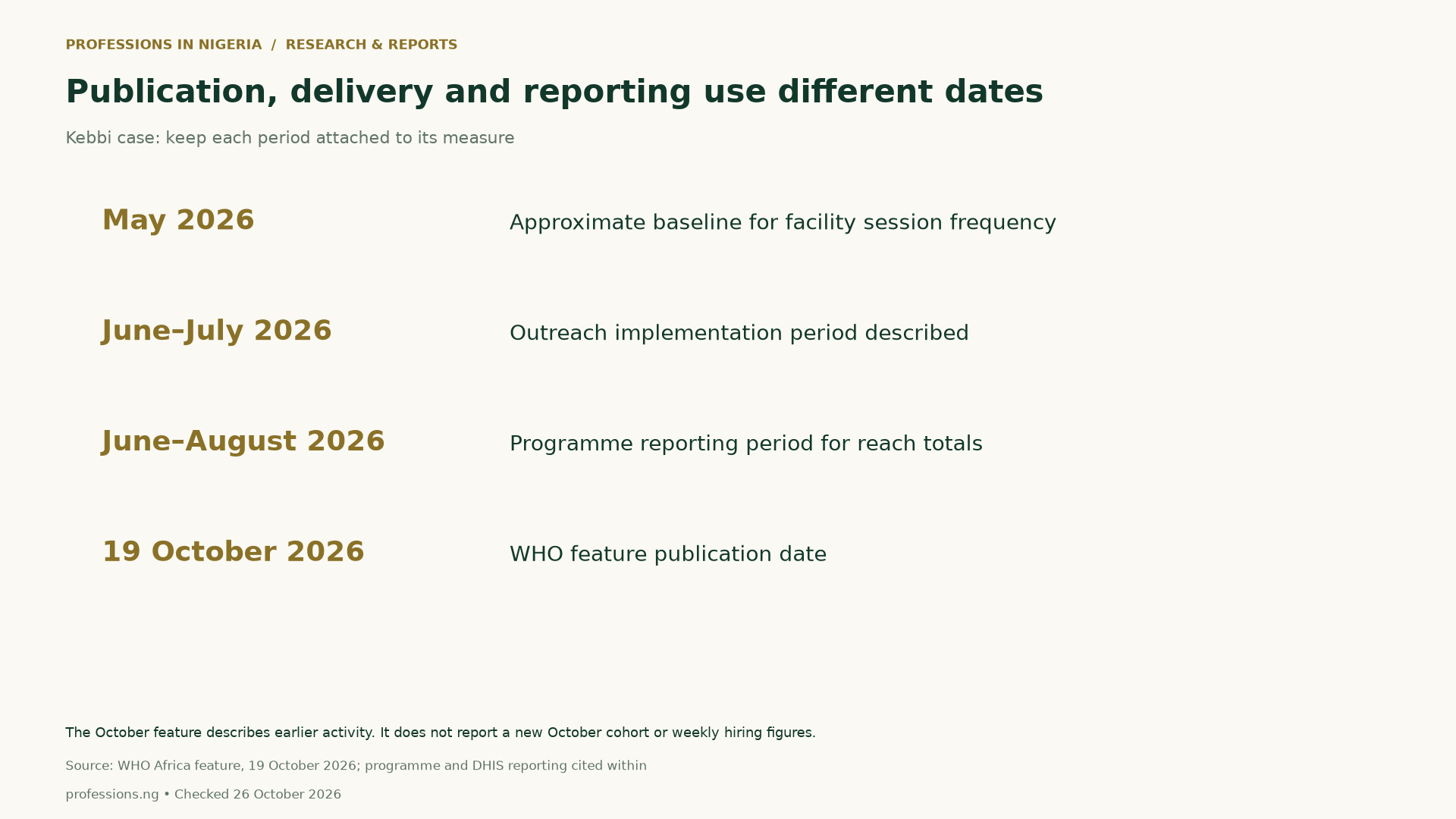
The WHO feature published October 19 describes June–July 2026 implementation and cites June–August programme reporting. It reports 543 facilities reaching more than 2,600 settlements. A separate indicator puts facilities conducting at least four outreach sessions at about 75% in May and 86% in July.
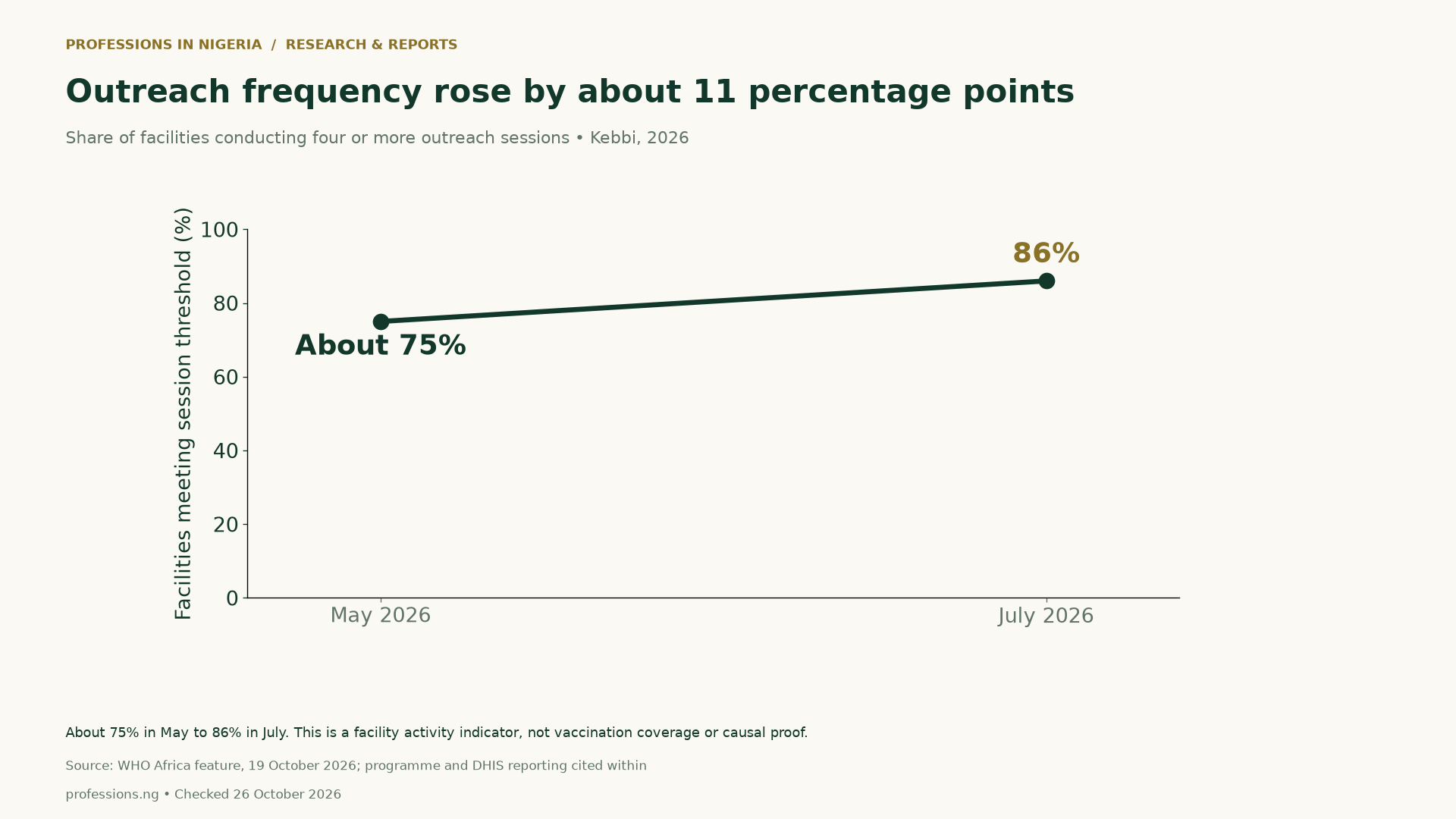
The percentage describes facility activity, not the proportion of children vaccinated. We do not assume an unchanged denominator or add separately reported vaccination groups into a unique-beneficiary total. The feature establishes neither job vacancies nor wages. Its descriptive account cannot isolate the effect of outreach from other influences.
Keep the publication date separate from the delivery period
A recent story can describe activity completed months earlier. Keep the relevant period beside each measure when quoting it. A useful evidence register contains the publication date, measurement period, unit, qualifier and source link. That structure helps another reader see exactly what the headline can support.
This distinction also matters when preparing for an interview. Instead of saying that a programme created a certain number of jobs, describe the indicator accurately and ask what operational responsibilities a specific advertised role contains. Check the actual job description, employer and contract rather than inferring them from programme reach.
A fictional settlement list: begin by finding the gaps
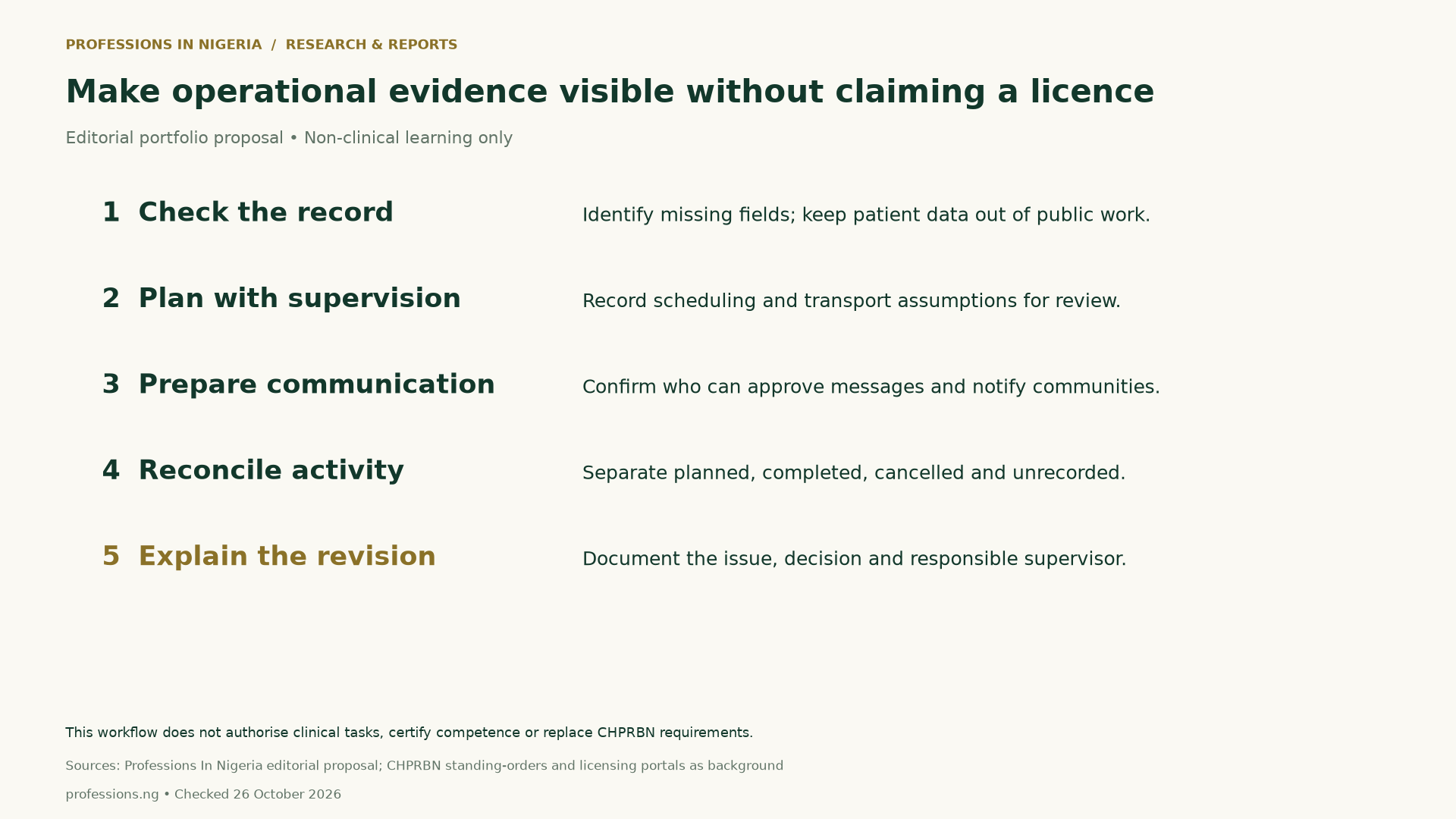
Our proposed exercise starts with four invented identifiers: DEMO-A, DEMO-B, DEMO-C and DEMO-D. They do not represent Kebbi communities or real patients. The worksheet deliberately includes missing schedule, transport or communication fields. Its purpose is to make record-quality decisions visible before any activity is promised.
First, identify which field is missing and why it matters. A missing schedule is a question for the responsible supervisor, not permission to invent a visit date. An undocumented transport assumption needs clarification before someone presents a plan as feasible. A blank communication field means the plan still needs an approved route for informing the intended community.
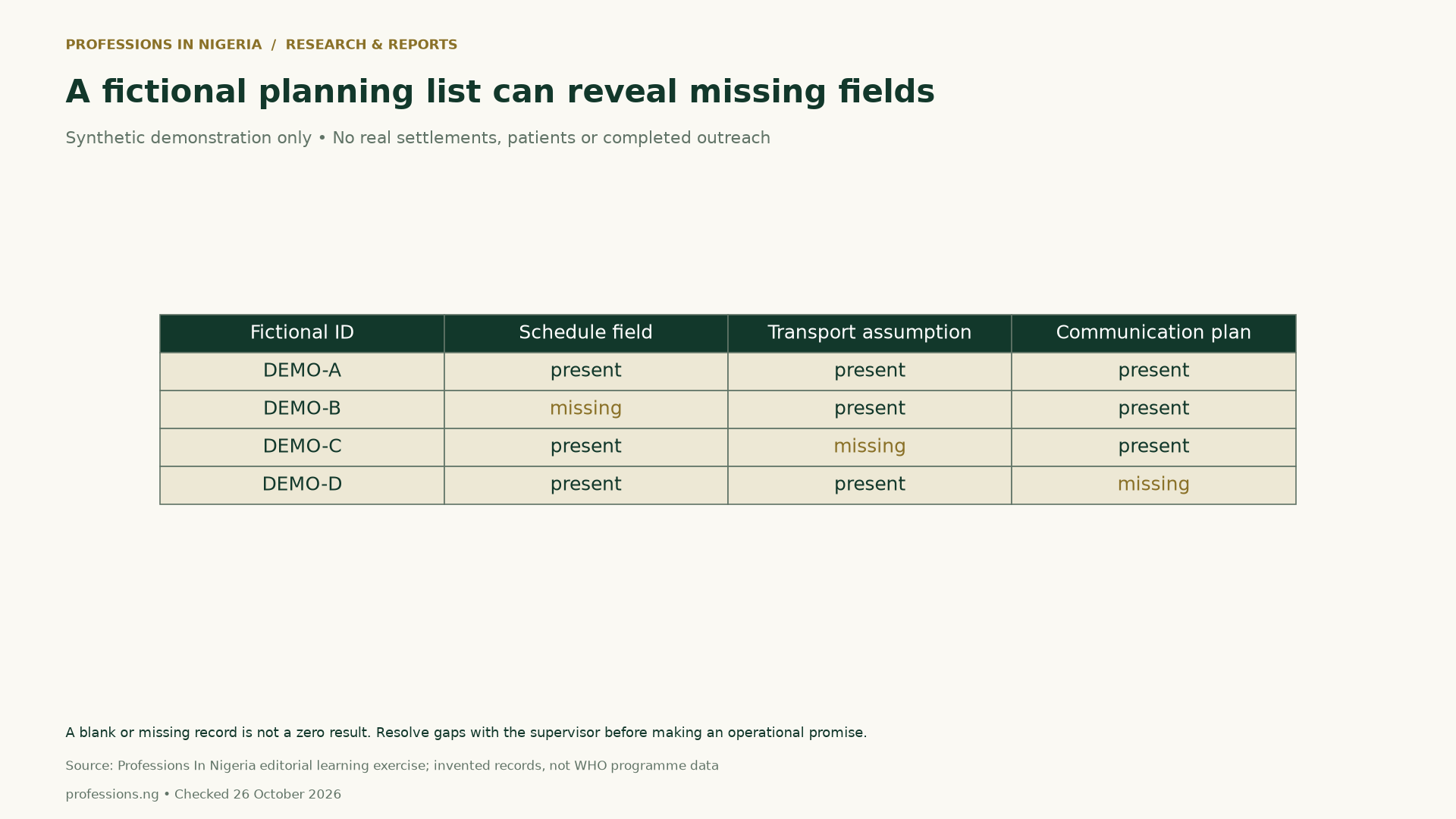
Next, write a short question for each gap. Keep the question specific: who confirms the date, which transport assumption needs review, or who approves the message? Record the answer only when it exists. Leaving a field unresolved is more honest than filling it with a plausible guess to make the sheet look finished.
| Planning issue | Proposed evidence | Boundary to preserve |
|---|---|---|
| Missing schedule | Question and supervisor response | Do not promise a visit without approval |
| Transport assumption | Assumption log and review status | A desk exercise does not establish field safety |
| Communication gap | Draft message and named approval role | Do not issue unauthorised public instructions |
| Unrecorded completion | Follow-up question and evidence reference | Missing is not the same as zero |
| Changed plan | Version and reason for revision | Keep the original plan traceable |
Show planning and reconciliation as separate work
A planned activity and a completed activity belong in different fields. If an exercise later includes an outcome, label it as invented or observed and retain its evidence. Use separate statuses for completed, cancelled and unrecorded. Otherwise, an incomplete return can disappear into a misleading total.
For example, the blank worksheet asks for planned activity, completed activity, record gap and supervisor question. We have not filled those outcome columns. No outreach exercise, travel test or patient follow-up has been run for this article. The four example rows demonstrate data checks, not the performance of a real service team.

When presenting a learning portfolio, include a brief change log. State what you changed, which evidence informed the revision and what remains uncertain. A reviewer should be able to distinguish your own decision from a supervisor’s instruction. Do not add an approval name, signature or professional title for a review that never occurred.
Keep qualifications and community support roles distinct
The CHPRBN standing-orders page provides separate materials for Community Health Officers, Community Health Extension Workers and Junior Community Health Extension Workers. These are distinct cadres. Consult the current requirements for the relevant role rather than treating a generic community-health label as one interchangeable qualification.
CHPRBN’s official services portal separates first-time applications, existing-practitioner services and licence verification. Follow its current guidance for your own situation. This article does not assess anyone’s eligibility or substitute for the Board’s decision. Community volunteering is not the same as professional registration.
Likewise, a support exercise about scheduling or communication does not authorise clinical tasks. Ask the employer to define the duties, reporting line and supervision arrangements. Where a task touches clinical judgement, seek direction from the appropriately qualified person within the actual service structure. Do not infer a clinical scope from a spreadsheet or short course.
Questions to ask before accepting an outreach assignment
Ask who supervises the assignment and how uncertainties are escalated. Confirm the location, expected travel, safety arrangements, working hours and responsibility for records. Establish the contract duration, payment terms and any allowances from the actual employer. The programme figures in this report provide no pay benchmark and no assurance that a vacancy exists.
Then ask which records you may access and what can leave the organisation. A public learning portfolio should contain synthetic records, not identifiable patient data, contact lists or screenshots from a live health system. Do not assume that removing a name makes every record suitable for publication. Use the organisation’s approved process for any real information.
For wider professional context, see our public-health professions overview and Healthcare coverage. This report adds a specific measurement case and a proposed operational exercise; it does not rank health careers or offer a shortcut into regulated practice.
Methods, limitations and downloads
We transcribed four measures from WHO’s feature and retained their units, periods and qualifiers. Subtracting the displayed percentages gives an approximate 11-percentage-point change. We made no estimate of additional facilities meeting the threshold, unique people vaccinated, national workforce demand or causal impact. The underlying facility-level data were not supplied in the feature.
The planning matrix, workflow and blank outcome fields are original editorial learning proposals. They remain untested. Before using an adapted version in a real service, seek the relevant supervisor’s review and follow the organisation’s procedures. A qualified health review of this article is part of our publication process; no reviewer endorsement should be inferred from the source citations.
Download the Kebbi outreach metric definitions (CSV) and synthetic outreach planning worksheet (CSV). The first retains source-linked definitions. The second contains four invented demonstration rows and blank evidence and outcome fields. Neither contains patient information.
Suggested citation: Professions In Nigeria, “Community Health Careers: The Operational Skills Behind Kebbi’s Outreach Gains,” checked October 26, 2026. Cite WHO for the programme reporting and CHPRBN for regulatory background. Attribute the proposed planning exercise to Professions In Nigeria, keeping its fictional and non-clinical status explicit.


