



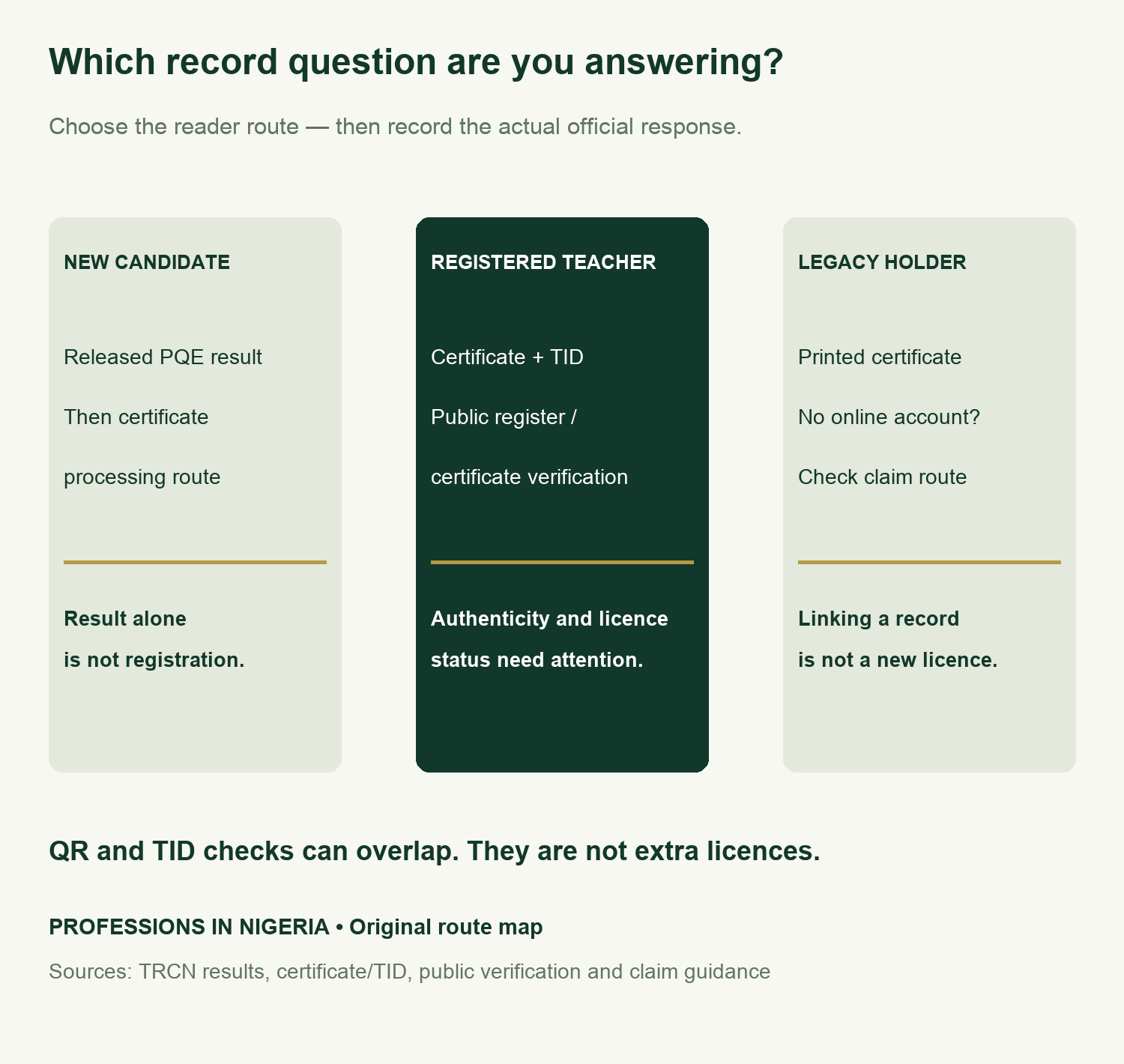
TRCN certificate verification, result checks and TID queries answer related questions, but they are not interchangeable proof. A school checking an exam outcome needs a different starting route from a registered teacher checking a current record or a holder linking an old printed certificate.
TRCN’s November 23 announcement directs successful PQE candidates towards certificate processing. This guide turns the official routes into a school verification worksheet, with a field-length chart, three-route infographic and four CSV tools. We checked the sources on 29 November 2026 without querying any real person’s record.
TRCN result verification: start with the exam question
The November PQE results announcement says results have been released and successful candidates should obtain their registration certificate through the portal. A successful result is therefore a stage in the process, not evidence that every later approval has already occurred.
The official result page asks for examination information and the candidate’s registered email. It distinguishes current results from claiming a past result. Follow the route shown for the candidate’s case; do not submit someone else’s credentials or treat a screenshot from an informal group as an official verification response.
For a fictional school file marked DEMO-A, the presented evidence is only an exam result. The unresolved question is certificate approval and registration. Record that gap and ask for the appropriate official evidence instead of changing the file label to registered merely because the result was successful.
TRCN certificate verification: match the approved record
TRCN’s Certificate and TID help article describes the certificate as lifetime proof of registration. It says the 10-digit teacher identification number is generated when the certificate is approved and serves as a permanent identifier. That connects the TID to an approved record; it does not make any correctly sized number authentic.
Next, separate that certificate question from current licence status. The public-verification guidance describes a register check using the TID and says the response includes the teacher’s name, state and licence status. Read the actual response and date. A lifetime registration certificate should not be used to skip the separate status field.
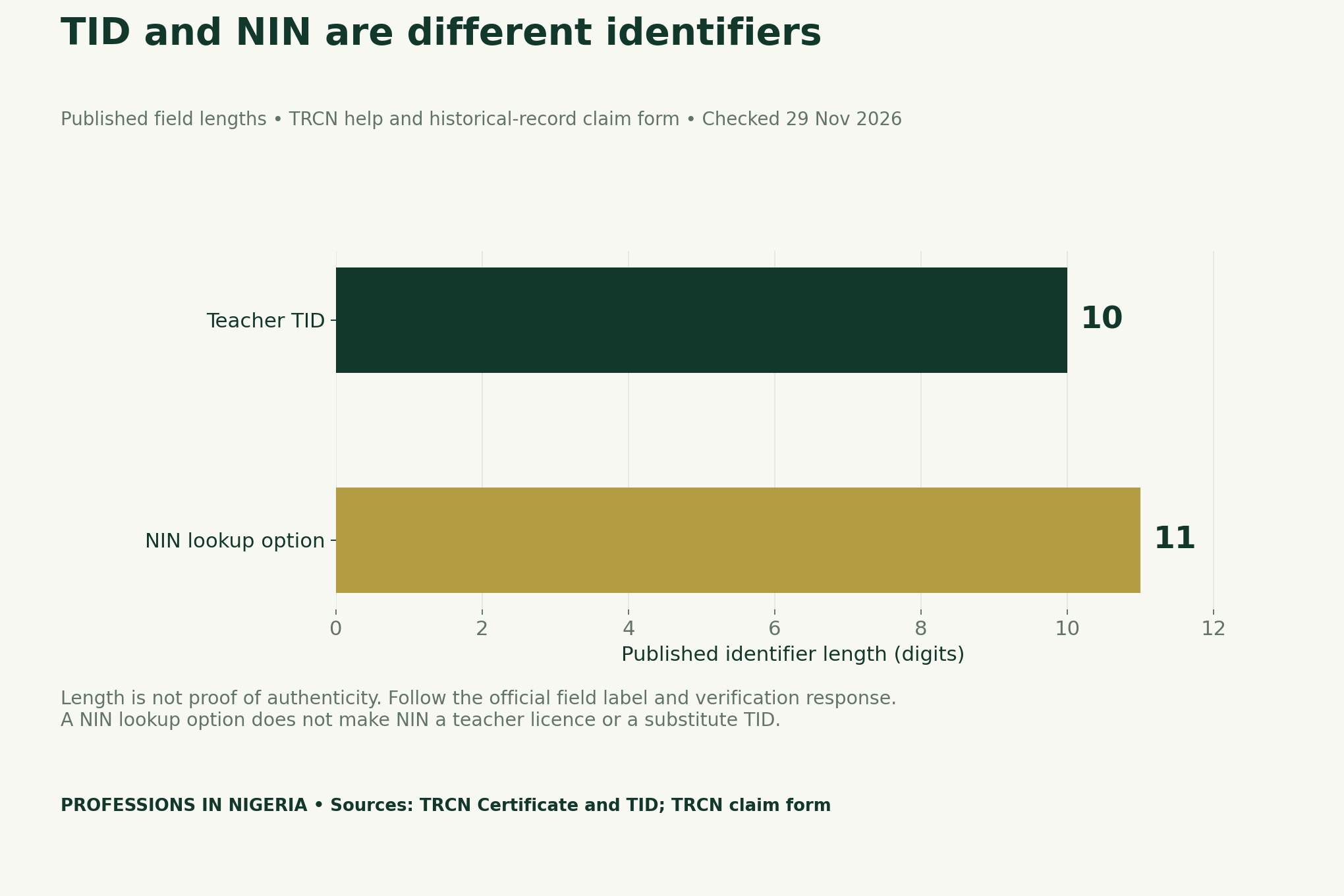
The one-digit difference is useful for explaining field labels, not for approving a teacher. An examination number, printed certificate number, historical registration number, TID and NIN may have distinct roles. Copy the label from the current official page rather than invent a universal format for every old record.
QR checks and public TID checks can overlap
The TRCN certificate-verification guide describes scanning a certificate QR code to reach a verification page and a portal route using the certificate identifier. The public TID guidance describes another way to inspect registration and licence information. These are overlapping checks on records, not separate licences earned by using different links.
Before relying on a QR destination, inspect the actual address and ensure it is the official route. Then compare the record with the evidence presented and note any discrepancy for follow-up. This article does not generate a QR code, authenticate a certificate or decide a real applicant’s eligibility.
Legacy printed records: use the route that fits the holder
The historical certificate claim page is for holders of printed certificates who have never created an account. Its lookup options include a historical registration number, certificate number, NIN, or name and date of birth for older records. A holder with an existing online account is directed to sign in instead.
For DEMO-C, an old printed certificate is present and no online account has been created. The practical question is whether the historical-record linking route applies and which conditions remain. The old paper format alone does not establish invalidity; equally, opening the claim page does not establish that a new licence has been issued.
A school worksheet should record evidence, not collect secrets
| Mock file | Evidence presented | Question to resolve |
|---|---|---|
| DEMO-A | Successful exam result | Has the certificate/registration stage been approved? |
| DEMO-B | Certificate and TID | What does the dated official licence response say? |
| DEMO-C | Old printed certificate; no online account | Does the historical-record claim route apply, and what remains? |
Use a private mock reference in the blank worksheet and retain only the evidence references your institution needs. Do not place NINs, birth dates, account credentials, certificate scans or individual verification results in a public spreadsheet. Our exercise does not require sending those details to Professions In Nigeria.
If a record is absent, inconsistent or unresolved, record the actual message and seek clarification through TRCN’s official support route. Avoid labelling a person fraudulent from a missing search response alone. We have not tested individual records and cannot promise a processing time, a correction or a hiring outcome.
Keep registration separate from other education questions
Our programme-specific accreditation guide addresses a different question about an education route. Our digital-teaching skills analysis distinguishes training participation from practical evidence. Neither substitutes for the current TRCN record checks described here.
Download the TRCN certificate verification pack
- Official reader-route comparison (CSV)
- Identifier definitions and published lengths (CSV)
- Three fictional school verification cases (CSV)
- Blank private-reference verification worksheet (CSV)
Method, limits and citation
Professions In Nigeria compared the public TRCN news, help and portal instructions on 29 November 2026. The chart reproduces the stated 10- and 11-digit field lengths; it contains no real identifiers. One chart is enough for this narrow quantitative distinction. The routing map, fictional cases and blank worksheet are original editorial tools.
Targeted archive checks were not exhaustive. We performed no candidate lookup, certificate claim, payment or individual assessment. Credit Professions In Nigeria for the original comparison and tools, and TRCN for the official guidance. Recheck the relevant source when handling a later case because form labels and instructions can change.