




Oil and gas manufacturing skills in Nigeria deserve a closer look than a list of promising job titles. A new NCDMB release discusses earlier company evidence. What can a student, technician or supply-chain candidate reasonably take from it? The useful answer starts by separating supplier readiness from an individual’s qualifications.
Checked October 26, 2026. This report provides five evidence graphics, a source-metrics CSV and a blank work-evidence worksheet. Our portfolio examples are editorial hypotheses for professional review. We have assessed no company or worker, tested no equipment and established no hiring or wage outcome.
What the October announcement actually adds
NCDMB’s October 21 implementation release describes discussions on domestic component production. The study was commissioned July 7, 2022 and submitted July 12, 2023. It identified approximately 60 indigenous companies; 18 met criteria that the release does not specify. The new development is implementation discussion about earlier findings, rather than a new 2026 survey.
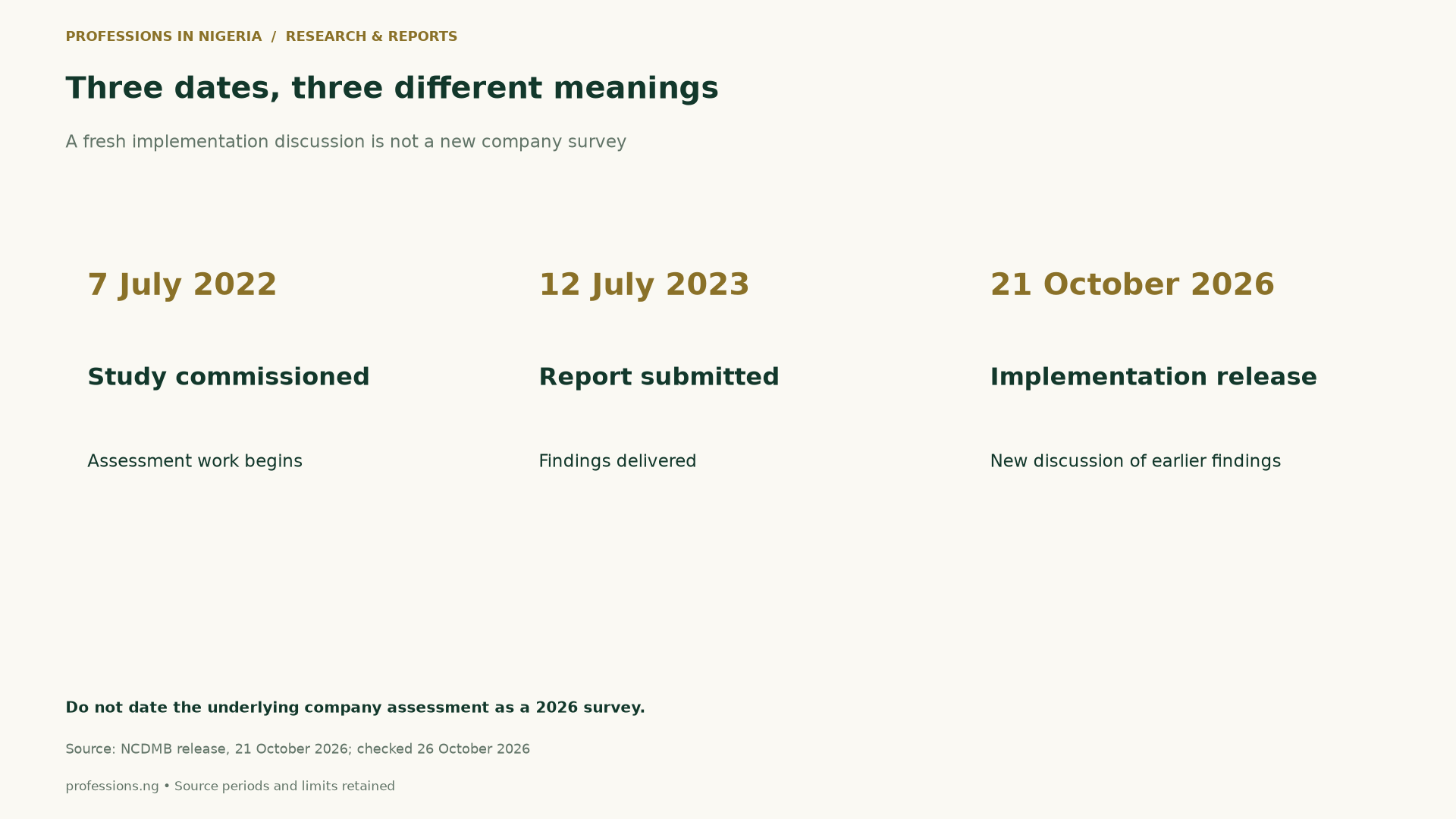
That distinction changes the reader’s next question. Instead of asking how many workers passed a current skills test, ask what assessment the source describes. Keep its unit, period and missing information beside the headline number. A fresh announcement can be relevant while its underlying evidence still needs those qualifications.
Read 18 within approximately 60 correctly
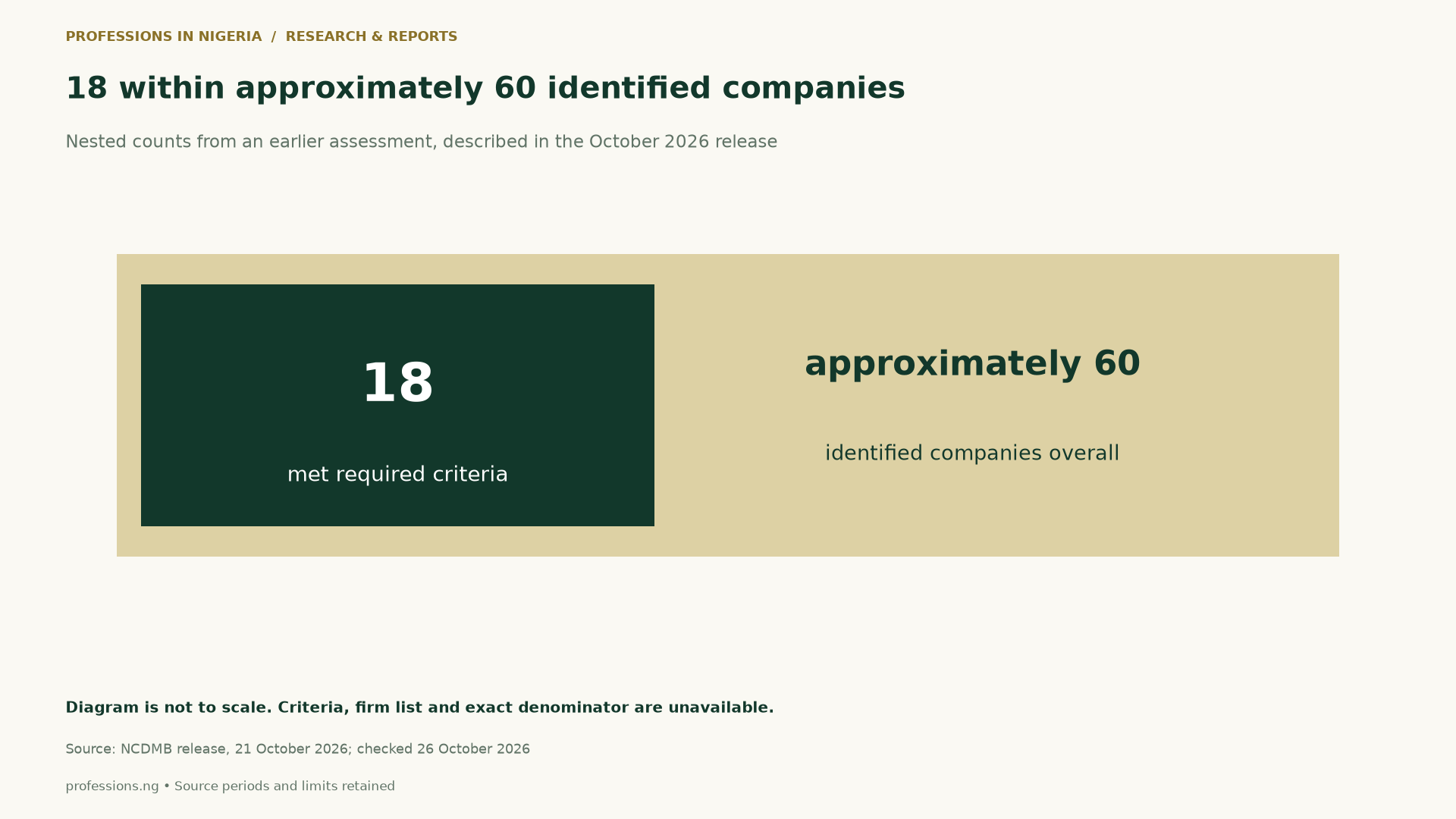
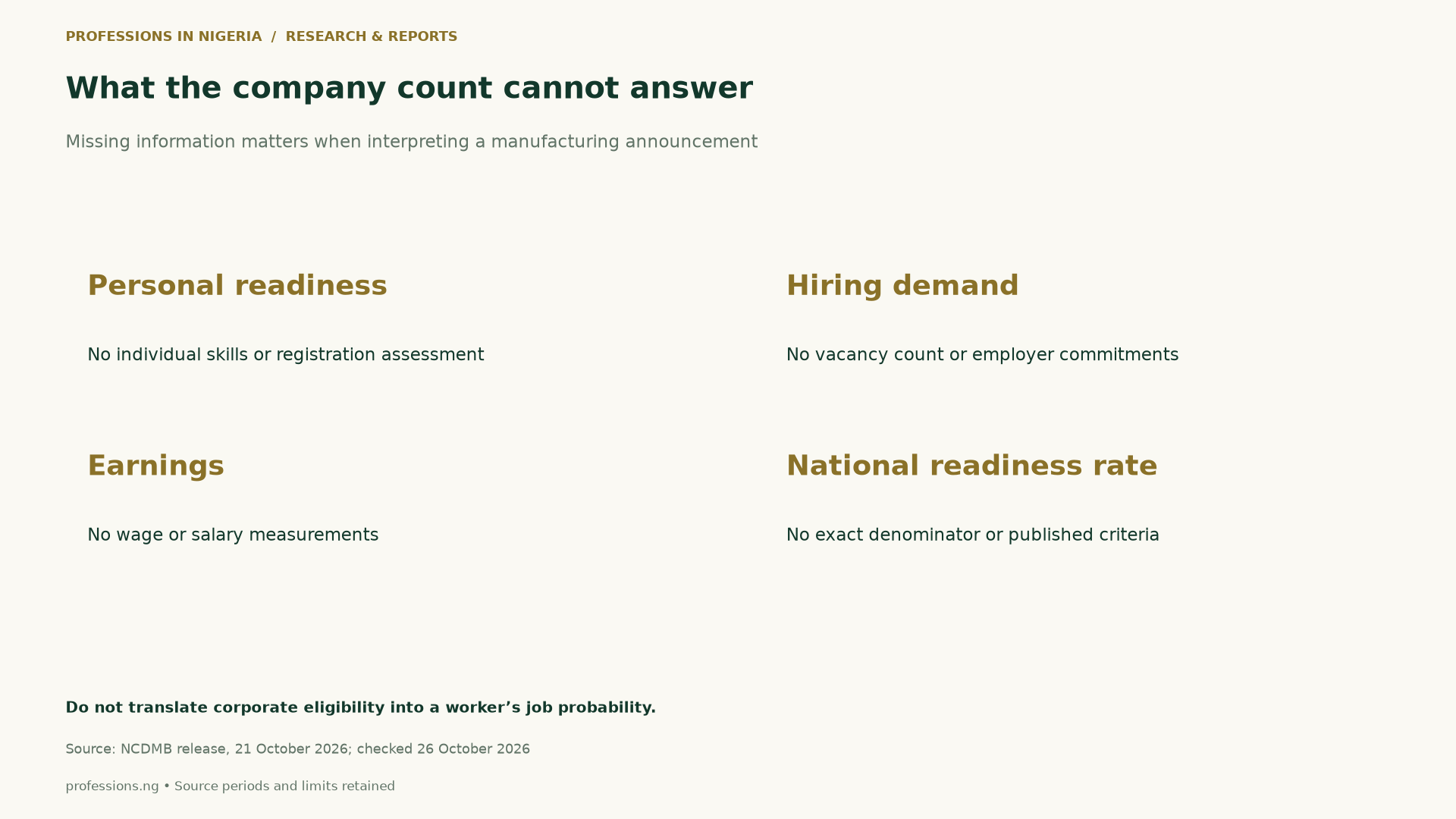
Using the rounded denominator gives 18 ÷ 60 × 100 = roughly 30% of identified firms. That is an illustrative ratio, not an exact national manufacturing-readiness rate. The missing firm list and criteria prevent a closer evaluation. These figures provide no individual skills measurement, vacancy count or salary estimate.
In particular, do not turn a company-level result into a personal probability. One firm may employ people in many functions, and a firm’s assessment may involve matters beyond an applicant’s skills. Without the assessment criteria, assigning a reason for a particular firm’s result would be speculation. Calling other firms or their staff unskilled would go beyond the evidence.
Oil and gas manufacturing skills Nigeria: build inspectable evidence
The release names components including pumps, valves, flanges, gaskets, bolts and nuts, metering solutions and instrument fittings. We use that industrial context to propose a learning exercise. Choose a fictional component and show how you organise information about it. Do not claim to reproduce a company assessment or a real engineering approval process.
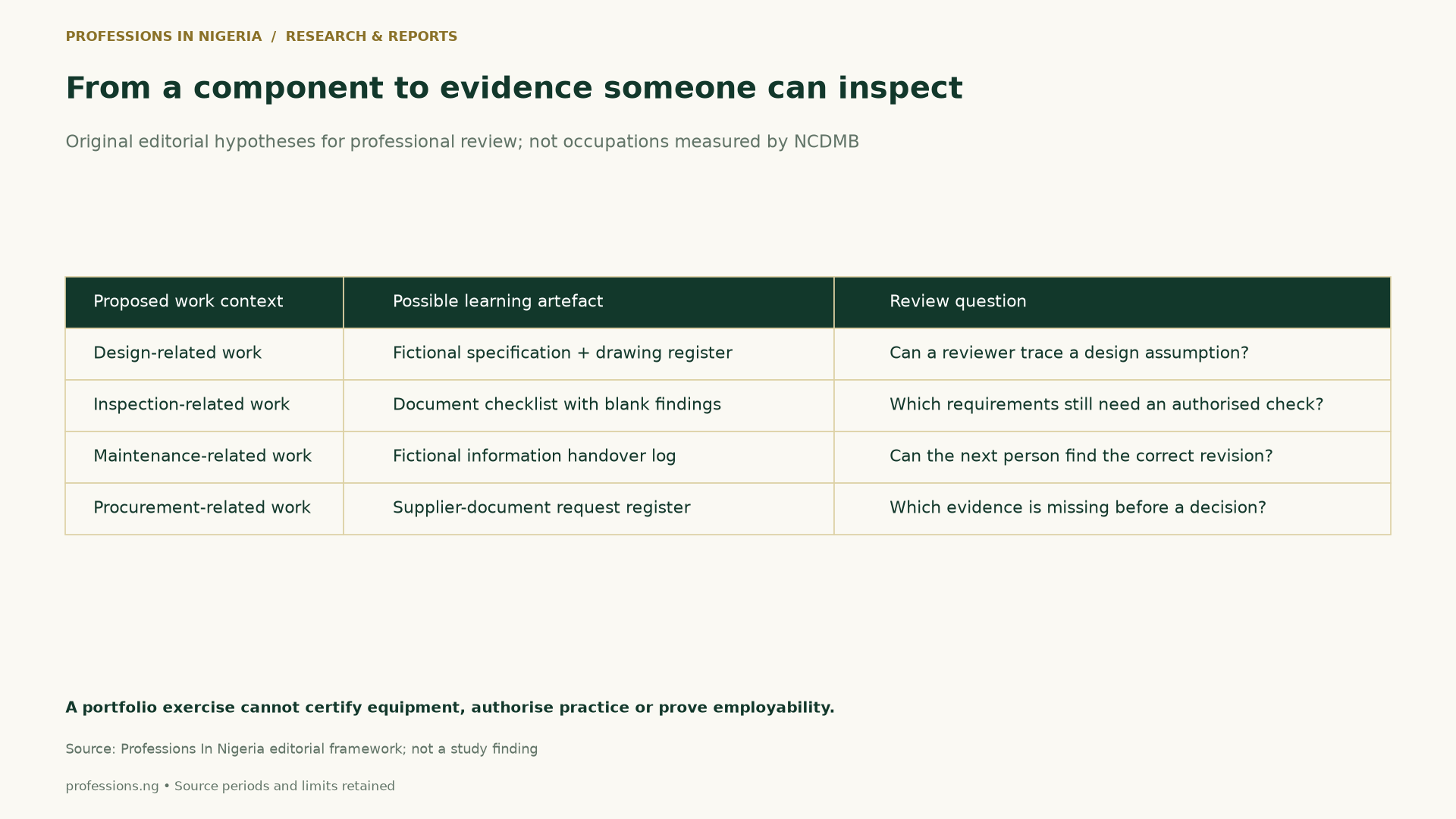
For design-related learning, a fictional specification and drawing register could expose an assumption that needs checking. For inspection-related learning, a document checklist could distinguish an available record from a missing one. Neither example authorises a candidate to certify a component. Use the exercise to explain what you would ask an appropriately qualified supervisor.
For maintenance-related learning, a handover log could help the next person identify a document revision. For procurement-related learning, a supplier-document register could show what evidence remains outstanding before a decision. The common skill being proposed is traceability: another reader should be able to follow your reasoning. Its value in a real role still needs professional and employer review.
| Proposed learning context | Possible evidence | Boundary |
|---|---|---|
| Design-related | Fictional specification and revision register | No approved engineering design |
| Inspection-related | Blank document checklist | No conformity finding or certification |
| Maintenance-related | Information handover log | No procedure for operating equipment |
| Procurement-related | Supplier-document request register | No approved supplier or purchase decision |
Make a fictional component exercise reproducible
To demonstrate oil and gas manufacturing skills in Nigeria, start with an identifier such as DEMO-COMPONENT and write that it is fictional. Describe the purpose of the exercise in plain language. For instance, your task might be to keep document revisions consistent across a small learning pack. It should not contain pressure ratings, operating instructions or dimensions that someone could mistake for an approved technical specification.
Next, create a document register with an ID, revision, assumption, evidence reference and unresolved issue. Leave reviewer and approval fields blank. If you change a document, retain the old version and explain the reason. This gives a reviewer something more useful than a polished screenshot with no history of how it was produced.
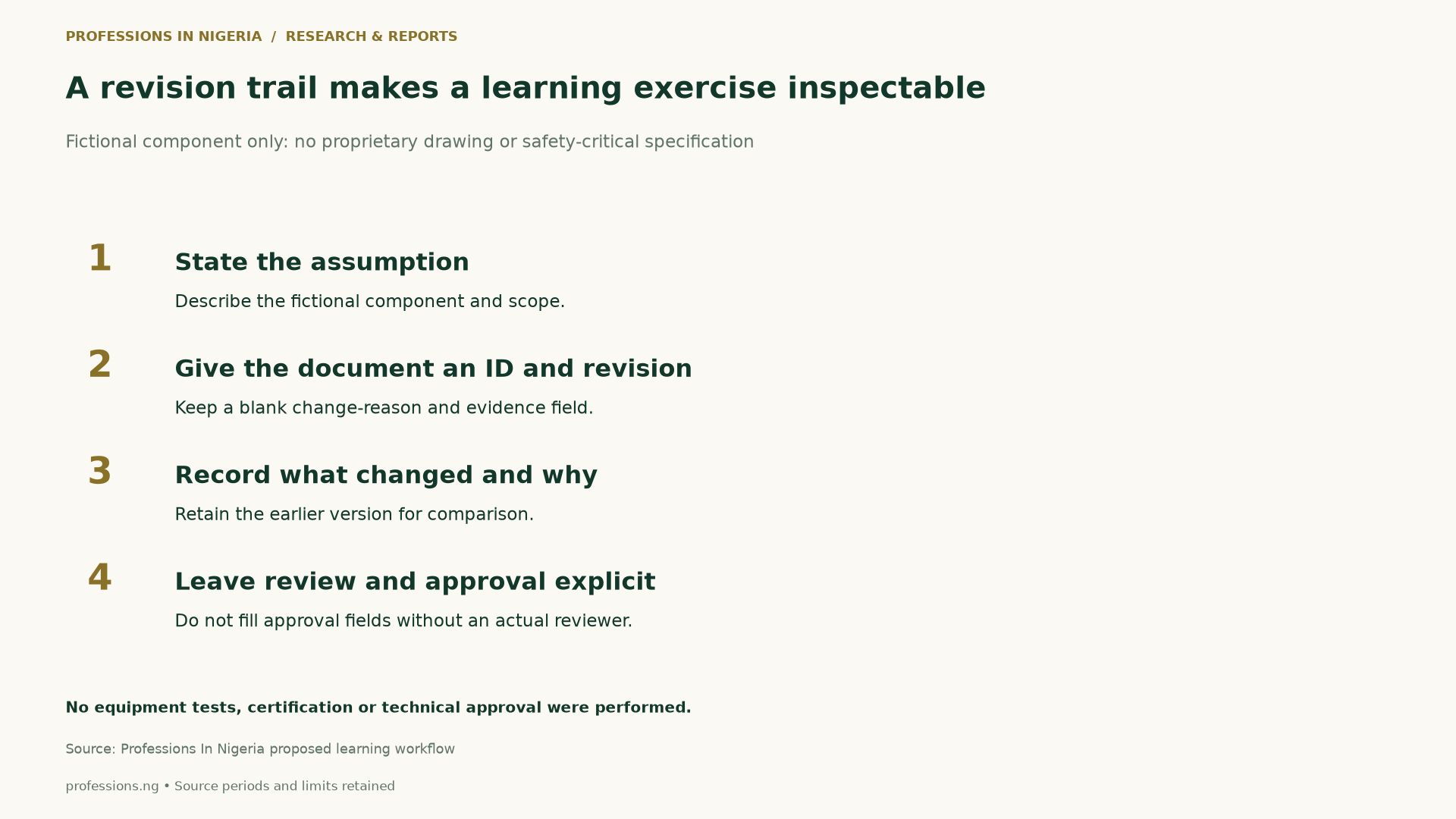
Then check the pack for internal consistency. Does the register point to a file that exists? Does the revision on the cover match the revision in the register? Can the reader distinguish an assumption from a verified requirement? These are proposed document checks, not results of an experiment conducted for this article.

Finally, write a short handover note. Explain the exercise’s scope, what changed and what remains unresolved. Ask a qualified professional whether the artefacts and questions make sense for the intended work context. Retain their actual corrections if a review occurs; do not describe a suggested review as one already completed.
Oil and gas manufacturing skills in Nigeria: qualification checks
The official COREN integrated portal provides separate applicant and firm routes, alongside a verification service. That distinction is useful background: corporate registration or eligibility does not grant an individual professional status. Consult the current route appropriate to your qualifications instead of relying on a manufacturing headline.
Engineers, engineering technologists, technicians and craftspeople should not be treated as interchangeable titles. Check the category and requirements relevant to your own background through official guidance. A portfolio may help explain a learning exercise, but it does not replace a qualification, registration or authorisation required for real work. We recommend no shortcut course or automatic pathway.
For a broader introduction, our entry-level oil-and-gas guide considers general career routes. This report serves a narrower purpose: evaluating supplier evidence and documenting a proposed work sample. You can also compare its traceability questions with our AI workplace verification report, which examines a different kind of review trail.
Questions worth taking to an employer or supervisor
Ask which documents the role actually handles and who approves changes. What supervision is provided? Which qualification or registration applies? How does the organisation distinguish a training exercise from an authorised production record? These questions bring the conversation back to the actual job and its responsibilities.
Also ask about the contract, location, travel, working pattern and training arrangements for a specific vacancy. Verify the written terms directly with the employer. The source reviewed here supplies no basis for a salary table or hiring forecast. A policy discussion may justify further research, but it cannot confirm that a particular employer is recruiting.
Methods, source limits and reusable files
We checked the official release and COREN portal on October 26, retaining the source dates and the approximate denominator. The only ratio shown is 18 divided by approximately 60, expressed as roughly 30%. The matrix, workflow and blank worksheet are original editorial proposals. No individual, firm, equipment or hiring assessment was carried out.
Download the manufacturing source metrics (CSV) for the dated claims and limitations. Use the blank work-evidence worksheet (CSV) for a fictional learning exercise. Evidence, findings and approval fields remain blank; the file is not a technical specification or certification form.
Suggested citation: Professions In Nigeria, “Oil-and-Gas Manufacturing Careers: What NCDMB’s Supplier Evidence Can Tell Us,” checked October 26, 2026. Cite NCDMB for the company figures and historical dates, and this report for the proposed learning tools. Preserve the qualifiers and company-level scope wherever the figures are reused.


