




The Nigeria postcode developer showcase offers a concrete starting point for a portfolio question: can you explain a narrow address-related problem, demonstrate a working approach and document what remains untested? Its published rubric gives four equally weighted criteria, plus a separate responsible-data check.
Checked October 26, 2026. Our focus is evidence for a developer portfolio, with a blank scorecard and a proposed synthetic test log. We have built no prototype, called no postcode API and measured no reliability or employment outcome for this report. The later session dates remain inconsistent across official pages, as documented below.
Nigeria postcode developer showcase: what the announcement offers
The ministry announcement dated October 21 describes a three-part showcase for Nigeria-based individuals, teams and companies. Applications are free. There is no prize money; the stated purpose is visibility and potential connections. Those possibilities do not establish a job offer, investment commitment or commercial agreement.
A portfolio can still be useful beyond a particular event. Define one user problem and retain evidence of your design decisions. For example, an address-validation prototype might help an imaginary dispatch clerk notice incomplete input and understand a failed lookup. That is our proposed learning exercise, not a finding that employers demand this exact project.
Read the four weights and the separate data check
The official programme portal lists a working solution, meaningful postcode use, practical value and strong execution at 25% each. Responsible data handling is a separate pass/fail condition. The weighted criteria sum to 100%; the data check is not another 25% category.
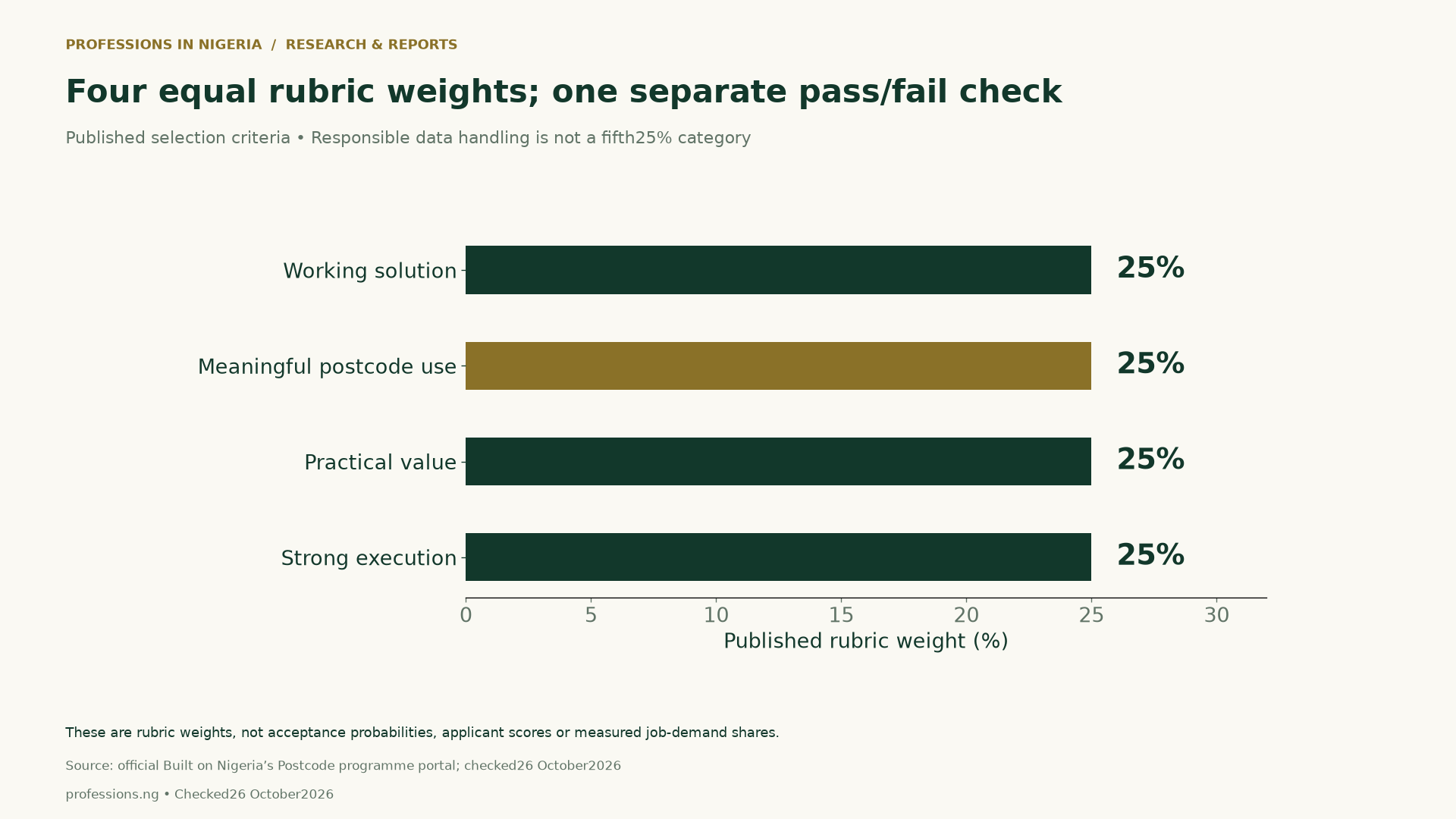
Our blank scorecard keeps the official criterion and weight beside empty columns for evidence, unresolved issues, proposed tests and reviewer notes. Leave scores empty until an actual reviewer applies a defined scoring method. Filling every cell with an invented number would make the document look complete while hiding what has not been assessed.
The official dates have not been reconciled
As checked October 26, the ministry announcement lists October 27, October 31 and November 14. The programme portal and its live page instead list October 27, November 6 and November 21. The portal carries an October 7 publication footer. We found no explicit correction explaining which later dates supersede the others.
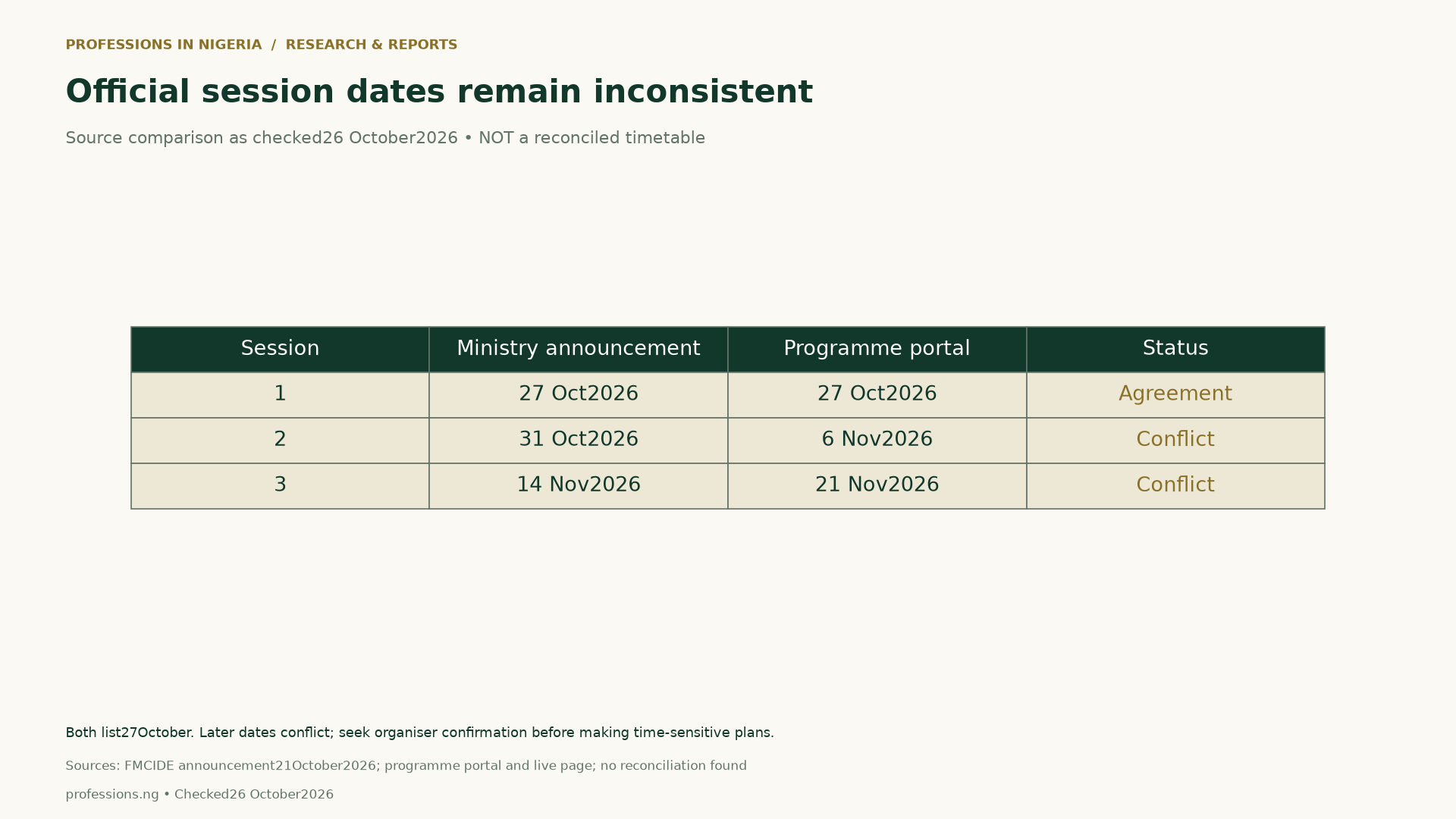
An agreement on the first session does not resolve the later differences. Nor does a page footer necessarily identify its latest edit. Keep the source URL and date of your check in any planning note. This article therefore makes no deadline-led claim that a reader must act by one of the disputed dates.
Choose a narrow prototype with an explicit user
Start the fictional brief with a single task. An imaginary dispatch clerk receives a postcode and needs a clear result or an understandable explanation of failure. Define what the screen should help that person decide. Avoid promising that one prototype solves national addressing, identity verification or emergency dispatch.
Next, state the assumptions. Which input rules come from current official documentation? Which parts of the demonstration use mock responses? What information is required, and what can the user do when it is missing? Record these choices before preparing an impressive-looking interface. Otherwise, reviewers cannot distinguish working behaviour from a visual demonstration.
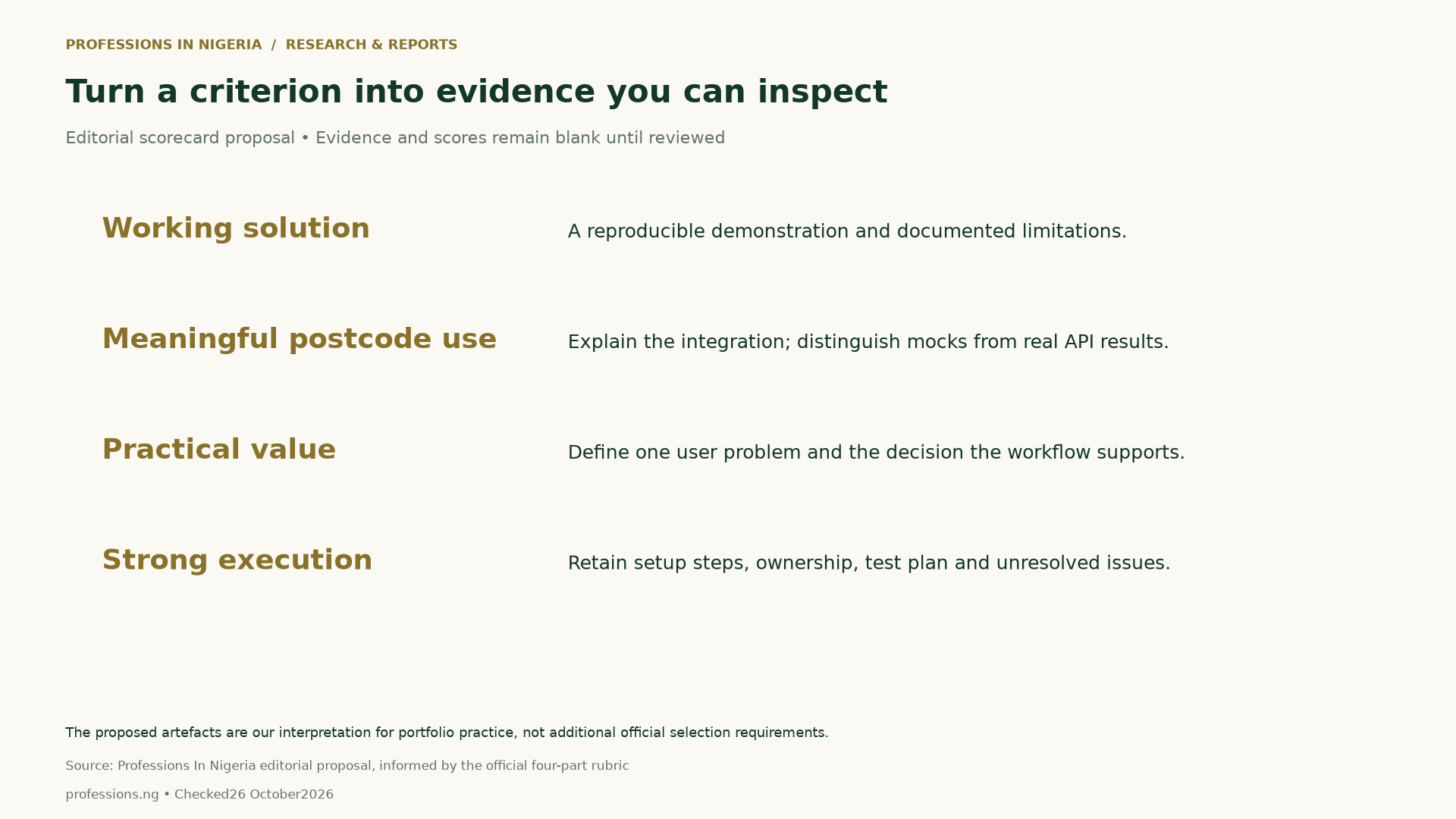
Then write setup instructions. Give the version of the code, required configuration and a way to reproduce the demonstration without sharing credentials. If an integration needs an account, explain that requirement honestly. Do not put API keys or private configuration into a public repository, screenshot or downloadable test log.
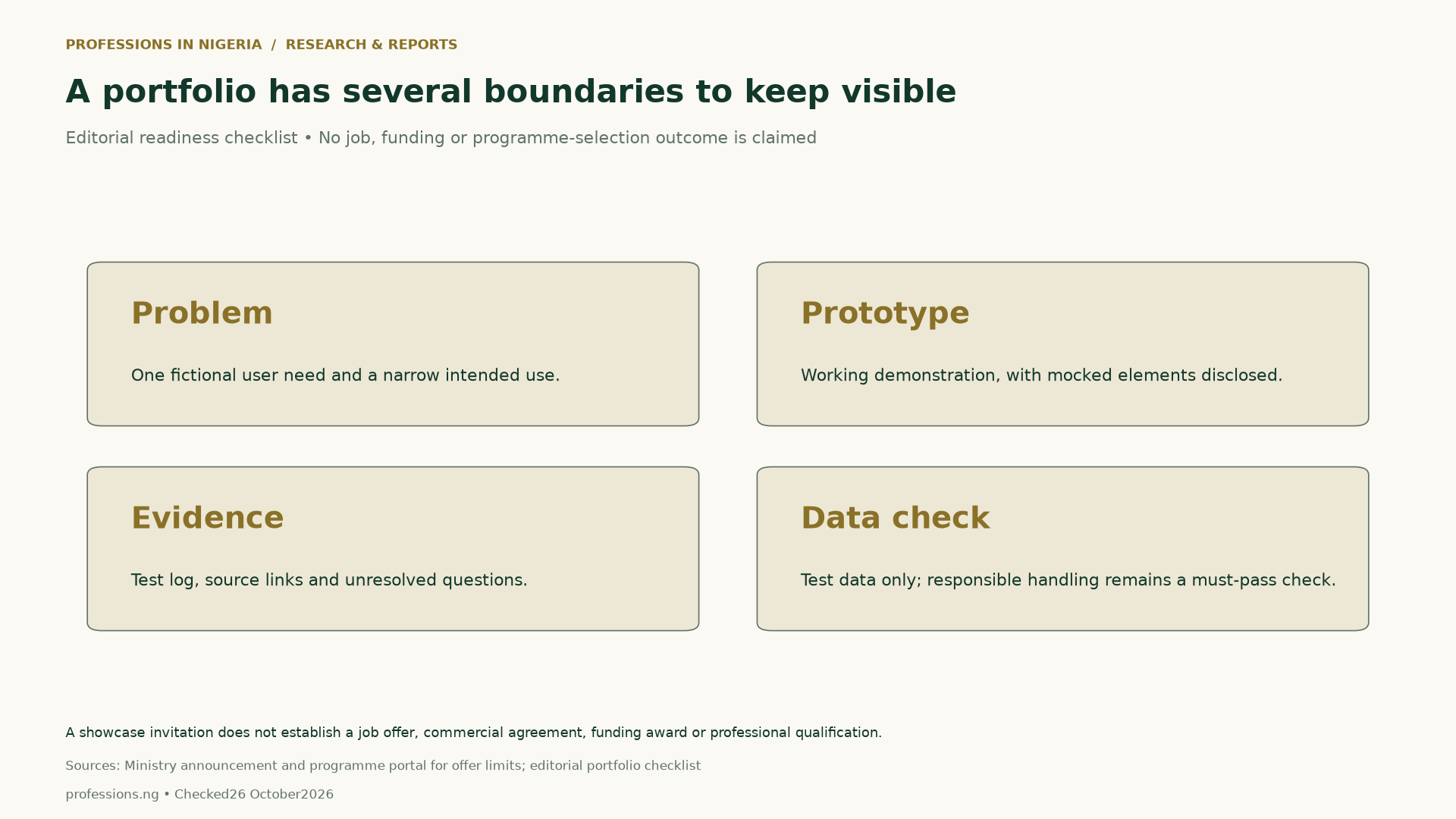
| Proposed portfolio artefact | What it should show | What remains unproven |
|---|---|---|
| Problem brief | One fictional user and intended decision | Demand from real customers |
| Prototype demonstration | Working steps and disclosed mock elements | Production readiness |
| Test log | Case, expected behaviour and actual evidence | Reliability until tests run |
| Revision note | Change, reason and unresolved issue | Commercial or hiring success |
| Data-handling note | Test-data source and access choices | Legal approval or official endorsement |
Plan failure cases before reporting success
The proposed test log separates expected behaviour from actual results. Its five starter cases cover empty input, malformed input, an unresolved lookup, an unavailable service and an ambiguous response. These are editorial design prompts. They do not describe the official API’s actual response codes or confirm that any test has passed.
For empty input, describe what information the interface should request. For malformed input, use rules from documentation you have actually checked. An unresolved lookup requires care: a missing result is not automatically proof that a building does not exist. Record the distinction rather than showing a confident conclusion that the evidence cannot support.
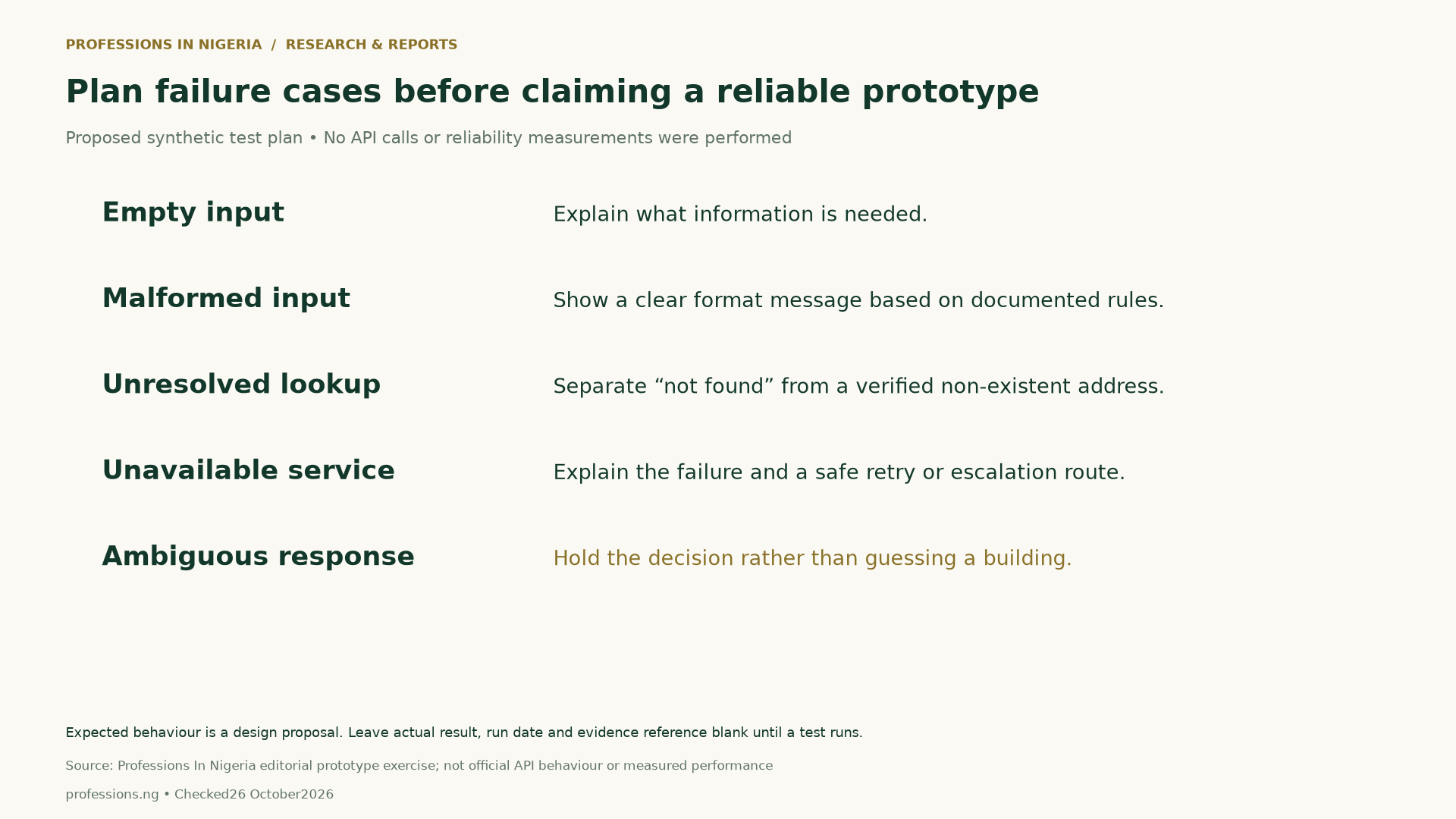
A service failure also needs an honest message. Explain that the lookup could not be completed and offer an appropriate next step for the fictional workflow. Do not silently replace an unavailable service with fabricated confirmation. Where a response is ambiguous, preserve that uncertainty for review instead of choosing a building by guesswork.

Keep responsible data handling visible
Use synthetic data for the demonstration and mark it clearly. Avoid home addresses, customer details, contact lists or private location records. Where you later work with real information, follow the organisation’s approved process and applicable requirements. A public test log should make its data source clear without disclosing records it should protect.
The programme’s responsible-data condition sits outside the weighted total. Treat it as a separate review question rather than something a strong interface score can offset. For background, consult the Nigeria Data Protection Commission’s FAQs. This report does not certify compliance, approve an application or provide a legal assessment of a product.
Explain what the portfolio does and does not demonstrate
A useful final note states what works, what is mocked, which tests ran and what needs further review. Explain a revision using its evidence. If no user research has taken place, say so. If the demonstration covers one narrow task, describe that scope rather than implying a complete production service.
Programme eligibility also differs from job qualifications. An invitation open to individuals, teams and companies does not waive a degree, registration or experience requirement for an unrelated vacancy. Check the actual employer’s requirements separately. No placement rate, wage premium or guaranteed investment follows from the sources checked here.
For broader geospatial context, see our mapping-industry guide. Our AI workplace verification report explores another evidence trail, from an assisted draft to a documented final decision. Keep each portfolio focused on the actual work it can show.
Methods and reusable downloads
We compared the official ministry announcement, programme portal and live page, retaining the unresolved date differences. We transcribed four rubric weights and kept the pass/fail data condition separate. The portfolio matrix and five-case test plan are original editorial proposals. We collected no applicant totals, selection outcomes, API measurements, customer results or job data.
Download the postcode rubric scorecard (CSV) and synthetic postcode test log (CSV). Both retain blank evidence and result fields. The expected behaviours are design prompts, not an API specification. Verify current documentation before implementing or testing a real integration.
Suggested citation: Professions In Nigeria, “Nigeria’s Postcode Showcase: A Practical Portfolio Brief for Developers,” checked October 26, 2026. Cite the official sources for the programme and rubric, and Professions In Nigeria for the proposed portfolio tools. Keep the unresolved schedule warning attached when reusing the date comparison.


